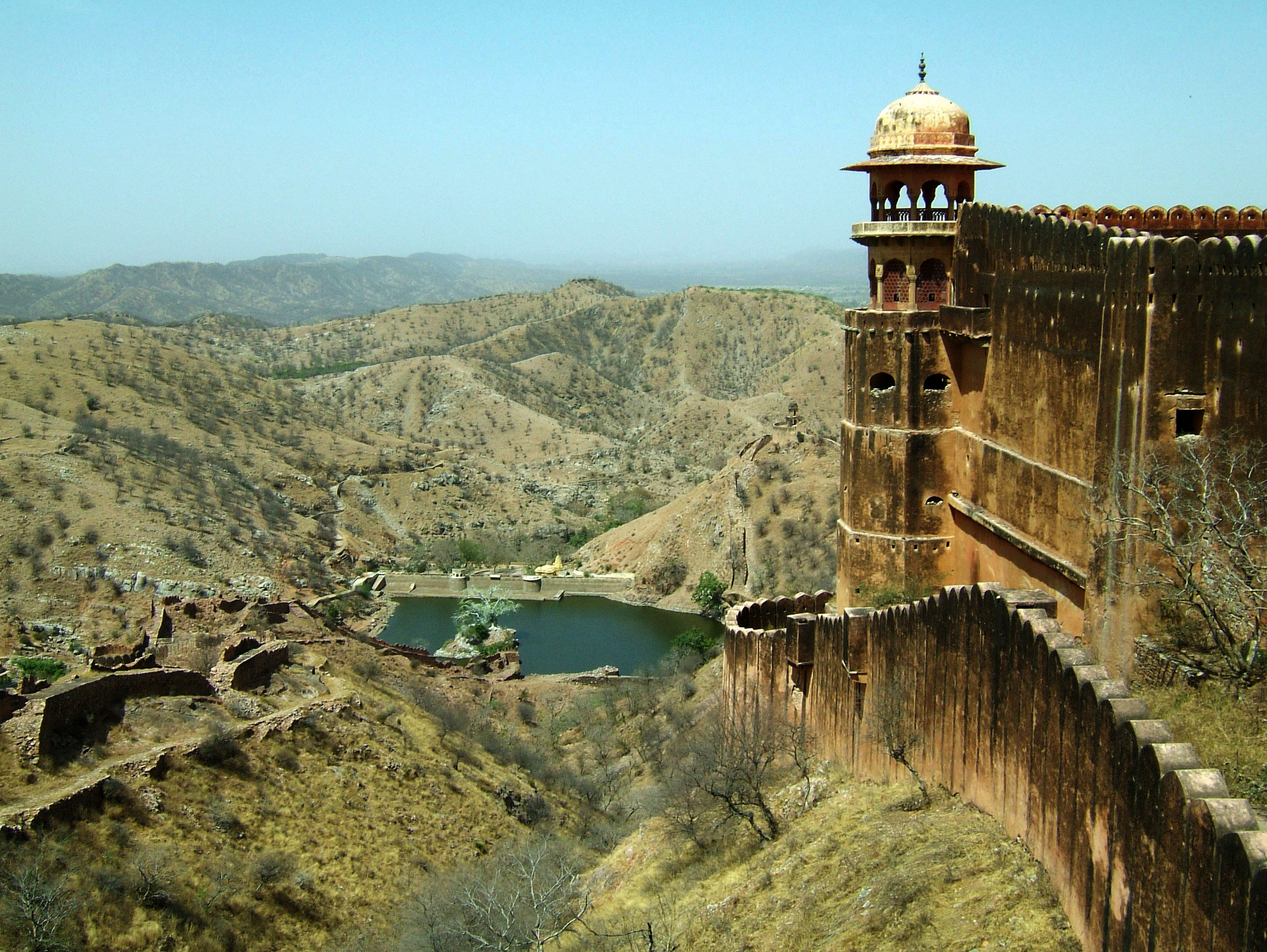
Jaipur
Jaipur is the Pink City. Not pink like bubblegum, but the terracotta rose applied across the old city in 1876 to welcome Prince Albert, a color maintained by law ever since. Maharaja Sawai Jai Singh II founded the city in 1727, moving his capital from nearby Amber to create one of India's first planned cities. Its grid layout and wide streets were radical for their time. Today three million people fill the metropolitan area, making Jaipur the capital of Rajasthan and the third corner of India's Golden Triangle with Delhi and Agra. Rajput rulers built forts and palaces across its hills. Artisans still practice crafts passed down through centuries. Former royalty makes a spectacle of itself. Tourism has brought prosperity, but tradition is what makes Jaipur distinctive.
The Pink City
In 1876, when Prince Albert, later King Edward VII, visited India, the entire walled city was coordinated in a single color. Rajput tradition specified pink as the color of hospitality, and so pink it became. A law still maintains the uniformity within the walled city walls, creating a visual coherence that Indian cities rarely achieve. The shade is not garish but warm. Terracotta ages gracefully here, and bazaar overhangs cast shadows that deepen the effect.
Beneath those pink walls, the old city hums as a commercial center. Textiles, jewelry, and handicrafts fill the bazaars lining its streets. Johari Bazaar specializes in gems. Tripolia Bazaar handles brasswork. Bapu Bazaar draws shoppers looking for textiles and souvenirs. This street-by-street specialization reflects the planned organization Sawai Jai Singh II envisioned three centuries ago, and commerce continues here regardless of whether tourists stop to photograph it.
The Amber Fort
Eleven kilometers from Jaipur, Amber Fort rises on a hilltop above the older capital that Sawai Jai Singh II abandoned when he built his new city below. Construction began in 1592 and continued for over a century as successive rulers added to what their predecessors built, blending Rajput and Mughal architectural styles. Inside, the Sheesh Mahal, or Hall of Mirrors, reflects candlelight into constellations. Private apartments balance defensive necessity against domestic comfort.
For decades, decorated elephants carried visitors up the hill to the entrance. This tourism tradition has come under scrutiny. Animal welfare concerns have led to restrictions, though advocates consider the current rules insufficient while the industry calls them onerous. Cars and jeeps now also make the climb. However visitors arrive, the architecture justifies the journey. Amber Fort is magnificent on its own terms.
The Hawa Mahal
Jaipur's most photographed structure is the Hawa Mahal, the Palace of Winds. Its pink facade rises five stories, punctuated by 953 small windows designed so that royal women could observe street life without being seen. Behind that elaborate screen facing the bazaar below, the building is surprisingly shallow. Purdah required seclusion, yet curiosity about the outside world persisted, and this building served both masters.
Step inside and the grandeur fades. The rooms behind the facade are small and functional rather than lavish. But climb to the top and the view stretches across the old city to the surrounding forts, while breezes flowing through hundreds of windows justify the Palace of Winds name. How did this facade become the symbol of an entire city? Perhaps because it captures something essential about Jaipur: an exterior so striking that visitors come to see in person what they have already seen in countless photographs.
The Jantar Mantar
Sawai Jai Singh II built the Jantar Mantar in 1734 as an astronomical observation site. It stands as the largest and best-preserved of five observatories he constructed across North India. Massive masonry structures fill the grounds, including the world's largest stone sundial. These instruments measured time and tracked celestial bodies with precision that European instruments of the era could not match. UNESCO has designated it a World Heritage Site, recognizing the scientific achievement of a ruler better known for his city planning.
Without a guide, the instruments can baffle visitors. What appears to be abstract sculpture turns out to be sophisticated engineering. The sundial is accurate to two seconds. Other devices tracked stars and predicted eclipses, all built on mathematical foundations that demanded extraordinary precision. These instruments represent a scientific tradition in Indian courts that colonial education would later suppress. Jantar Mantar stands as proof of what those courts achieved, even as Europe was still discovering what India already knew.
The Crafts
Block-printed textiles, cut gems, lacquerwork, blue pottery: Jaipur is India's craft capital, where tradition and tourism demand have concentrated workshops into a thriving industry. This is not museum performance. Artisans whose skills descend through generations produce goods for both export and local markets, and visitors watching demonstration workshops see genuine craft practiced at the speed that years of repetition enable.
The gem trade looms especially large. Most of the world's emeralds pass through Jaipur for cutting and polishing, an industry employing thousands in small workshops across the city. Blue pottery unique to Jaipur, Sanganeri block prints decorating fabric, lac bangles worn by women throughout Rajasthan: each tradition survives because tourism provided the market to sustain it. Machines cannot replicate these skills. As long as demand holds, Jaipur's living heritage will endure.
From the Air
Jaipur (26.92N, 75.79E) sits on the edge of the Thar Desert in Rajasthan. Jaipur International Airport (VIJP/JAI) lies 13km south of the city center, with a single runway 09/27 measuring 3,476m. From the air, the pink old city stands out with its distinctive grid pattern. Amber Fort occupies a hilltop 11km to the north, while the Nahargarh and Jaigarh forts crown surrounding hills. The terrain is mostly flat, broken by rocky hills. Conditions are semi-arid: summers bring extreme heat (40-45°C), winters stay mild. The monsoon arrives July through September, delivering most of the limited annual rainfall. Dust and haze can reduce visibility significantly, especially during the hot season.