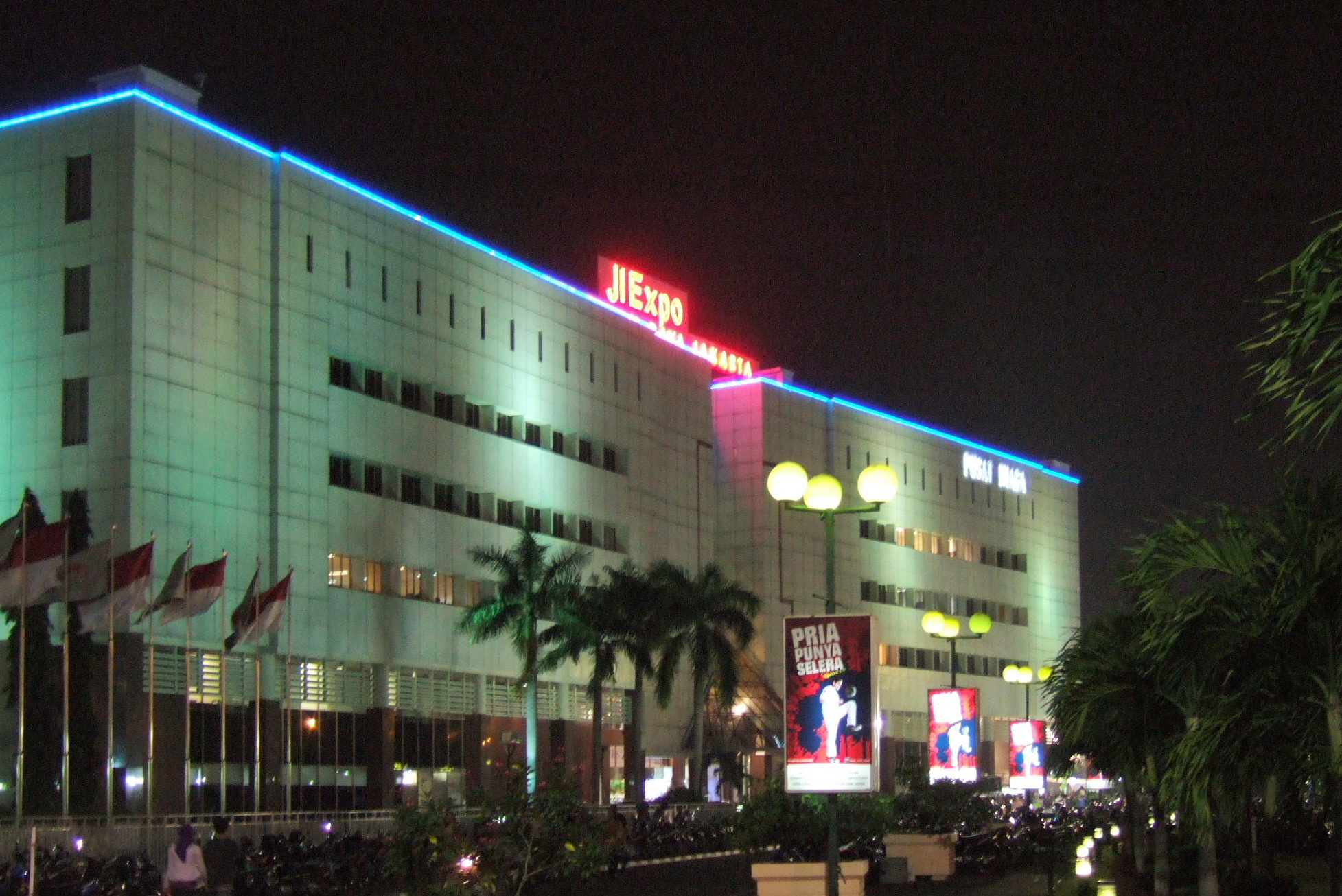
Jakarta Fair
Ice skating came to the tropics in 1955. At the Pekan Raya Indonesia, held on what is now the site of Atma Jaya University, the Holiday on Ice show performed for crowds who had never seen a frozen rink -- Eleanor Roosevelt was in the audience. That same year, many Indonesians encountered color television for the first time at the fair's Stand Televisi. These Cold War-era spectacles seem almost quaint now, but they capture something essential about Jakarta Fair: for over seven decades, this annual event has been the place where the capital meets the wider world, where commerce and carnival collide, and where millions of Jakartans come to eat, shop, gawk, and celebrate their city's anniversary on June 22.
Pasar Gambir and the Colonial Roots
Long before it had a formal name, the fair existed as Pasar Gambir -- a colonial-era market and entertainment gathering held in Koningsplein, the grand square in Weltevreden, Batavia, that would later become Merdeka Square. The tradition of festive night markets, pasar malam, was deeply rooted in Javanese and Betawi culture, and the Dutch colonial administration formalized it into a recurring event that mixed commerce with spectacle. After independence, the new nation recast the concept. The Pekan Raya Indonesia of 1953-1955 turned the fair into a showcase for national ambition. China headlined the first year's international pavilions. The Soviet Union took center stage the next. By 1955, the United States was the main exhibitor, with Ford, General Motors, Caterpillar, Goodyear, RCA, and Pan Am all setting up displays. The fair was not just entertainment -- it was postcolonial Indonesia declaring itself open for business.
The Merdeka Square Years
The modern Jakarta Fair was reborn in 1968, the brainchild of Governor Ali Sadikin. Inaugurated by President Suharto, it sprawled across the southern end of Merdeka Square, within sight of the towering National Monument. Sadikin's idea was practical: consolidate the scattered night markets that popped up across the city into one grand event, timed to the capital's anniversary celebrations. The formula worked immediately. The 1969 edition ran for 71 days -- still the longest Jakarta Fair on record -- and attracted a notable visitor: U.S. President Richard Nixon. For the next two decades, the fair occupied its Merdeka Square home, anchored by the Taman Ria fun park that operated year-round on the grounds' southwest corner. The location became synonymous with the event, and an entire generation of Jakartans grew up associating the southern edge of the square with the lights, noise, and fried food of the annual fair.
An Airport Becomes a Fairground
By the early 1990s, the fair had outgrown the square. Participant numbers climbed every year, and the park could no longer contain the sprawl of exhibitors, food stalls, and amusement rides. In 1992, the Jakarta Fair made its final move -- to the Jakarta International Expo complex at Kemayoran, built on the grounds of the decommissioned Kemayoran Airport. The old runways and hangars gave way to exhibition halls, and the additional space allowed the fair to expand dramatically. The relocation traded urban intimacy for scale. Where the Merdeka Square fair had the city's political heart as its backdrop, Kemayoran offered room for the event to become something closer to a small temporary city in its own right -- with thousands of stalls, stages for nightly music performances, amusement rides, and a food festival that draws visitors from across the archipelago.
Four Million Through the Gates
The numbers tell a story of commercial gravity. In 2010, trade transactions at Jakarta Fair totaled 3.5 trillion rupiah -- roughly $410 million. The following year, 2,600 companies filled more than 1,300 stalls, and over four million visitors pushed through the gates, generating 3.7 trillion rupiah in transactions. The fair runs for about thirty to thirty-five days each summer, typically spanning June and July, and its scope ranges from specialty food items and traditional handmade crafts to electronics and automotive displays. Live entertainment fills the evenings -- music, dance, and cultural performances from across Indonesia's diverse provinces. During the COVID-19 pandemic, the fair went dark for two years, 2020 and 2021, the first interruption in its modern history. It returned in 2022, and by 2025 was once again running its full summer schedule, a reminder that some traditions survive even when the world pauses.
Night Market, National Mirror
What began as a pasar malam has become something more revealing. Each era of the Jakarta Fair mirrors the political and cultural moment of its time: the colonial Pasar Gambir reflected Dutch-organized commerce; the 1950s Pekan Raya displayed Cold War courtship as China, the Soviets, and America each vied for Indonesian attention through their pavilions; the Suharto-era fair projected centralized national identity; and the contemporary event reflects a consumer economy open to global brands and domestic entrepreneurs alike. The fair has even exported its DNA -- a similar event called Pasar Malam Besar, held annually in The Hague, was directly inspired by the Jakarta original, carried to the Netherlands by the Indonesian diaspora. For a month each summer, the old airport grounds at Kemayoran become the place where Jakarta shows itself to itself. The amusement rides spin, the food vendors shout over each other, and four million people come to see what the capital has become since the last time they checked.
From the Air
Located at 6.15°S, 106.85°E at the Jakarta International Expo complex in Kemayoran, built on the former Kemayoran Airport grounds in central Jakarta. From 2,000-4,000 feet, the expo complex is identifiable by its large exhibition halls and parking areas, distinct from the surrounding dense urban fabric. Merdeka Square and the National Monument (Monas) are visible approximately 3 km to the south. Nearest major airport is Soekarno-Hatta International (WIII), about 25 km to the west. Halim Perdanakusuma Airport (WIIH) lies approximately 12 km to the southeast. The fair runs annually in June-July, when grounds and temporary structures are visible.