Jalesveva Jayamahe: Surabaya's Sentinel of the Sea
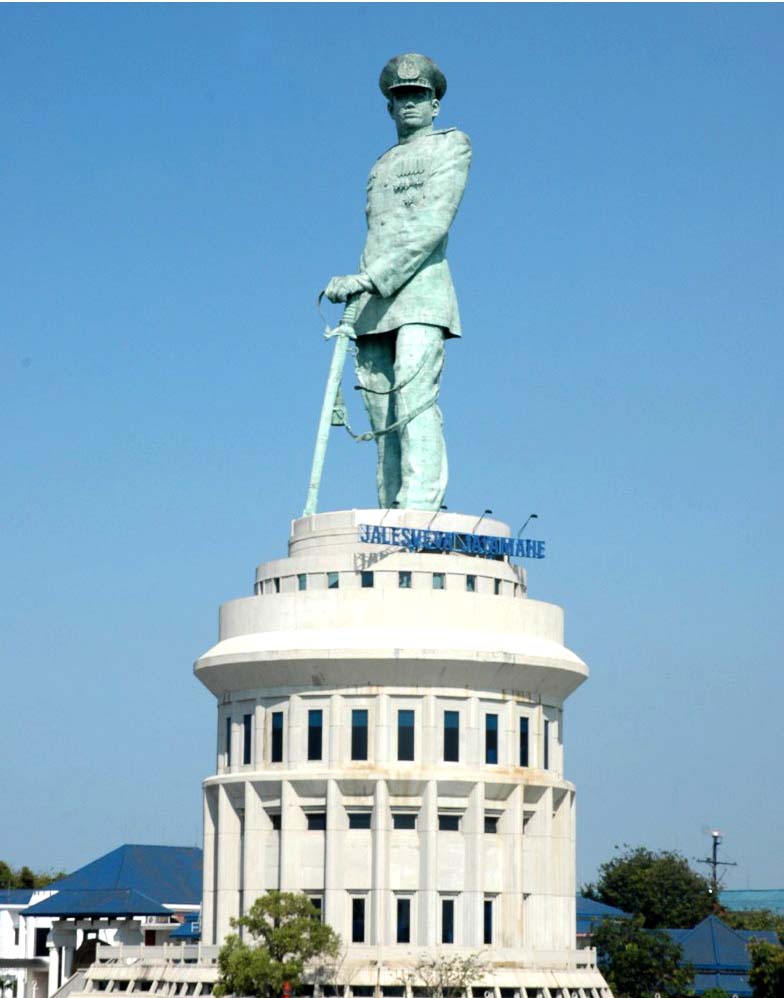
The sword catches the light first. From the Madura Strait, approaching Surabaya's northern waterfront, the silhouette sharpens into something unmistakable: a naval officer in full ceremonial dress, nearly two hundred feet tall, staring down the Java Sea as though daring it to misbehave. The Jalesveva Jayamahe Monument -- Monjaya to locals -- is not subtle. It was never meant to be. Standing 60.6 meters above the port district of Semampir, roughly the height of a twenty-story building, the statue ranks among the tallest monuments in Southeast Asia. Its name comes from a Sanskrit phrase adopted as the Indonesian Navy's motto: Jalesveva Jayamahe, meaning "On the water we are victorious." In a nation of seventeen thousand islands, where the sea is less a border than a connective tissue, the motto is not boast but biography.
A Navy's Identity, Cast in Bronze
Construction began in 1993 under the direction of the Indonesian Chief of Navy. The project passed through multiple commands before Admiral Muhammad Arifin of the Indonesian National Armed Forces saw it through. The sculptor chosen for the work was I Nyoman Nuarta, one of Indonesia's most celebrated artists, known for monumental pieces that blur the line between patriotism and spectacle. Nuarta would later design the Garuda Wisnu Kencana statue in Bali, an even larger work, but the Monjaya remains one of his most recognizable commissions. The officer depicted wears the Navy's Ceremonial Service Dress and holds a drawn sword of honor -- not raised in attack but held at the ready, a posture of vigilance rather than aggression. His gaze is fixed seaward, toward the shipping lanes of the Madura Strait, where cargo vessels and naval ships have passed for centuries.
Lighthouse and Landmark
What makes the Monjaya unusual among monuments is that it serves a practical purpose. The structure doubles as a lighthouse, its beacon guiding vessels through the busy approach to the Port of Tanjung Perak, Indonesia's second-busiest seaport. The dual function is fitting: a monument to naval supremacy that also helps civilian ships navigate safely. The location in Semampir, along Surabaya's industrial northern coast, places the statue amid the working infrastructure of a major port city rather than in a park or ceremonial plaza. Cranes and container stacks share the skyline with the officer's silhouette. The juxtaposition is deliberate -- this is a monument to a living navy, not a historical one, planted in the grit of the port it symbolically guards.
Surabaya's Maritime Soul
Surabaya has always defined itself through water. The city's name derives from the Javanese words for shark (sura) and crocodile (baya), creatures of the strait that became the city's emblem. As the capital of East Java and Indonesia's second-largest city, Surabaya earned the title Kota Pahlawan -- Hero City -- for its fierce resistance during the Battle of Surabaya in November 1945, one of the bloodiest engagements of the Indonesian independence struggle. The naval tradition runs equally deep. The Indonesian Navy's Eastern Fleet Command is headquartered here, and the nearby PT PAL shipyard has built warships for navies across Asia and Africa. The Monjaya stands at the intersection of all these identities: maritime, military, industrial, defiant.
A Stamp of National Pride
The monument's significance extends beyond Surabaya. In 1997, the Indonesian government featured the Monjaya on a postage stamp issued to commemorate National Armed Forces Day, placing a regional landmark on the national stage. The stamp series underscored the monument's role as a symbol not just of naval power but of Indonesia's broader identity as a maritime nation -- an archipelago whose sovereignty depends on the ability to project power across vast stretches of open water. For the Indonesian Navy, the Monjaya embodies its founding promise: that a nation born of islands must master the sea that connects them, or be fragmented by it.
Approaching from Above
From the air, the monument is impossible to miss along Surabaya's northern waterfront. The statue's height and its position near the port make it one of the first landmarks visible when approaching the city from the Java Sea side. The surrounding area is dense with port infrastructure -- container terminals, warehouses, the sprawling docks of Tanjung Perak -- and the monument rises from this industrial landscape like an exclamation point. At dawn, when the equatorial light turns the Java Sea copper, the officer's silhouette catches the sun before anything else on the coast. The sword, the stance, the fixed gaze seaward -- from any altitude, the message is the same: Indonesia is watching its waters.
From the Air
Located at 7.20°S, 112.74°E on Surabaya's northern waterfront near the Port of Tanjung Perak. The 60.6-meter monument is clearly visible from low to medium altitudes, standing prominently among the port's industrial infrastructure. Nearest major airport is Juanda International Airport (WARR), approximately 18 km to the south. The Madura Strait lies directly to the north, with Madura Island visible across the channel. The Suramadu Bridge, one of Indonesia's longest, is visible to the northeast connecting Java to Madura.