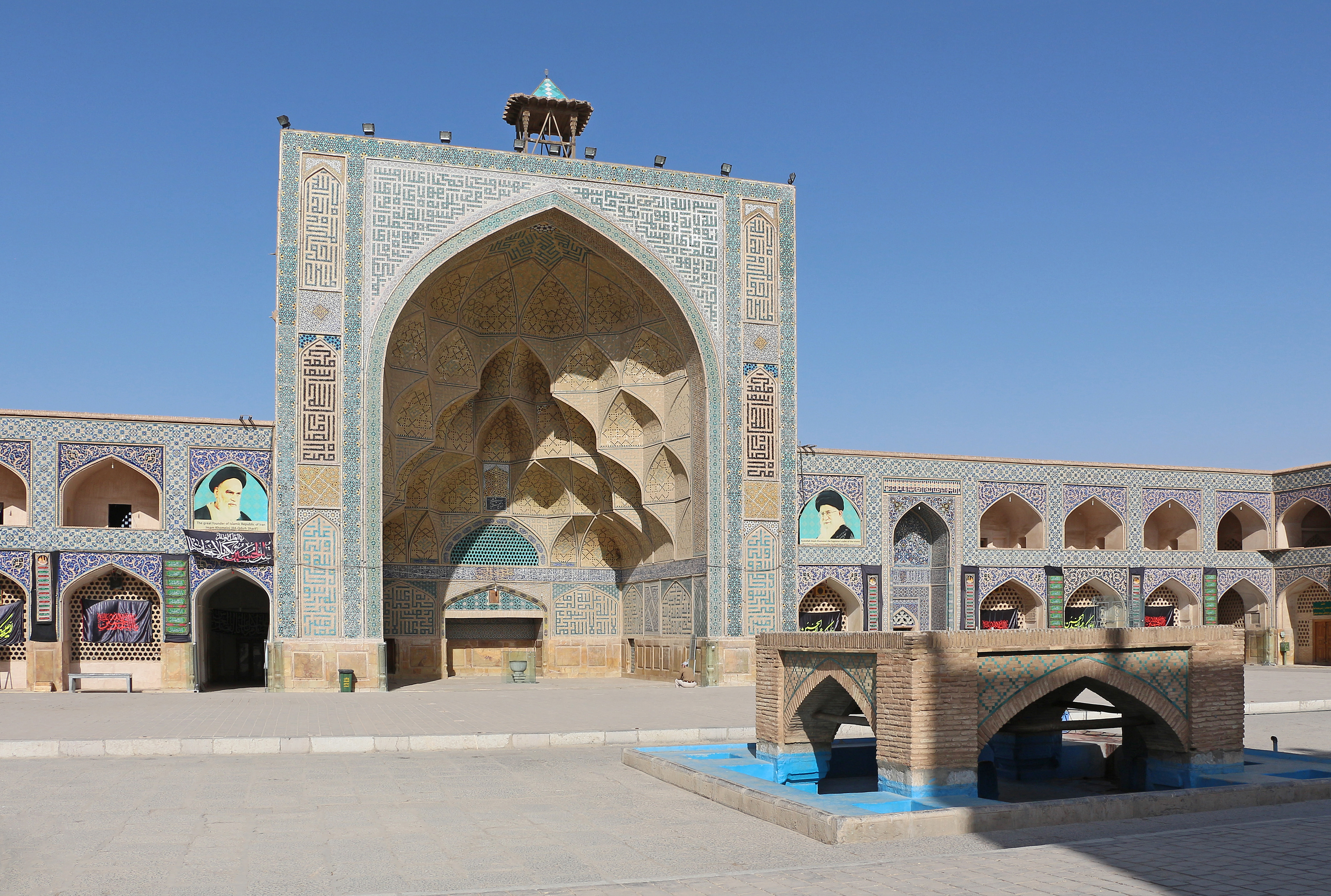
Jameh Mosque of Isfahan
Every dynasty that ruled Isfahan left its signature on this mosque. Walk through the complex today and you are reading twelve centuries of architectural ambition written in brick, stucco, and tile -- each era layered atop the last, none willing to erase what came before. The Jameh Mosque of Isfahan, also called the Friday Mosque, sprawls across more than 20,000 square meters in the heart of the old city, its perimeter so thoroughly enmeshed with the surrounding bazaar that entering it feels less like crossing a threshold than like surfacing from underground into sudden light and open sky.
Twelve Centuries in Stone
The first mosque on this site rose around 771 CE during the reign of the Abbasid caliph al-Mansur. Excavations revealed that even that early structure was built over an older Sassanid building in Isfahan's Yahudiya quarter, so the site's significance predates Islam itself. A larger mosque replaced the original in 840-841 under al-Mu'tasim. The Buyid dynasty added arcades of polylobed brick piers in the 10th and 11th centuries, decorating them not with stucco but with bricks laid in circles, diamonds, and zigzags -- geometric patterns that marked a new decorative vocabulary. Then came the Seljuks. When they made Isfahan their imperial capital after conquering the city in 1050, the mosque became the canvas for their architectural revolution.
The Innovation That Changed Everything
Under the patronage of the powerful vizier Nizam al-Mulk, builders tore out the columns in front of the mihrab in 1086-87 and replaced them with a massive domed chamber -- the largest masonry dome in the Islamic world at that time. But the Seljuk transformation went further. The mosque became the first Islamic building to adapt the four-iwan courtyard layout, originally a feature of Sassanid palaces, to religious architecture. Four monumental iwans -- vaulted halls open on one side -- now framed the central courtyard at the cardinal points. This four-iwan plan proved so compelling that it became the prototype for mosques across Central Asia, Iran, and beyond, shaping Islamic architecture for centuries to come.
Layer Upon Layer
The building never stopped changing. The Muzaffarids added a madrasa on the east side and a new prayer hall on the west during the 14th century, pushing the mosque beyond its original walls. Also in the 14th century, the vaulted ceiling of the prayer hall added by the Ilkhanid sultan Uljaytu (built around 1310) was reconstructed, and many of the smaller domes and vaults in the hypostyle hall likely date from this period as well. The Safavids contributed their own refinements. Each generation solved problems created by the last, reinforced structures weakened by earthquakes, and added beauty wherever they saw an opportunity. The result is not a single building but a dense archaeological record you can walk through, where a Buyid brick pattern might sit next to a Seljuk dome and a Safavid tile panel.
Woven Into the City
UNESCO inscribed the Jameh Mosque as a World Heritage Site in 2012, recognizing it as an outstanding example of the evolution of mosque architecture over more than a millennium. But the inscription also acknowledged something subtler: the mosque is inseparable from the city around it. Its southwestern wing merges with the Grand Bazaar of Isfahan, and its other edges dissolve into the dense fabric of the old quarter. Few clear exterior facades exist. The mosque does not stand apart from Isfahan -- it is woven into it, a public room in the city's collective house. Worshippers still gather here for Friday prayers, as they have for over twelve hundred years, surrounded by walls that carry the handwriting of every civilization that called this city home.
From the Air
Located at 32.67N, 51.69E in the historic center of Isfahan. The mosque's expansive courtyard and dome structures cover over 20,000 square meters, making it identifiable from moderate altitudes. Isfahan Shahid Beheshti International Airport (OIFM) lies approximately 20 km to the east. The Zayanderud River runs east-west through the city south of the mosque. Best viewed below 5,000 feet AGL for structural detail.