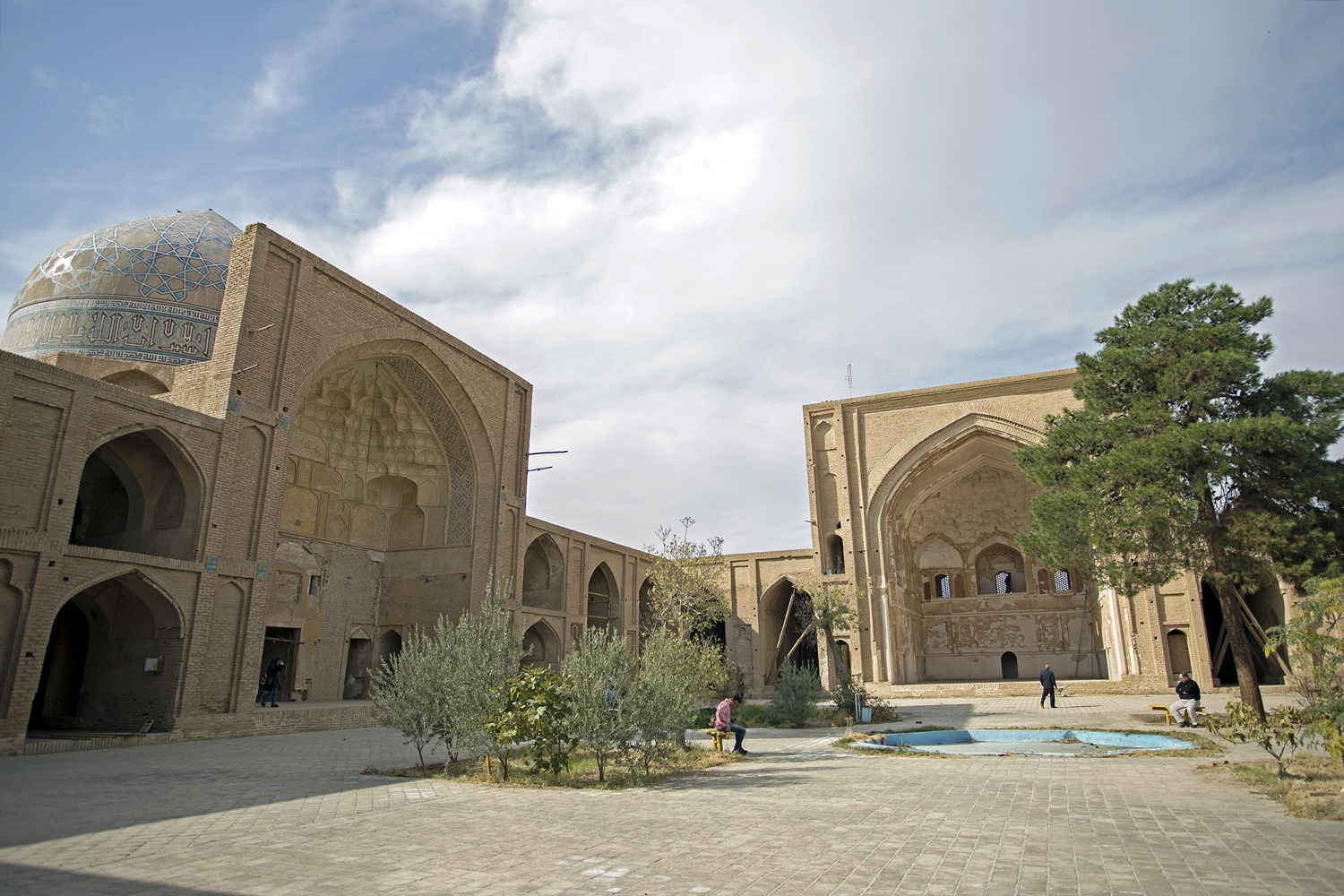
Jameh Mosque of Saveh: Twelve Centuries in Brick and Stucco
Dig beneath the Jameh Mosque of Saveh and you find another mosque. Dig beneath that one and you find a third. Archaeological excavations have revealed at least three congregational buildings stacked on this site, the oldest dating to the 8th or 9th century - its piers built of stamped earth, its roof long collapsed. Each generation tore down walls, reinforced columns, added domes, and inscribed new names over old ones. The result is not a single building but a geological record of Iranian architecture, compressed into 5,400 square meters on the southeastern edge of a small city most travelers pass through without stopping.
A Crossroads Town and Its Mosque
Saveh sits in the historic region of Jibal, the uplands of western-central Iran that medieval geographers used as a label for the territory between Ray, Hamadan, Isfahan, and Baghdad. The city prospered because it lay on caravan routes connecting these larger centers, and because it had good water in an otherwise dry landscape. Under the Seljuks in the 11th and 12th centuries, rulers used Saveh as a winter station, bringing wealth and patronage. The Friday mosque was the natural beneficiary. A congregational mosque in a Sunni trading town was more than a place of prayer - it was the civic center, the gathering point, the building that announced a city's importance to travelers arriving along the trade routes. Saveh's mosque performed that function for over a millennium.
Building Upon Building
The earliest mosque on the site was a hypostyle hall - rows of closely spaced piers supporting a flat roof, a design borrowed from the earliest mosques of Arabia and Iraq. It was built largely of stamped earth, a technique called china in Persian, with fragments of its mud-brick barrel vaults still embedded in later walls. A second hypostyle mosque replaced it, three bays deep around a nearly square courtyard of about 43 by 43 meters. Then, in the early 12th century, the Seljuks added a domed chamber on the qibla side, removing three older piers to create a square room of roughly 10.5 by 10.5 meters. A freestanding brick minaret east of the mosque bears an inscription dated 504 AH - the year 1110 or 1111 CE - naming the patron Abu Shugha Muhammad ibn Malikshah and invoking the Abbasid caliph al-Mustazhir.
Destruction and Reinvention
The Mongol invasions of the early 13th century devastated Saveh. The scholar Yaqut al-Hamawi, writing before his death in 1229, reported that the mosque's library was burned. The city recovered under the Ilkhanids, and in the early 14th century the mosque was substantially remodeled. A massive iwan - a vaulted hall open on one side - was built on the northwest side of the courtyard, standing about 15 meters high and over 13 meters deep, with a four-centered arch framed by engaged columns. Workers removed two rows of hypostyle piers to make space for it, strengthening the survivors with brick jackets. Traces of an inscription name the builder Shahvird and give a date around 1320-1321. The Ilkhanid iwan dominates the courtyard to this day, its thick walls containing hidden staircases to upper galleries.
The Safavid Transformation
When Shah Ismail I established Twelver Shi'ism as the state religion in the early 16th century, mosques across Iran were redecorated to reflect the new orthodoxy. At Saveh, a new outer dome shell was added over the Seljuk dome, creating a tall double-shell profile rising 21.9 meters. The architect Mir Ahmad ibn Mir Haj of Qom inscribed his name and the date 922 AH (1516-1517 CE) on the chamber walls. Inside, geometric tilework covers the dome interior. Three stacked Kufic inscription bands on the drum proclaim doctrinal formulae about God, the Prophet Muhammad, and the authority of Ali. Sixteen medallions below contain prayers for the Prophet, Fatima, and the Twelve Imams. A new qibla iwan was built in front of the dome chamber in 1539-1540, its dedicatory inscription naming another builder from Qom. The Safavids did not demolish their predecessors' work. They built over it, around it, through it - adding their theology in tile and stucco while the Seljuk bones held firm underneath.
Reading the Walls
Walking through the Jameh Mosque today is an exercise in dating by decoration. The earliest mihrabs are flat plaster panels with Kufic and Naskh scripts, resembling work from Nain and Nishapur. Seljuk-era stucco survives in the dome chamber as interlaced star patterns with vegetal motifs. The Ilkhanid iwan preserves painted plaster with the name Ali - a motif that appeared after the Ilkhanid rulers converted to Shi'ism. The Safavid mihrab combines carved stucco, colored plaster, and muqarnas with blue hexagonal tiles on the dado. Each layer is legible if you know what to look for. The mosque was added to the Iran National Heritage List in 1932, and archaeological investigations in the 1980s and 1990s finally clarified the building's full chronology. Large parts of the northeast range and the original entrance remain unexcavated. There is likely still another mosque waiting to be found.
From the Air
The Jameh Mosque of Saveh sits at 35.01°N, 50.36°E in the city of Saveh, Markazi province, in central-western Iran. The city lies roughly 130 km southwest of Tehran in the dry uplands between the Zagros foothills and the central plateau. The nearest major airport is Tehran's Imam Khomeini International Airport (OIIE). From altitude, Saveh appears as a compact city in an arid plain; the mosque complex is located near the southeastern edge of the old city. The double-shell dome and the truncated brick minaret (15.9 meters high) are potential visual references from lower altitudes.