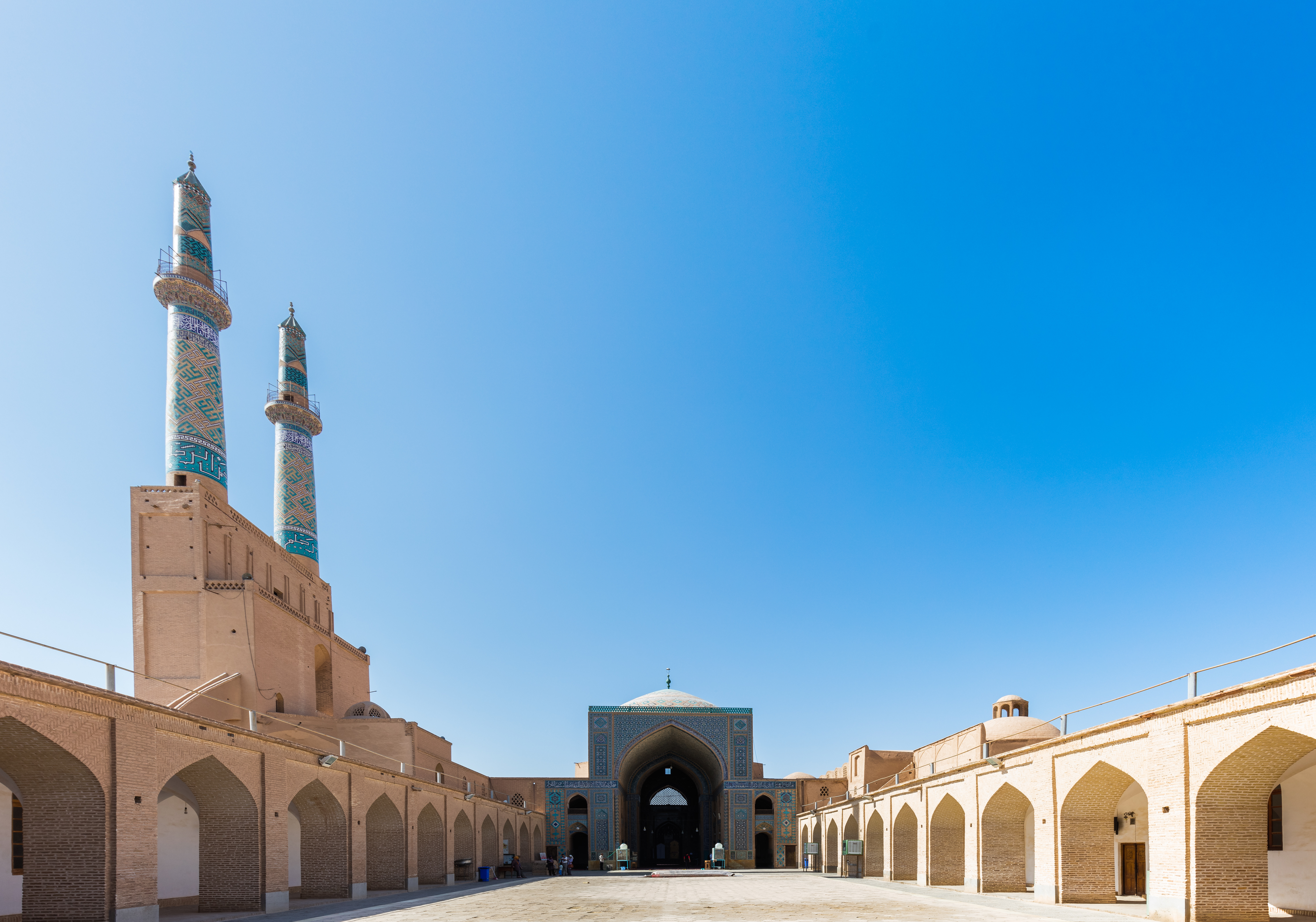
Jameh Mosque of Yazd
Six dynasties left their fingerprints on this mosque. Walk through the entrance portal of the Jameh Mosque of Yazd and you are walking through a timeline of Iranian civilization -- Seljuk foundations beneath Ilkhanid walls beneath Timurid muqarnas beneath Safavid minarets, all of it layered like geological strata in brick and turquoise tile. The twin minarets that crown the entrance soar 52 meters into the desert sky, the tallest in Iran, visible long before you can make out the intricate Kufic script that spirals up their shafts. What stands here today is not one building but many, each generation of rulers adding, demolishing, rebuilding, and always reaching a little higher.
A Site Older Than Islam
Before the first muezzin's call echoed across this ground, fire burned here. The site of the Jameh Mosque is believed to have hosted a Sasanian-era Zoroastrian fire temple, possibly dating to the fifth century. When Islam arrived in Yazd, the transition from fire temple to mosque followed a pattern seen across Iran -- sacred ground remained sacred, even as the faith practiced upon it changed. The earliest mosque on this site dates to the twelfth century under the Seljuk dynasty, but little of that structure survives. The Mongol conquests of the thirteenth century devastated much of the region. What rose from the ruins would become something far grander.
The Ilkhanid Transformation
The mosque as it exists today owes its bones to the Ilkhanid period of the fourteenth century. Under Shah Rukn al-Din Muhammad, the main structure took shape -- prayer halls oriented toward Mecca, a broad courtyard designed to gather the faithful under open sky, and the intricate brickwork that would define Yazd's architectural identity. The Mozaffarid dynasty that followed added refinements, and then the Timurids arrived in the early fifteenth century. They constructed the north prayer hall, added galleries, installed a marble minbar, and wrapped the entrance portal in muqarnas -- the honeycomb-like stalactite vaulting that transforms flat surfaces into cascading geometry. The Timurid muqarnas at the Jameh Mosque are considered among the best preserved in all of Central Asia.
Dynasties in Tile
In 1457, the Qara Qoyunlu ruler Jahan Shah turned his attention to the mosque's eastern entrance iwan. A carved inscription still bears his name and titles: "the structure of this lofty arch was restored during the reign of Abu'l-Muzaffar Sultan Jahanshah." His craftsmen covered the entrance from top to bottom in tilework, adding the deep blue glazes characteristic of the Qara Qoyunlu aesthetic. Similar work appears at the Masjid-i Muzaffariyya in Tabriz, tying the mosque to a broader artistic movement across the Turkmen empire. Each dynasty that touched this building left its signature in a particular shade of blue, a specific calligraphic style, a distinctive approach to geometry. Reading the walls is like reading a history of Iranian art.
Minarets That Fell and Rose Again
The Safavids gave the mosque its most dramatic feature. Sometime in the sixteenth century -- possibly under Shah Tahmasp -- the entrance was crowned with a pair of minarets that became the tallest in Iran. At 52 meters high and 6 meters in diameter, they are wrapped in turquoise and blue tiles arranged in geometric patterns, with the names of Shia imams and prophets woven into the design in Kufic script. The minarets announced the Safavid Empire's state religion of Twelver Shia Islam in letters large enough to read from across the city. Then, in 1815, an earthquake brought both minarets crashing down. The Qajar dynasty rebuilt them in the same Safavid style, adding their own emperors' names in Thuluth script around the portal arch. What visitors see today are Qajar reconstructions faithful to Safavid vision -- another layer in a building that has never stopped accumulating them.
Yazd's Living Center
In 2017, UNESCO inscribed the Historic City of Yazd as a World Heritage Site, recognizing a city that has survived at the edge of two deserts for millennia. The Jameh Mosque stands at the heart of that recognition. Its courtyard, remodeled by the Qajars with a central pool reflecting the sky, still gathers worshippers and visitors beneath the same proportions that medieval architects calculated. The tilework -- faded in places, restored in others, always commanding -- catches the desert light differently at every hour. Six dynasties built this place. None of them finished it. Perhaps that is the point. In Yazd, where Zoroastrian fire temples and Islamic mosques share the same ancient ground, nothing is ever truly complete. The city simply keeps building on what came before.
From the Air
Located at 31.90N, 54.37E in the heart of Yazd's historic old city, Iran. The mosque's twin minarets -- the tallest in Iran at 52 meters -- are a prominent landmark visible from altitude. Yazd Shahid Sadooghi Airport (OIYY) lies approximately 10 km to the south. The city sits at roughly 1,230 meters on the Iranian plateau, surrounded by desert terrain with the Shir Kuh mountains to the southwest. Yazd's UNESCO-listed old city, with its distinctive mud-brick skyline and badgirs (windcatchers), is easily identifiable from the air.