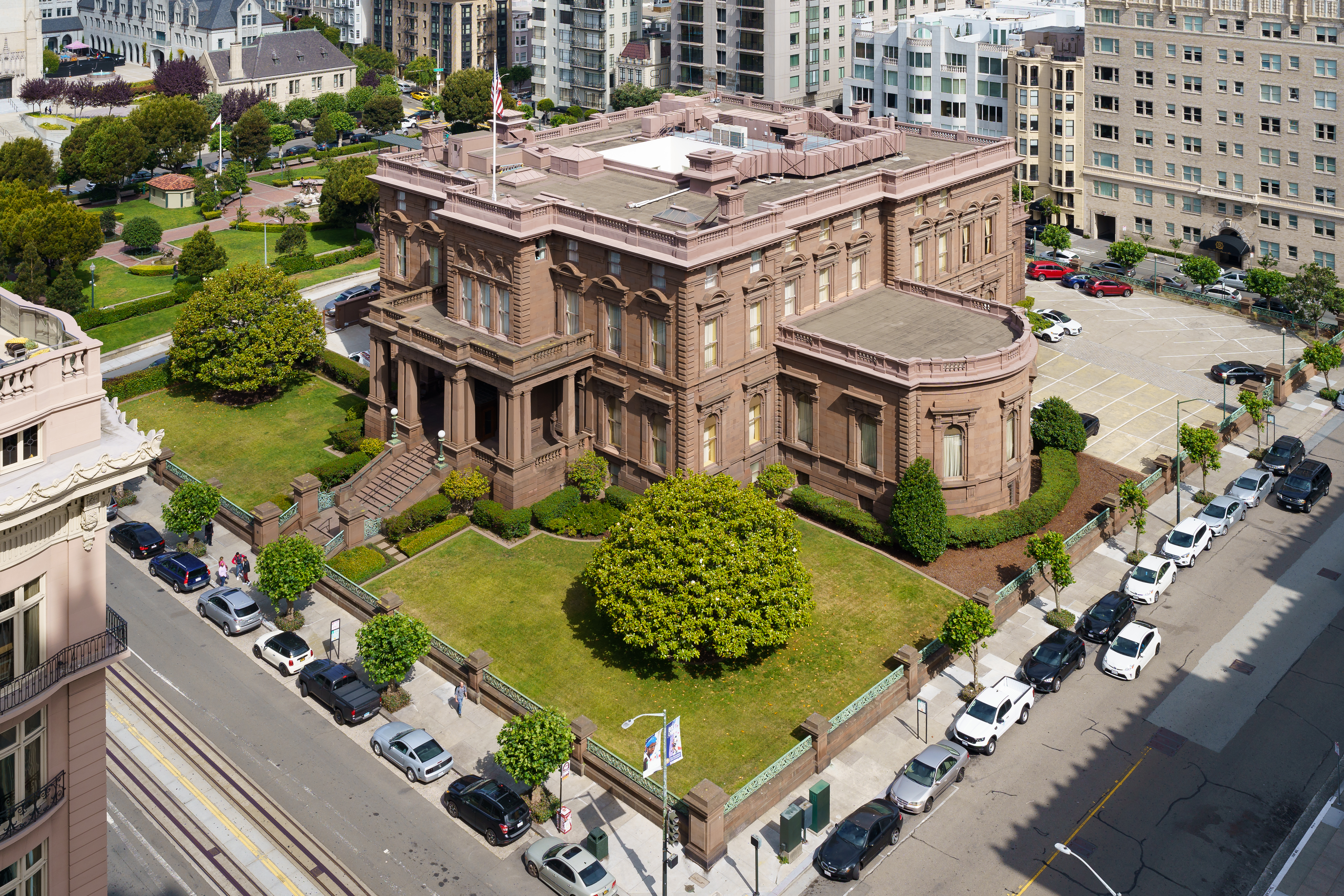
James C. Flood Mansion
Every other mansion on Nob Hill burned in 1906. The wooden palaces of Stanford, Hopkins, Crocker, and Huntington -- the railroad barons who had colonized the hilltop in the 1870s -- were consumed by the fires that followed the earthquake, leaving nothing but foundations and chimneys. But the James C. Flood Mansion at 1000 California Street survived, its brownstone walls resisting the flames that destroyed everything around it. It was the first brownstone building west of the Mississippi River, and its survival turned a silver baron's vanity project into the most historically significant residential structure in San Francisco.
Comstock Silver and Brownstone
James Clair Flood began his California career as a saloonkeeper on Washington Street, where he and his partner William O'Brien served drinks and collected mining stock tips from their customers. When the Firm of Flood and O'Brien struck the Comstock Lode's Big Bonanza in 1873, Flood became one of the wealthiest men in California. He built his mansion on Nob Hill in 1886, choosing Connecticut brownstone -- an unusual material for the West Coast -- as a declaration of Eastern establishment respectability. The brownstone was shipped around Cape Horn, an extravagance that underscored Flood's determination to build a house that would outlast him.
Sole Survivor
The 1906 earthquake damaged the mansion's interior but left the brownstone shell standing. The fires that followed the earthquake destroyed the wooden mansions surrounding it, including the Hopkins, Stanford, and Crocker mansions that had defined the hilltop. Flood's brownstone walls proved fireproof in a way that his neighbors' wood and plaster could not match. The mansion's survival was structural rather than miraculous -- stone resists fire, wood does not -- but the result was dramatic: a single mansion standing amid the ruins of an entire hilltop, the only original Nob Hill residence still standing.
The Pacific-Union Club
After the earthquake, the mansion was purchased and renovated as the home of the Pacific-Union Club, one of the most exclusive private clubs on the West Coast. The club occupies the building today, maintaining Flood's brownstone exterior while operating behind closed doors as a gathering place for San Francisco's business and social elite. The mansion's transformation from private residence to private club preserved its exclusivity while changing its function -- it remains, as Flood intended, a symbol of wealth and status on the summit of Nob Hill. The bronze fence that surrounds the property, said to have required a full-time polisher in Flood's day, still gleams on California Street.
From the Air
Located at 37.792°N, 122.411°W at 1000 California Street atop Nob Hill, San Francisco. The brownstone mansion is visible among the larger hotels and Grace Cathedral on the hilltop. Best viewed at 2,000-3,000 feet AGL. Nearest airports: KSFO (11 nm south), KOAK (10 nm east).