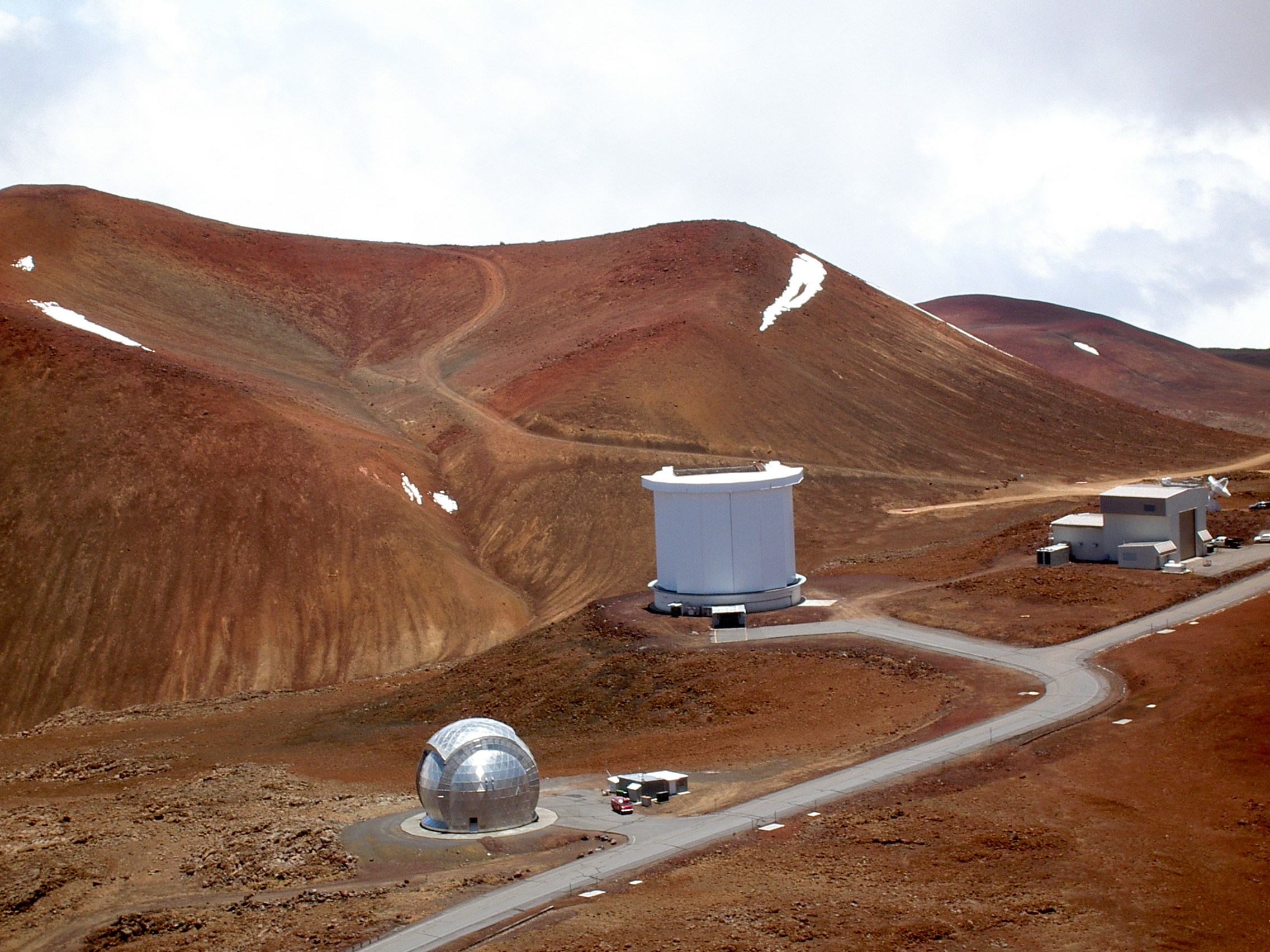
James Clerk Maxwell Telescope
One of its heterodyne receivers is named Namakanui, after the big-eyed fish that swim in Hawaiian waters at night. The name fits. At 13,425 feet on Mauna Kea, the James Clerk Maxwell Telescope stares into the submillimetre band of the electromagnetic spectrum, a narrow window between far-infrared and microwave wavelengths where cosmic dust glows, stellar nurseries smolder, and the cold gas between galaxies reveals its molecular fingerprints. With a 15-meter primary mirror composed of 276 individually adjustable panels, the JCMT is the largest single-dish telescope operating in this range anywhere in the world. It sees what optical telescopes cannot: the hidden architecture of star formation, the chemical signatures of distant galaxies, and the silhouettes of objects so dense that light itself cannot escape them.
A Telescope Named for Equations
The story begins in the late 1960s, when the UK's Science Research Council recognized that submillimetre and millimetre wavelengths held scientific riches that existing instruments could barely access. By 1975, a steering committee concluded that a 15-meter dish could reach wavelengths as short as 750 micrometers. The project, initially called the National New Technology Telescope, was planned as a British-Dutch collaboration. Site tests compared Mauna Kea, the Pinaleno Mountains in Arizona, and a location in Chile. Mauna Kea won. Construction began in 1983, and first light came in 1987. The telescope was named for James Clerk Maxwell, the Scottish physicist whose equations unified electricity, magnetism, and light into a single theory, predicting the very electromagnetic waves the instrument was built to detect.
The Carousel and the Membrane
Submillimetre wavelengths demand extreme precision. The JCMT's 276 panels must maintain a surface accuracy better than 50 micrometers, roughly the thickness of a human hair. The antenna sits inside a co-rotating carousel, an enclosure that turns with the dish and shields it from wind and weather. Stretched across the carousel's aperture is a transparent membrane, invisible to submillimetre radiation but tough enough to block the gusts that would otherwise distort the mirror surface. This Cassegrain telescope uses a tertiary mirror to redirect incoming radiation toward a suite of receivers, each tuned to different aspects of the submillimetre universe. The design was larger and more capable than its competitors, the Caltech Submillimeter Observatory and the Submillimeter Telescope in Arizona, and it delivered on that ambition from the start.
SCUBA and the Dust Detectives
No instrument defined the JCMT's scientific legacy more than SCUBA, the Submillimetre Common-User Bolometer Array. Delivered in 1996, it operated simultaneously at 450 and 850 micrometers, detecting thermal emission from interstellar dust. Between 1997 and 2003, SCUBA ranked among the highest-impact astronomical instruments in the world, revealing populations of dusty, intensely star-forming galaxies at cosmological distances that had been invisible to optical surveys. Retired in 2005, the original SCUBA now resides in the National Museum of Scotland. Its successor, SCUBA-2, commissioned in 2011, uses superconducting transition edge sensors to achieve mapping speeds hundreds of times faster, with 10,240 total pixels across its two wavelength bands. Where SCUBA was a flashlight, SCUBA-2 is a floodlight.
From Three Continents to Four
The JCMT's ownership has traced a path across the globe. From 1987 to 2013, the UK contributed 55 percent of funding, Canada 25 percent, and the Netherlands 20 percent. When the Netherlands withdrew in 2013, the remaining partners carried on until March 2015, when they handed the telescope to the East Asian Observatory. Funding now flows from the national observatories of China, Japan, and South Korea, and from Taiwan's Academia Sinica Institute of Astronomy and Astrophysics, with continued participation from British and Canadian universities. The transition reshaped the JCMT's research priorities without diminishing its ambitions.
Imaging the Unseeable
In its early years, the JCMT was paired with the neighboring Caltech Submillimeter Observatory to create the first submillimetre astronomical interferometer, a proof of concept that drove the construction of both the Submillimeter Array on Mauna Kea and the Atacama Large Millimeter Array in Chile. More recently, the JCMT joined the Event Horizon Telescope, the planet-spanning network that produced the first direct image of a black hole in 2019. The telescope also contributed to the controversial 2020 detection of phosphine in the atmosphere of Venus, a potential biomarker that sparked fierce scientific debate. From resolving the dust lanes of newborn star systems to probing the atmospheres of neighboring planets, the JCMT remains a telescope whose reach exceeds what its builders could have imagined.
From the Air
Located at 19.823N, 155.477W near the summit of Mauna Kea on the Big Island of Hawaii, at approximately 13,425 feet elevation. The JCMT's distinctive carousel enclosure is visible among the observatory cluster on the summit ridge. Nearest airports: Ellison Onizuka Kona International at Keahole (PHKO) about 35 nm west, Hilo International (PHTO) about 28 nm east. Summit typically sits above the trade wind inversion, providing clear skies and extremely dry conditions.