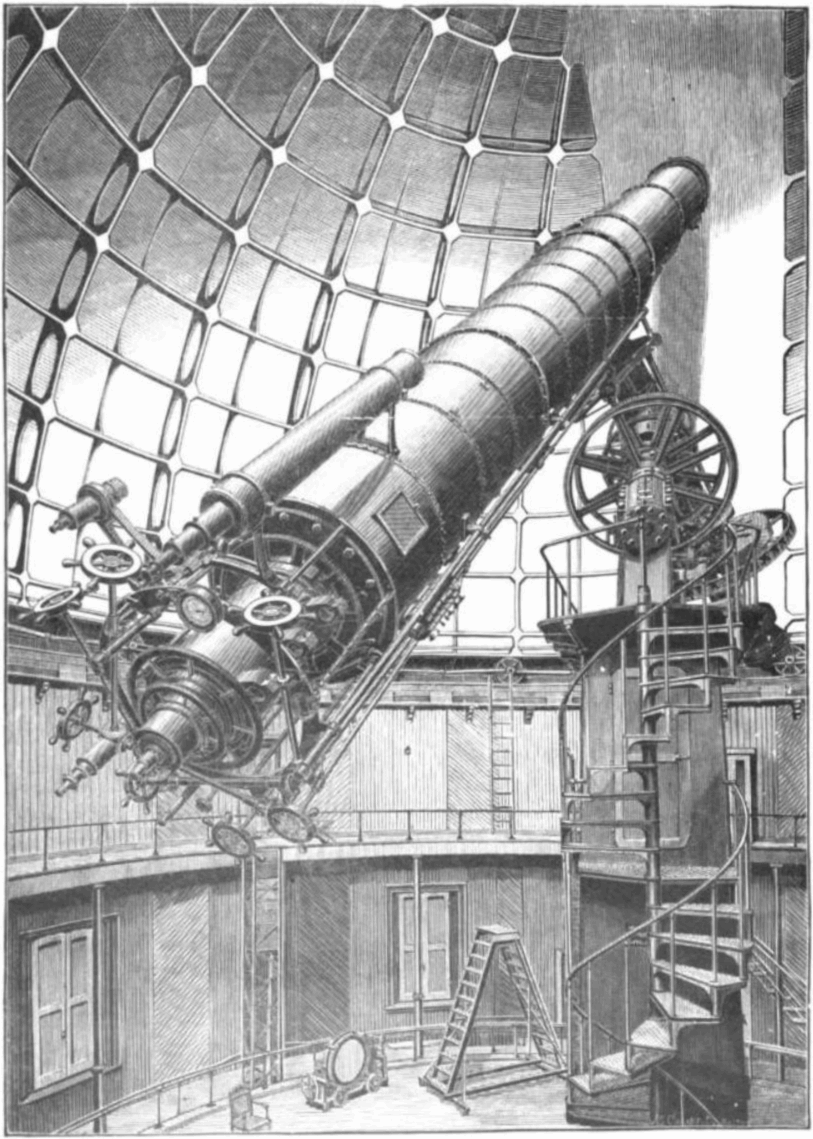
James Lick Telescope
On the evening of January 3, 1888, astronomers aimed a brand-new telescope at the sky above Mount Hamilton and discovered they couldn't focus it. The tube was too long -- an error in calculating the lens's focal length had left the instrument useless. Someone fetched a hacksaw. They cut the great 57-foot tube to the correct length, pointed it at the star Aldebaran, and watched the bright orange point snap into crystalline focus. That improvised fix launched a scientific career that continues to this day. The James Lick Telescope, also known as the Great Lick Refractor, still operates atop the mountain where it was first aimed at the heavens nearly a century and a half ago.
A Fortune Aimed at the Stars
The telescope exists because a piano maker got rich buying California real estate. James Lick arrived in San Francisco in 1848, parlayed $30,000 in gold into a land empire, and became the wealthiest man in the state. In his later years, he directed $700,000 -- an enormous sum at the time -- toward building an observatory that would surpass anything in Europe. Mount Hamilton, rising 4,209 feet above the Santa Clara Valley, was chosen for its elevation above the nightly fog that blanketed the lowlands. Lick died in 1876, more than a decade before the telescope saw first light, but his will ensured the project's completion. He is entombed beneath the floor of the observing room -- the only person buried under a major working telescope.
Ground Glass and Cleveland Steel
Building the world's largest refracting telescope required a collaboration spanning two continents. The two glass disks for the 36-inch achromatic objective lens were fabricated in France, then shipped to Cambridge, Massachusetts, where Alvan Clark and his son Alvan G. Clark ground and polished them into precision optics. The lens commission alone cost $51,000, placed in 1880, with manufacturing dragging on until 1885. The massive tube and equatorial mount came from Warner and Swasey in Cleveland -- 57 feet long and 4 feet in diameter. The lens finally arrived at the observatory on December 29, 1886. Assembly and calibration took another year before that fateful January night when first light revealed the focusing error and the hacksaw provided the solution.
Discoveries in the Dome
Once properly focused, the Great Lick Refractor justified every dollar of Lick's bequest. In 1888, the same year it was commissioned, astronomer James Keeler used it to discover the Encke Gap in Saturn's rings. Four years later, Edward Emerson Barnard spotted a tiny dot near Jupiter that turned out to be Amalthea -- the planet's fifth moon and the first Jovian satellite discovered since Galileo identified the original four in 1610. The telescope held the title of world's largest refractor until 1897, when the 40-inch instrument at Yerkes Observatory surpassed it. Today it ranks third among refracting telescopes, but its scientific legacy is unmatched for an instrument of its era. The original hydraulic systems -- designed to raise and lower the floor, rotate the dome, and track Earth's rotation -- still function, though electric pumps have replaced the wind-powered originals.
Still Watching from the Summit
Lick Observatory became the world's first permanently occupied mountaintop observatory when it was turned over to the University of California's Board of Regents in May 1888. The winding road up Mount Hamilton -- built specifically so horse-drawn wagons could haul construction materials to the summit -- remains the only way to reach it by car. On select evenings, the public is still allowed to look through the Great Refractor, peering through the same optics that revealed a gap in Saturn's rings and a new moon of Jupiter. Beneath their feet, James Lick rests under a brass tablet bearing the inscription: "Here lies the body of James Lick." The piano maker who traded Peru for California, and real estate profits for starlight, got exactly the monument he paid for.
From the Air
Located at 37.34N, 121.64W atop Mount Hamilton at 4,209 feet elevation, east of San Jose. The observatory's white domes are visible from considerable distance, perched on the summit of the Diablo Range. From the air, the winding Mount Hamilton Road (CA-130) snaking up the western slope is a distinctive landmark. Norman Y. Mineta San Jose International Airport (KSJC) is approximately 18 nautical miles to the west-northwest. Reid-Hillview Airport (KRHV) is closer at roughly 12 nautical miles west. Terrain rises sharply in this area -- maintain safe altitudes when approaching from the valley floor. Best viewed at 5,000-6,000 feet MSL on a clear day.