Jamestown: The Colony That Nearly Starved to Death
They landed in May 1607, 104 English colonists sent by the Virginia Company to establish England's first permanent settlement in America. Within two years, most of them were dead. Jamestown's early history is a chronicle of catastrophe: disease, starvation, warfare with Powhatan Confederacy, and leadership failures that nearly extinguished the colony entirely. The 'Starving Time' of 1609-1610 killed at least 80% of colonists; archaeological evidence confirms that survivors ate the dead. Yet Jamestown persisted, eventually thriving on tobacco exports and establishing patterns - representative government, chattel slavery, Native dispossession - that would shape American history. The myth-making came later, smoothing Pocahontas into a Disney princess and John Smith into a hero. The archaeology tells darker truths.
The Arrival
The Susan Constant, Godspeed, and Discovery carried 104 colonists up the James River in May 1607. They chose a site for defensive reasons - the peninsula was connected to the mainland by a narrow isthmus, easily defended - but the location was terrible for habitation. The water was brackish, the ground swampy, mosquitoes carried malaria. The colonists were poorly chosen: too many gentlemen who disdained manual labor, too few farmers and craftsmen. The Virginia Company expected gold and a passage to Asia; they got swamp and hostility. Within six months, more than half the colonists had died from disease and starvation.
The Starving Time
The winter of 1609-1610 was apocalyptic. Relations with the Powhatan Confederacy had collapsed; the colonists were besieged. Of roughly 500 people in Jamestown that autumn, only 60 survived the winter. They ate horses, dogs, rats, boot leather, and finally each other. In 2012, archaeologists discovered the remains of a 14-year-old girl whose bones showed clear evidence of cannibalism - butchering marks consistent with attempts to remove flesh and brain tissue. The colonists who survived 'Starving Time' were found by relief ships in May 1610 and immediately abandoned the colony. Only meeting incoming supply ships convinced them to return.
The Myths
Pocahontas was real - a Powhatan girl named Amonute who did interact with colonists. Whether she 'saved' John Smith is disputed; Smith only reported the story years later, after her death, and no contemporary accounts confirm it. What's documented: she was kidnapped by colonists in 1613, converted to Christianity, married tobacco planter John Rolfe, traveled to England as a propaganda exhibit, and died there at about 21. Her story has been romanticized into reconciliation fantasy; the reality was captivity and colonial exploitation. John Smith was a self-promoting soldier whose accounts are unreliable. The myths serve American founding narratives better than the truth.
The Consequences
Jamestown survived through tobacco. John Rolfe's introduction of Caribbean tobacco varieties created an export crop that finally made Virginia profitable. The labor demands of tobacco cultivation led first to indentured servitude, then in 1619 to the arrival of the first enslaved Africans in English North America. That same year, the House of Burgesses met - the first representative assembly in America. Jamestown established the templates: plantation agriculture, racial slavery, representative government, Native American dispossession. The colony that nearly died became the seed of what grew into American society, for good and ill.
Visiting Jamestown
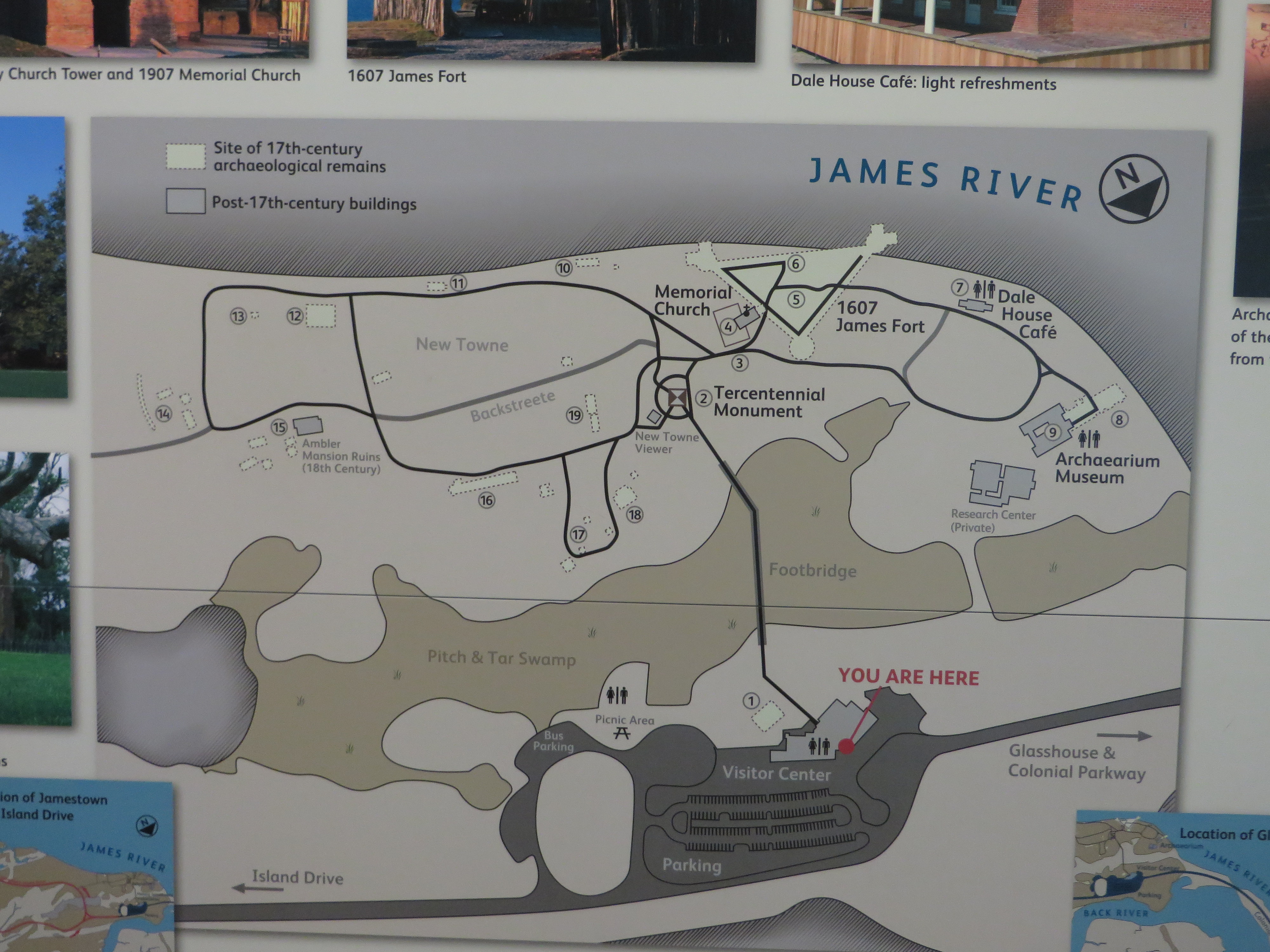
Historic Jamestowne is located on Jamestown Island in James City County, Virginia, accessible from Williamsburg via Colonial Parkway. The site is jointly managed by the National Park Service and Preservation Virginia. Archaeological excavations are ongoing; visitors can observe work in progress. The Archaearium museum displays artifacts including cannibalism evidence. A reconstruction of the 1607 fort offers spatial understanding. The Jamestown-Yorktown Foundation operates Jamestown Settlement nearby, featuring ship replicas and living history interpretation. Allow a full day for both sites. The Colonial Parkway connects Jamestown to Colonial Williamsburg and Yorktown, forming Virginia's Historic Triangle.
From the Air
Located at 37.21°N, 76.78°W on the James River in coastal Virginia. From altitude, Jamestown Island appears as a wooded peninsula extending into the river, connected to the mainland by a marshy isthmus. The Colonial Parkway is visible as a curving road along the river. The James River widens toward Chesapeake Bay to the east. Colonial Williamsburg is visible 5 miles northeast; the York River and Yorktown beyond. The tidewater landscape is flat, green, and water-dominated - the same terrain that greeted English colonists in 1607, though now protected as parkland rather than desperate frontier. The swampy character that made the site deadly is visible in the many waterways and marshes.