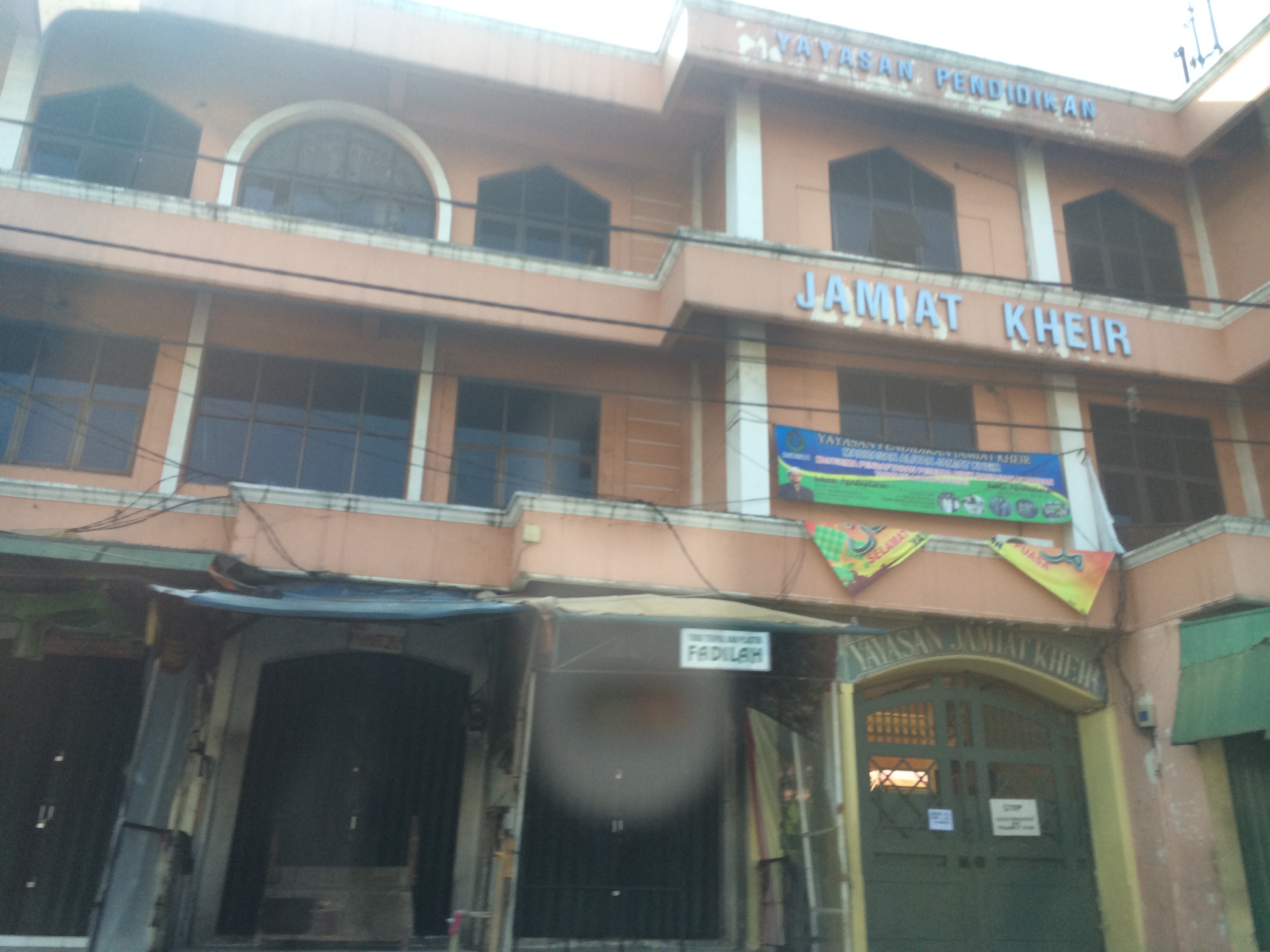
Jamiat Kheir
Seven years before Budi Utomo, the organization traditionally credited with sparking Indonesia's national awakening, a group of Arab community leaders gathered at the Raudah Mosque on Pekojan Road II in Batavia. They had a plan: build a modern Muslim school to counter the Dutch colonial education system, which they saw as a vehicle for Christianization. The organization they founded in 1901 was called al-Jam'iyyatoul Khairiyyah -- the Association of Goodness. When Budi Utomo adopted its own name a few years later, the choice was deliberate. According to the scholar Ahmad Djajadiningrat, the founders simply translated 'Jamiat Kheir' from Arabic into Javanese. Both names mean the same thing: benevolent society. The translation was a compliment. The precedence was a fact.
Classrooms Against the Colony
The Dutch colonial government was not naive about the risks of Muslim education. A body called the Priesterraden, established in 1882, monitored religious instruction across the archipelago. In 1905, the government passed a law requiring every religious instructor to obtain a teaching permit -- a measure aimed squarely at controlling what was taught and by whom. Jamiat Kheir navigated this system and obtained its license. It opened an elementary-level madrasa in Pekojan that offered free education, blending religious studies with general subjects. The choice of language for secular instruction was pointed: not Dutch, which would have signaled accommodation, but English, which signaled defiance without dependence on the colonizer's tongue. The school's first board read like a roster of the Hadrami Arab elite of Batavia, drawn from the Shahab, Alatas, and Alhabsi families. A petition filed on August 15, 1903, had sought permission for a community organization to assist with funerals and weddings. Education, the real engine, came next.
The Sudanese Teacher
In 1911, Jamiat Kheir invited Ahmad Surkati, a scholar from Sudan, to lead its school. His arrival changed the organization's trajectory. Surkati brought other Sudanese educators with him -- his brother Abu al-Fadl, along with Shaykh Muhammad Nur and Shaikh Hasan Hamid al-Ansari -- and introduced reformist Islamic ideas that emphasized equality among Muslims regardless of lineage. This philosophy collided with the beliefs of the organization's more conservative members, particularly the Sayyids -- descendants of the Prophet Muhammad who held a privileged social position in Hadrami society. The collision became a rupture in 1913, when Surkati was asked about a marriage between a Sayyid woman and a non-Sayyid man. He argued that Islamic law, properly interpreted, permitted it. The conservative Sayyids disagreed, and the argument escalated far beyond theology.
The Rupture Over Kafa'ah
The dispute exposed fault lines that ran deeper than jurisprudence. Some Hadrami Sayyids attacked Surkati with language that was explicitly racist. Abdullah Dahlan asked whether 'the Negro will return from his error or persist in his stubbornness.' Others called Surkati 'the black death,' 'black slave,' and 'the Sudanese,' all while claiming he could not properly speak Arabic -- a scholar who had been recruited specifically for his learning. The conflict split the Hadrami community into two factions: the Alawi Sayyids, who insisted on lineage-based hierarchy, and the supporters of al-Irshad, Surkati's reformist movement, which held that all Muslims were equal. Pamphlets and books flew in both directions. A public debate was planned twice -- once in Bandung, once at Masjid Ampel in Surabaya -- and cancelled both times by Surkati's opponents. The theological argument was never formally settled. The social rift it created persisted for decades.
From Movement to Institution
By 1919, Jamiat Kheir had narrowed its focus exclusively to education, shedding its broader social activities. Those functions migrated to al-Rabitah al-Alawiyah, a new organization whose founders overlapped with Jamiat Kheir's original leadership -- the Shahab brothers, the Alatas and Alhabshi families. In 1924, Ahmad bin Abdullah al-Saggaf established an internaat, a boarding house for students, in two houses on Jalan Karet number 72, at a cost of thirty guilders per month. Five years later the foundation purchased a 2,500-square-meter plot of land in Kebun Melati for a girls-only elementary school. Sharifah Qamar of Darul Aytam, the first student financed by al-Rabitah to graduate from Jamiat Kheir, received a stipend of fifteen guilders a month -- a modest sum that represented something immodest: an Arab-Indonesian girl, in colonial Java, completing a formal education.
Still Teaching
Today the schools operate under the Yayasan Pendidikan Jamiat Kheir, the Education Foundation of Jamiat Kheir, headquartered in Tanah Abang, Central Jakarta. The foundation runs elementary, middle, and high schools as well as an undergraduate college, all on the same ground where the original arguments about education, equality, and colonialism were waged a century ago. The elementary and middle schools remain single-sex. In 2005 the foundation opened Binakheir, an elementary school in Depok, its first expansion beyond Jakarta. The name Jamiat Kheir has outlasted the Dutch colonial government that tried to regulate it, the internal conflict that nearly destroyed it, and the generations of students who passed through its classrooms without knowing they were attending one of Indonesia's oldest private educational institutions -- older, by seven years, than the one history usually remembers first.
From the Air
Located at 6.19S, 106.82E in Tanah Abang, Central Jakarta. The Jamiat Kheir compound is situated in the dense urban fabric south of Merdeka Square. From the air, the area is identifiable by its proximity to the Tanah Abang textile market district and the railway station. The historical Pekojan area where the organization was first founded lies approximately 3 km to the northwest, near Jakarta's old Chinatown. Nearest major airport is Soekarno-Hatta International (WIII), about 25 km northwest. Halim Perdanakusuma Airport (WIHH) is approximately 12 km southeast.