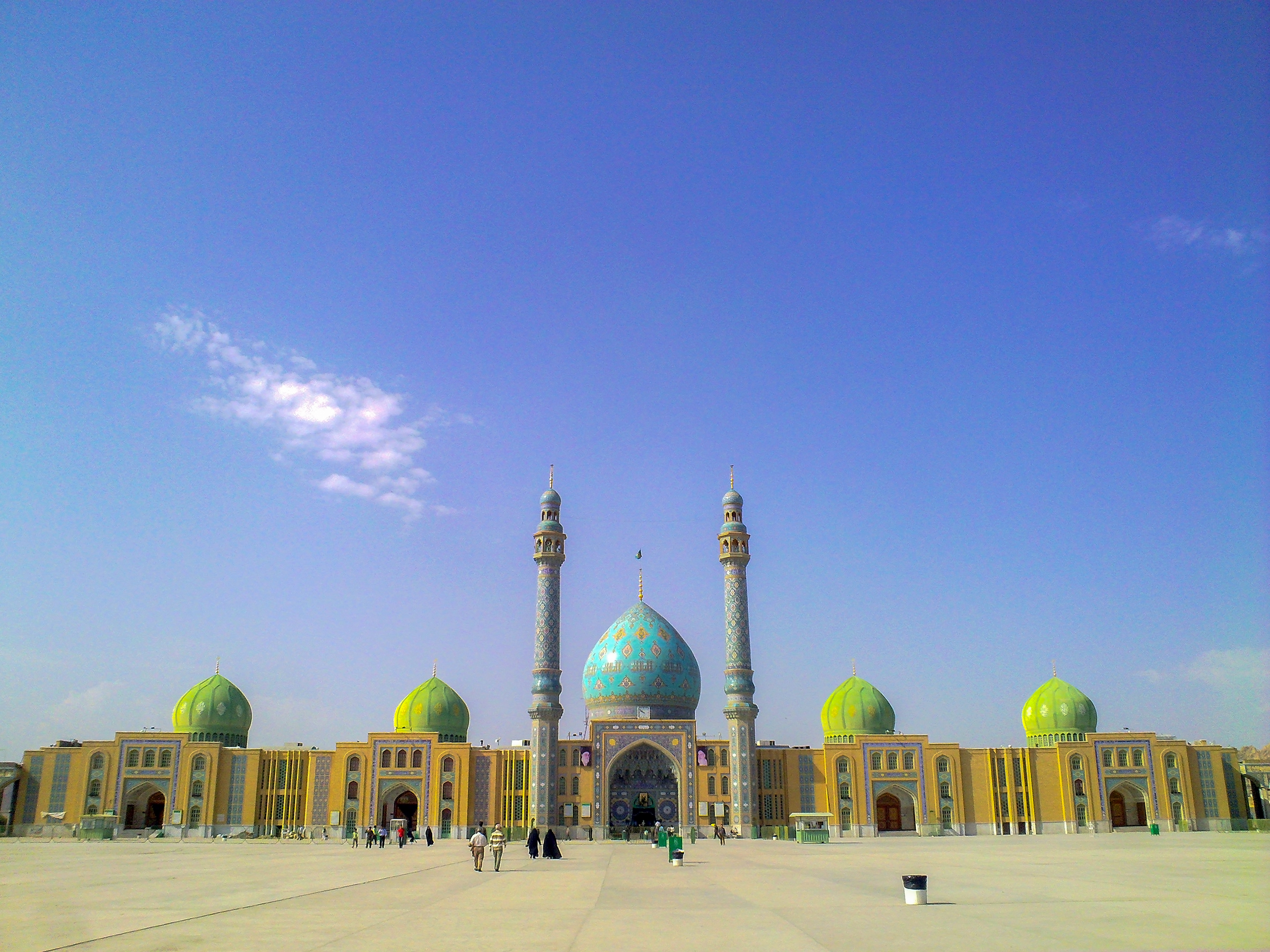
Jamkaran Mosque
Every Tuesday night, tens of thousands of people gather in the parking lots and courtyards of a mosque six kilometers east of Qom. Vendors set up stalls. Families spread picnic rugs on the ground. The atmosphere has been compared to a vast tailgate party, though the occasion is devotional rather than athletic: Tuesday is the day the Twelfth Imam is said to have appeared here, and therefore the day of the week when the faithful believe he -- though invisible -- accepts their requests. More than a hundred thousand worshippers sometimes overflow the Jamkaran Mosque for Maghrib prayer, filling the grounds beyond the building's capacity. At the rear of the mosque, they queue at a small well, tying knotted strings around the metal grids that cover it, each knot carrying a whispered petition.
A Vision on Noble Ground
The founding story of Jamkaran Mosque reaches back to a night on the 17th of Ramadan, when a man named Sheikh Hassan ibn Muthlih Jamkarani reportedly encountered the Twelfth Imam alongside the prophet Al-Khidr. According to the account, the Imam told Jamkarani that the ground they stood on was noble -- that the landowner, Hasan bin Muslim, must stop farming it and instead use his accumulated earnings to build a mosque on the site. Twelver Shia theology holds that the Twelfth Imam, Muhammad al-Mahdi, went into a state of occultation in the ninth century and remains hidden, awaiting the appointed time to return. Jamkaran is one of the few places where believers say he briefly became visible. The vision gave this modest village site outside Qom a significance that would grow, slowly at first and then dramatically, over the following centuries.
Five Domes and a Well of Requests
The mosque that stands today bears little resemblance to whatever simple structure first rose on the site. Five domes crown the complex, their surfaces covered in the intricate tilework characteristic of Iranian Islamic architecture. The main prayer hall opens through an impressive iwan -- a vaulted portal -- adorned with Quranic verses and geometric motifs. Spacious courtyards, including the Sahib Al-Zaman Courtyard, accommodate the enormous crowds that fill the grounds on peak nights. But the most distinctive feature sits behind the main building: the well of requests. Believers hold that the Twelfth Imam once appeared at this well in a brief, miraculous moment. Pilgrims approach and knot small strings around the metal grids covering it, each string representing a prayer or petition they hope the hidden Imam will receive. Every morning, custodians cut away the previous day's strings to make room for the next wave.
Tuesday Nights in Jamkaran
Sometime between 1995 and 2005, the mosque's reputation expanded beyond its traditional base and young pilgrims in particular began arriving in large numbers. The weekly Tuesday gatherings became the mosque's defining rhythm. The scene is remarkable for its scale and informality. The enormous crowd spills far past the mosque's walls, filling adjacent lots and streets. Men and women worship in separate areas, each with access to their own well. The atmosphere mixes deep reverence with the communal energy of a festival -- families eating together, children running between groups, the low murmur of prayer mixing with the sounds of commerce at vendors' stalls. When the call sounds for Maghrib, the entire mass of humanity orients toward Mecca and the scale of the gathering becomes fully visible: a hundred thousand people or more, praying in unison on the open ground of a small village that the rest of the week reverts to quiet.
Qom's Outer Ring of Devotion
Jamkaran sits in the gravitational pull of Qom, one of the holiest cities in Shia Islam and home to the Shrine of Fatima Masumeh and the great seminary that has shaped Shia scholarship for centuries. But the mosque occupies its own distinct space in the devotional landscape. Where Qom's shrines and seminaries carry the weight of institutional authority and centuries of scholarship, Jamkaran speaks to something more personal -- the direct petition, the individual prayer knotted into a string and lowered toward a hidden listener. The mosque's rapid growth in popularity in recent decades reflects a living tradition that continues to evolve. For the pilgrims who come on Tuesday nights, Jamkaran is not a museum of faith. It is the place where the boundary between the visible and the unseen feels thinnest.
From the Air
Located at 34.58N, 50.91E, approximately 6 km east of the city of Qom in central Iran. The mosque complex is identifiable from the air by its five domes and large courtyard areas, surrounded by otherwise flat terrain. Qom sits in a semi-arid basin south of Tehran. Nearest airports: OIIQ (Qom Airport), a small facility nearby; OIIE (Imam Khomeini International Airport, Tehran) approximately 130 km to the north. Clear visibility is typical in the dry climate, though dust haze can reduce range in summer months.