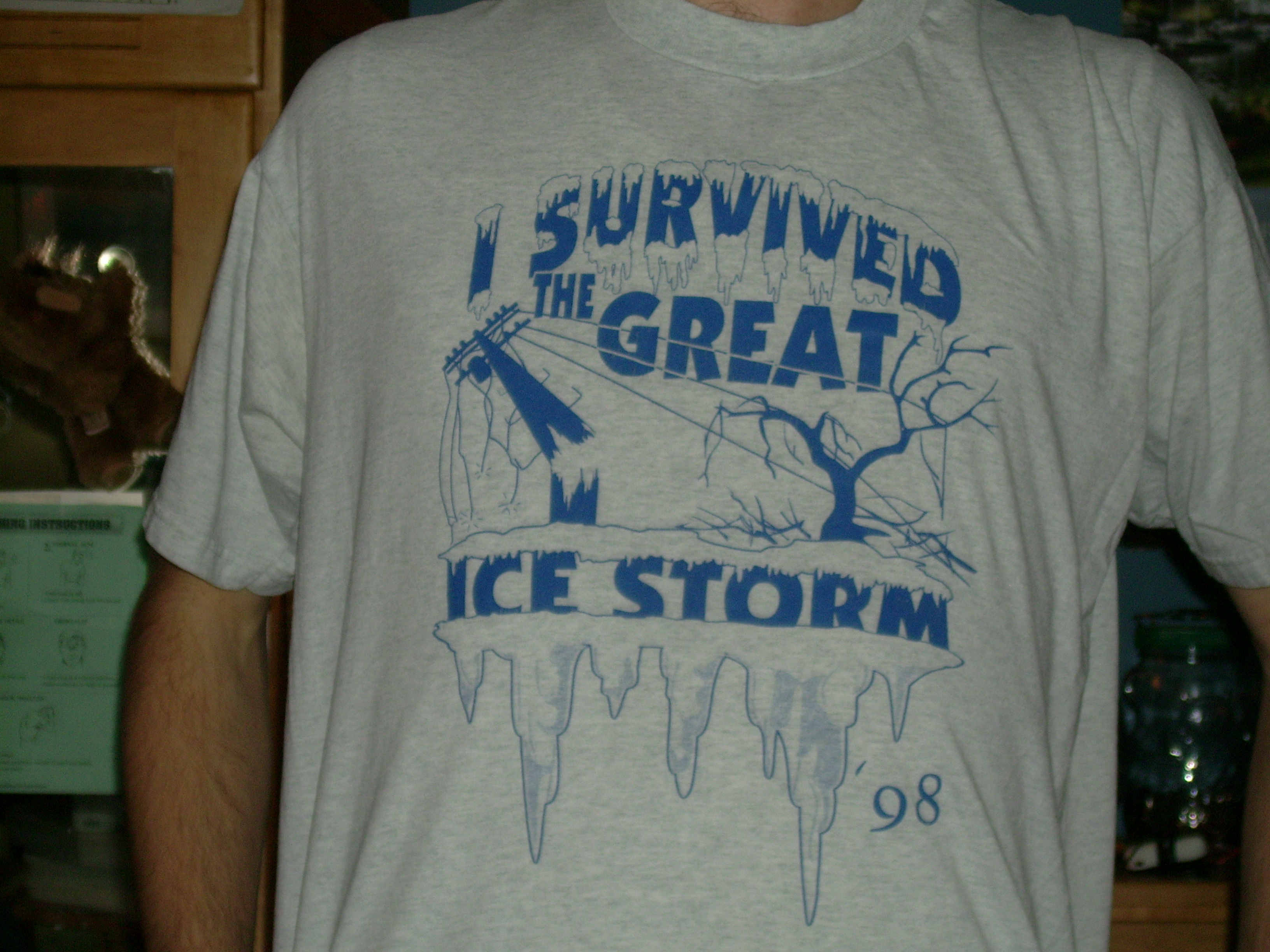
January 1998 North American Ice Storm
For eighty straight hours, the sky did not stop weeping. Between January 5 and January 10, 1998, freezing rain fell without relent across a narrow swath of land stretching from eastern Ontario through southern Quebec and into northern New England. What began as a routine winter weather pattern became five successive ice storms that merged into a single catastrophe, coating everything -- every power line, every tree limb, every rooftop -- in a glassy armor of ice twice as thick as anything the region had endured in living memory. By the time the rain finally stopped and temperatures plunged, more than four million people sat in the dark, and the landscape looked as though it had been dipped in crystal and then shattered.
A Storm That Wouldn't Leave
Freezing rain is no stranger to eastern Canada and New England. Cold arctic air spilling south meets warm, moist air pushing north along the Mississippi Valley, and where those masses collide, rain freezes on contact with the ground. Normally these events last a few hours and leave a thin glaze that road crews quickly treat. But in early January 1998, an unusually strong Bermuda high pressure system anchored itself over the Atlantic and refused to budge. The atmospheric pattern that typically sweeps weather systems eastward stalled completely, trapping a corridor from Ottawa and Kingston through Montreal and into Maine under a relentless conveyor belt of moisture. The last major ice storm to hit Montreal, in 1961, had deposited a significant layer of ice. The 1998 storm left deposits twice as thick. Over eighty hours of continuous freezing rain transformed a familiar winter nuisance into a once-in-a-generation disaster.
The Triangle of Darkness
The scale of destruction was staggering. More than 1,000 steel transmission towers collapsed in chain reactions, toppling like dominoes under loads they were never designed to bear. Another 35,000 wooden utility poles snapped or buckled. Over four million people lost electricity, most in southern Quebec, western New Brunswick, and eastern Ontario. Some would not see their lights come back on for an entire month. The area south of Montreal -- the Monteregie region bounded by Saint-Hyacinthe, Granby, and Saint-Jean-sur-Richelieu -- earned a grim nickname from the French-language media: the triangle noir, the Triangle of Darkness, where electricity vanished completely for weeks. Bridges and tunnels linking Montreal to the South Shore closed under fears of structural overload and falling ice. Large sections of Old Montreal and the downtown core were cordoned off by police as massive sheets of ice slid from rooftops, endangering anyone below.
Locomotives and Soldiers
On January 7, the provinces of Ontario, Quebec, and New Brunswick requested military aid, and Operation Recuperation began the following day. More than 15,000 Canadian Forces personnel deployed across the affected region -- the largest domestic military mobilization since the Korean War. Soldiers cleared roads choked with fallen trees and downed power lines, operated shelters, and checked on isolated rural residents. Meanwhile, ingenuity filled the gaps. CN Rail locomotives CN3502 and CN3555 were pulled off the tracks and repurposed as mobile power generators, providing electricity to residents of Boucherville and Coteau-du-Lac south and west of Montreal. Utility crews arrived from as far away as Prince Edward Island, Nova Scotia, and North Carolina to help rebuild what amounted to an entirely new electrical grid. In Maine, roughly 700,000 of the state's 1.2 million residents lost power, the Maine National Guard mobilized, and the storm became the deadliest natural disaster in the state's history, claiming eight lives.
A Landscape Transformed
The ice did not discriminate. Millions of trees collapsed under its weight across the affected region, snapping century-old maples and splintering orchards. Quebec's maple sugar industry -- the largest in the world -- was devastated as countless sugar maples shattered or lost their crowns. Farmers faced their own emergencies: without electricity, barns had no ventilation or running water, and many livestock perished. Some barns collapsed entirely under the ice, killing the animals trapped inside. The human toll reached 34 fatalities across the affected area. Many deaths came not from the ice itself but from its aftermath -- hypothermia in unheated homes and carbon monoxide poisoning from generators and improvised heating as people desperately tried to stay warm in the brutal cold that followed the storm.
The Long Thaw
Three weeks after the last freezing rain fell, 150,000 people in Quebec alone still had no electricity. The damage was so extensive that Hydro-Quebec and other utilities could not simply repair their systems -- they had to rebuild them from the ground up. Material damage reached an estimated $2 billion Canadian in Quebec alone, with total costs across all affected areas estimated at $4 to $6 billion US. The 1998 ice storm reshaped how Canada thinks about infrastructure resilience and emergency preparedness. It prompted sweeping upgrades to the electrical grid, changes in how transmission towers are engineered, and a fundamental rethinking of emergency response coordination between civilian authorities and the military. Today, the Triangle of Darkness is lit again, but for the millions who lived through those dark January weeks, the memory of a world encased in ice remains vivid.
From the Air
Centered near 45.11N, 73.67W in the Monteregie region south of Montreal. The affected corridor stretches roughly from Ottawa (CYOW) northeast through Montreal (CYUL) to the Quebec-Maine border. From cruising altitude, the flat agricultural lands of the St. Lawrence lowlands and the Richelieu River valley define the geography. Nearby airports include Montreal-Trudeau (CYUL), Ottawa-Macdonald-Cartier (CYOW), and Plattsburgh (KPBG) across the border.