Japan Mint: Where a Nation Forged Its Modern Identity in Metal
Every coin in your pocket, if you are in Japan, began here. Or rather, it began with the idea that took physical form here on April 4, 1871, when the inaugural ceremony of the Imperial Japanese Mint was held in Kawasaki, Osaka, and the actual work of stamping metal into money commenced. The urgency was real. Throughout the Tokugawa period, Japan's currency had been a bewildering tangle of regional coins, clan-issued notes, and competing standards that made commerce across domains an exercise in frustration. The Meiji government, barely three years old and racing to modernize a nation that had been sealed from the world for two and a half centuries, understood that a country needs a single currency before it can function as a single country. The Osaka Mint was their answer -- not just a factory, but a declaration of sovereignty stamped in copper, silver, and gold.
Building Money from Scratch
The Meiji government had a problem before the Mint could even open: Japan did not yet know how to print its own modern paper currency. In the early Meiji era, banknotes were printed by Dondorf and Naumann in Germany, shipped across the world, then inspected and sealed by the Banknote Annex Office of the Ministry of Finance. It was an embarrassing dependency for a government asserting national independence. In May 1874, a proposal to build a domestic banknote manufacturing plant was submitted to the Grand Council of State, and construction was approved that December. By October 1876, a two-story Western-style red brick building stood ready -- one of the first European-inspired structures in Japan, a physical emblem of the country's headlong sprint into modernity. The Mint itself, however, focused on coinage, and that division of labor persists to this day: the Japan Mint produces coins, while the National Printing Bureau handles paper money.
More Than Money
Over its century and a half of operation, the Mint's mission has expanded far beyond stamping yen. The facility produces Japanese orders and decorations -- the medals that recognize military service, civic contribution, and cultural achievement. It manufactures medals of honor and metallic art objects. It conducts analysis and testing of metal ores and minerals, serving as a national authority on metallurgy. And it provides fineness certification for precious metal wares, the hallmarking that guarantees the purity of gold and silver objects sold in Japan. The Mint became an Incorporated Administrative Agency on April 1, 2003, shifting from direct government control to a more autonomous administrative structure while maintaining its core functions. Today, the Osaka headquarters coordinates operations with branches in Saitama and Hiroshima, each with its own layered history.
The Branch That Survived the Bomb
The Hiroshima branch carries the heaviest history. It was established in 1942 with a specific wartime purpose: minting coins for Southeast Asian countries under Japanese occupation. Production began in February 1945. Months later, on August 6, the atomic bombing of Hiroshima obliterated the city around it. The minting operations stopped. But in 1946, barely a year after the bombing, operations resumed at the same address. By 1948, the Hiroshima branch had rebuilt its capacity to manage the entire coinage process from raw metal to finished coin. The survival and resurrection of the branch mirrors Hiroshima's own story -- a city that refused to remain a ruin. Meanwhile, the Saitama branch traces a quieter arc: established in 1879 in the Ministry of Finance building in Tokyo to accept gold and silver for coinage, it was abolished in 1907, reestablished in 1929 in Kojimachi-ku to focus on precious metal certification, relocated to Toshima-ku in 1939, and finally moved to its current address in Saitama in 2016.
Cherry Blossoms Along the Riverside
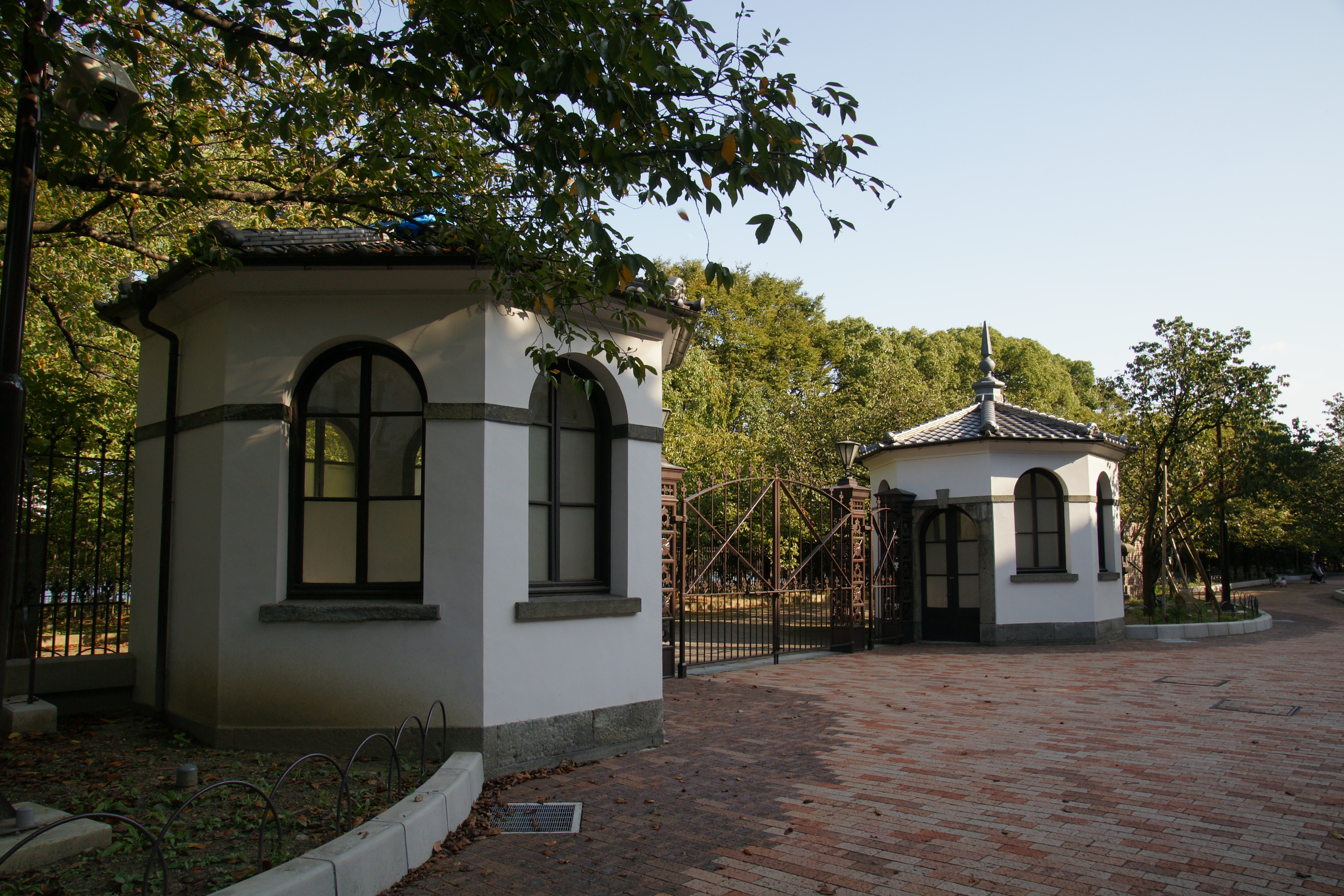
The Osaka headquarters sits along the Okawa River, and every spring, the Mint opens its grounds for one of Osaka's most beloved seasonal events. The walkway through the compound is lined with over a hundred varieties of cherry trees, many of them rare cultivars found nowhere else in the city. During the annual Sakura no Torinuke -- the cherry blossom passage -- hundreds of thousands of visitors walk beneath the canopy of blossoms on a path that runs through the Mint's campus. The preserved facade of the original 1871 Mint building still stands, a Western red-brick frontispiece that looks almost out of place amid the cherry trees and modern Osaka skyline. It is a reminder that this institution was born in a moment of radical reinvention, when Japan was building not just a mint but a modern nation, one coin at a time.
From the Air
Located at 34.697N, 135.521E along the north bank of the Okawa River in Osaka's Kita-ku area. The Mint campus is a long, narrow compound running east-west along the river, identifiable from the air by its riverside position and the tree-lined walkway that becomes famous during cherry blossom season. Osaka International Airport at Itami (RJOO) is approximately 8 nautical miles to the northwest. Kansai International Airport (RJBB) is approximately 27 nautical miles to the south-southwest. The site is near the junction of the Okawa River and the main Yodo River system, a useful visual reference from altitude. Osaka Castle, a prominent landmark, is approximately 1 kilometer to the east-southeast.