Japan National Stadium: The Stadium That Was Built Twice
One architect compared the original design to a turtle. Another called it a white elephant. A third said he was shocked to see the dynamism stripped from it. The Japan National Stadium in Tokyo's Shinjuku ward was supposed to be a soaring statement of futuristic ambition -- a Zaha Hadid creation with sweeping arches and a retractable roof. Instead, after years of controversy, ballooning budgets, and the personal intervention of Prime Minister Shinzo Abe, the entire plan was thrown out. What rose in its place was something quieter and more deeply Japanese: a 68,000-seat arena wrapped in timber harvested from all 47 prefectures, designed by Kengo Kuma to breathe with the wind rather than fight it. The stadium that nearly tore Japan's architectural establishment apart became the centerpiece of the most unusual Olympics ever held.
A Design War Among Giants
The trouble started in November 2012, when British-Iraqi architect Zaha Hadid unveiled her vision for the new National Stadium: a swooping, organic form with twin steel arches and a retractable roof. Hadid had designed the London Aquatics Centre for the 2012 Olympics, and her Tokyo proposal carried the same fluid ambition. But Japan's architectural elite revolted. Pritzker Prize laureate Toyo Ito compared the design to a turtle. Fellow laureate Fumihiko Maki called it a white elephant that would overwhelm the outer gardens of the nearby Meiji Shrine. The projected cost climbed past 300 billion yen -- more than three times what London's Olympic Stadium cost and more than five times Beijing's Bird's Nest. By mid-2015, public anger had reached a boiling point. On July 17, 2015, Abe scrapped the entire project and ordered a fresh start.
Wood from Every Corner of Japan
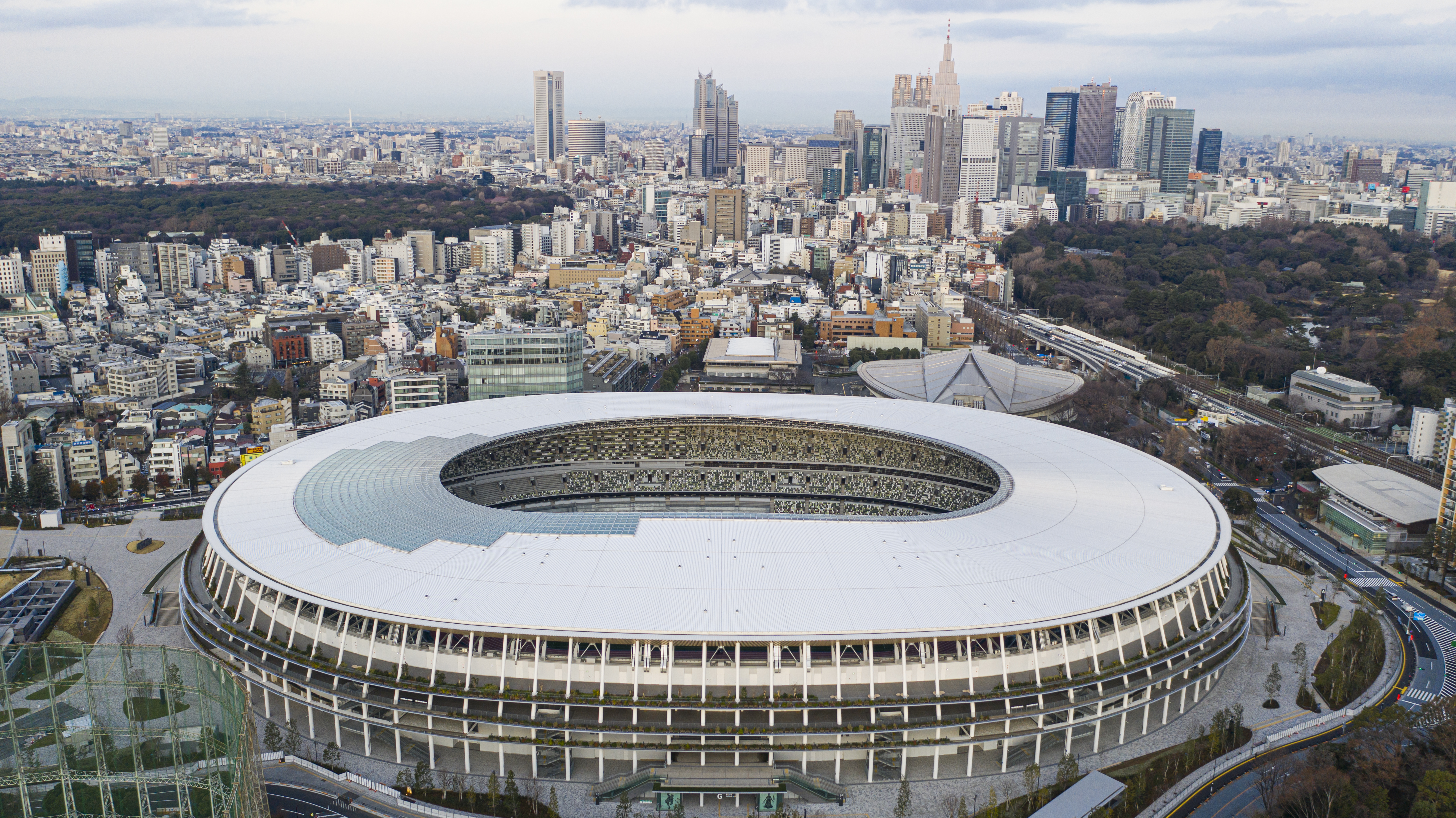
The winning redesign came from Kengo Kuma and Taisei Corporation, announced in December 2015. Where Hadid had proposed steel and spectacle, Kuma offered timber and restraint. The stadium's most striking feature is its lattice of exposed wooden beams and eaves, inspired by the ancient Horyuji temple -- the world's oldest surviving wooden structure. The certified wood was sourced from all 47 prefectures, following a tradition established by the Meiji Shrine itself, whose surrounding forest was planted with trees donated from across the nation. The layered eaves do more than look beautiful: they channel prevailing winds into the open-air bowl, creating natural ventilation that helps compensate for the absence of air conditioning, which was cut from the budget to reduce costs. Transparent solar panels line part of the roof, and underground cisterns collect rainwater to irrigate the playing surface and the plants along the top-floor promenade.
An Empty Ceremony
Construction began in December 2016 and concluded on schedule in November 2019. The inauguration ceremony took place on December 21, 2019, and the first sporting event -- the Emperor's Cup football final -- followed on January 1, 2020. The stadium was ready. Then the world changed. When the delayed 2020 Summer Olympics finally opened on July 23, 2021, the ceremony unfolded inside a stadium designed for 68,000 but holding almost no one. The COVID-19 pandemic forced all events behind closed doors. Drones formed the Olympic logo in the sky above, watched by a global television audience but not by fans in the seats below. The irony was sharp: the stadium built to showcase Japan to the world performed before an audience that existed only on screens.
Life After the Rings
With the Olympic flame extinguished, Japan faced the question every host city confronts: what to do with the stadium. The original plan called for removing the athletics track to boost capacity for football and rugby. In October 2021, the government reversed course and kept the track, maintaining the hybrid design. The 2025 World Athletics Championships marked the stadium's first major spectator event for track and field -- the sport it was built for, finally enjoyed by a live crowd. Football has filled the calendar too: the J. League's 30th anniversary in May 2023 brought FC Tokyo and Kashima Antlers matches to the venue. In April 2025, operating rights were franchised, and financial group MUFG moved to acquire naming rights beginning in 2026. The stadium that was nearly never built has become a permanent fixture of Tokyo's sporting landscape.
From the Air
Located at 35.678N, 139.715E in Shinjuku ward, adjacent to the outer gardens of Meiji Shrine. The oval stadium and its distinctive layered timber eaves are visible from 3,000-5,000 feet AGL. The green expanse of Meiji Jingu Gaien and Shinjuku Gyoen National Garden provide useful visual references nearby. Tokyo Haneda International Airport (RJTT) lies approximately 10 nautical miles to the south. Narita International Airport (RJAA) is approximately 35 nautical miles to the east-northeast.