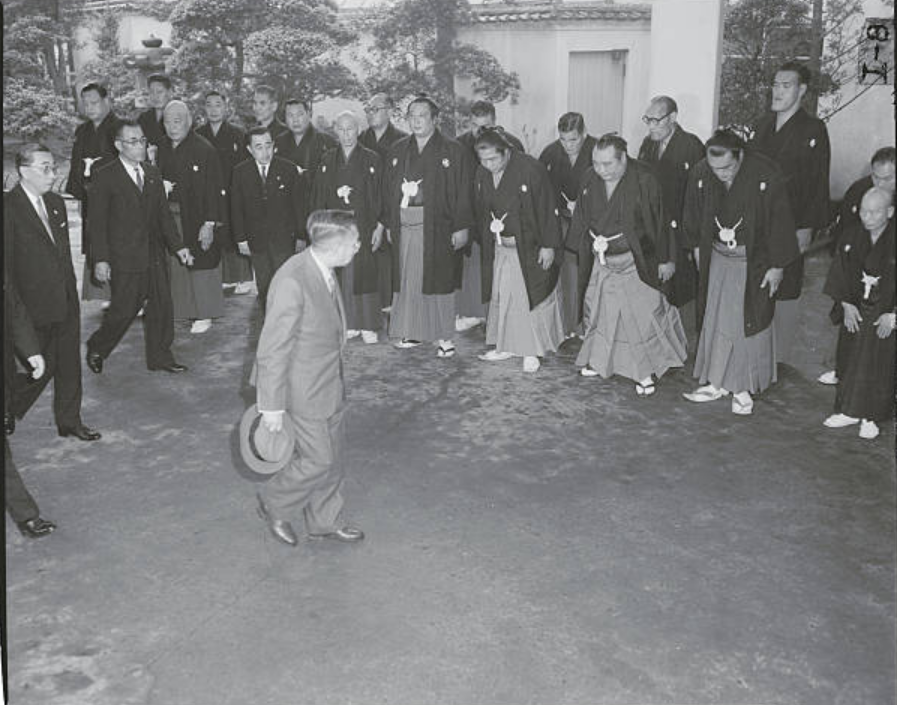
The Japan Sumo Association: Sacred Sport, Street Brawl Origins
In 1648, the authorities of Edo issued a ban on street sumo. The brawls had become too violent -- wrestlers fighting for coins, samurai who had lost their social standing mixing with commoners in contests of strength, and disputes over money sometimes ending in death. For the next two decades, the wrestlers petitioned to lift the ban, forming informal coalitions to protect their livelihoods. In 1684, a wrestler finally obtained permission to hold a tournament by proposing a new etiquette for the sport. From that moment of reinvention -- street fighting repackaged as ceremony -- professional sumo began its transformation into a national institution. Today, the Japan Sumo Association governs the sport from the Ryogoku Kokugikan arena in Sumida, Tokyo, where retired wrestlers manage an organization whose roots reach back to Shinto harvest rituals held in ancient Japan.
Ronin and Ritual
Sumo's organizational history reflects Japan's feudal social turbulence. During the Sengoku period, Oda Nobunaga helped popularize the sport as cities like Edo, Osaka, and Nagoya emerged to challenge Kyoto's cultural monopoly. Under the Tokugawa shogunate's peace, displaced masterless samurai -- ronin -- split into two worlds. Some powerful clans assembled suites of wrestlers into royal households, elevating them to vassals. Others had no choice but to fight in street tournaments for entertainment money. Wrestling groups toured with support from shrines that recruited them for religious festivities and fundraising for temple construction. This volatile mix of professional wrestlers, disgraced samurai, and commoners created the conflicts that led to the 1648 ban. When tournaments were eventually permitted again, they depended on retired wrestlers who organized bouts according to new standards of etiquette satisfying municipal authorities.
Two Rivals Become One
For most of sumo's formal history, rival associations in Tokyo and Osaka competed for dominance. The Tokyo-based association was organized around a duo of executives who controlled tournament profits, filtering money through layers of elders before scraps reached lower-ranked wrestlers. In 1757, during the Horeki era, the foundations of the modern associations were formally established. A turning point came in April 1925, when Prince-Regent Hirohito invited the Tokyo Sumo Association to hold a tournament at the Imperial Palace, with the implied aim of also featuring Osaka wrestlers. During that tournament, the Emperor's Cup was awarded for the first time. Qualifying tournaments followed, and in January 1927, the Osaka association officially merged with the All Japan Sumo Association. The merged body was recognized as a nonprofit organization under the Ministry of Education. In 1958, it took its definitive name: the Japan Sumo Association.
Scandals, Strikes, and Survival
The association's history is punctuated by crises that would have destroyed a less resilient institution. The 1932 Shunjuen Incident saw a mass resignation of wrestlers demanding fundamental reform. From 1933 to 1937, a secessionist association threatened to split the sport permanently. After World War II, the association convinced American occupation forces that sumo tournaments were not disguised martial-arts training, and the first postwar tournament was held in November 1945. In more recent decades, the 2007 hazing scandal and 2008 cannabis scandal forced the resignation of chairman Kitanoumi. Gambling links to organized crime emerged in 2010, with the Ministry of Education threatening to dissolve the association and confiscate the Kokugikan. A match-fixing scandal followed. Through each crisis, the association reformed just enough to survive -- opening its board to external auditors for the first time in 63 years, transitioning to a Public Interest Incorporated Foundation in 2014, and banning organized crime members from all sumo venues.
The Elder Stock System
The association's internal power structure revolves around 105 elder stocks -- shares that grant retired wrestlers the right to participate in management. Only former wrestlers who reached at least the sekitori rank and hold Japanese citizenship may inherit these shares. Before the 2014 transition, elder stocks traded on a speculative market at prices of 100 to 400 million yen, effectively locking out many retired wrestlers. Today, the shares are technically no longer purchasable, though the monetization of their inheritance appears to be tolerated. The most dominant yokozuna have been offered lifetime elder stocks, allowing them to remain in the association under their ring name. This honor was extended to Taiho, Kitanoumi, and Takanohana, while Chiyonofuji declined it in favor of a normal share. When record-holder Hakuho retired in 2021, the lifetime stock was denied, with officials declaring that no such system exists under the new foundation statutes.
Chickens and Cherry Blossoms
For all its gravity, the association has a lighter side. Its official logo, created in 1909 for the opening of the first Ryogoku Kokugikan, features a cherry blossom encircled by stylized characters for 'great.' In 2009, it unveiled chicken mascots to attract young fans -- chickens being considered good luck in sumo because, like wrestlers, they walk on two legs. The association launched a YouTube channel in 2018 and an English-language channel called Sumo Prime Time in 2022. The early 2020s brought a popularity boom driven by growing international interest and the rise of female fans known as sujo, who share their enthusiasm on social media. The COVID-19 pandemic forced the March 2020 Osaka tournament behind closed doors -- the first time since 1945 -- and created a record 6.3 billion yen deficit in 2021. By March 2024, finances had recovered to a 300 million yen surplus. The ancient sport, born from harvest prayers and street fights, continues to reinvent itself.
From the Air
Located at 35.697N, 139.793E in Sumida, Tokyo. The Ryogoku Kokugikan arena, headquarters of the Japan Sumo Association, is visible from altitude as a distinctive green-roofed structure adjacent to the Sumida River in eastern Tokyo. The arena sits near Ryogoku Station and the Edo-Tokyo Museum. Best viewed at 2,000-4,000 feet AGL. Tokyo Haneda International Airport (RJTT) is approximately 10 nautical miles south-southwest. The Sumida River's curve through this district provides a useful visual reference from the air.