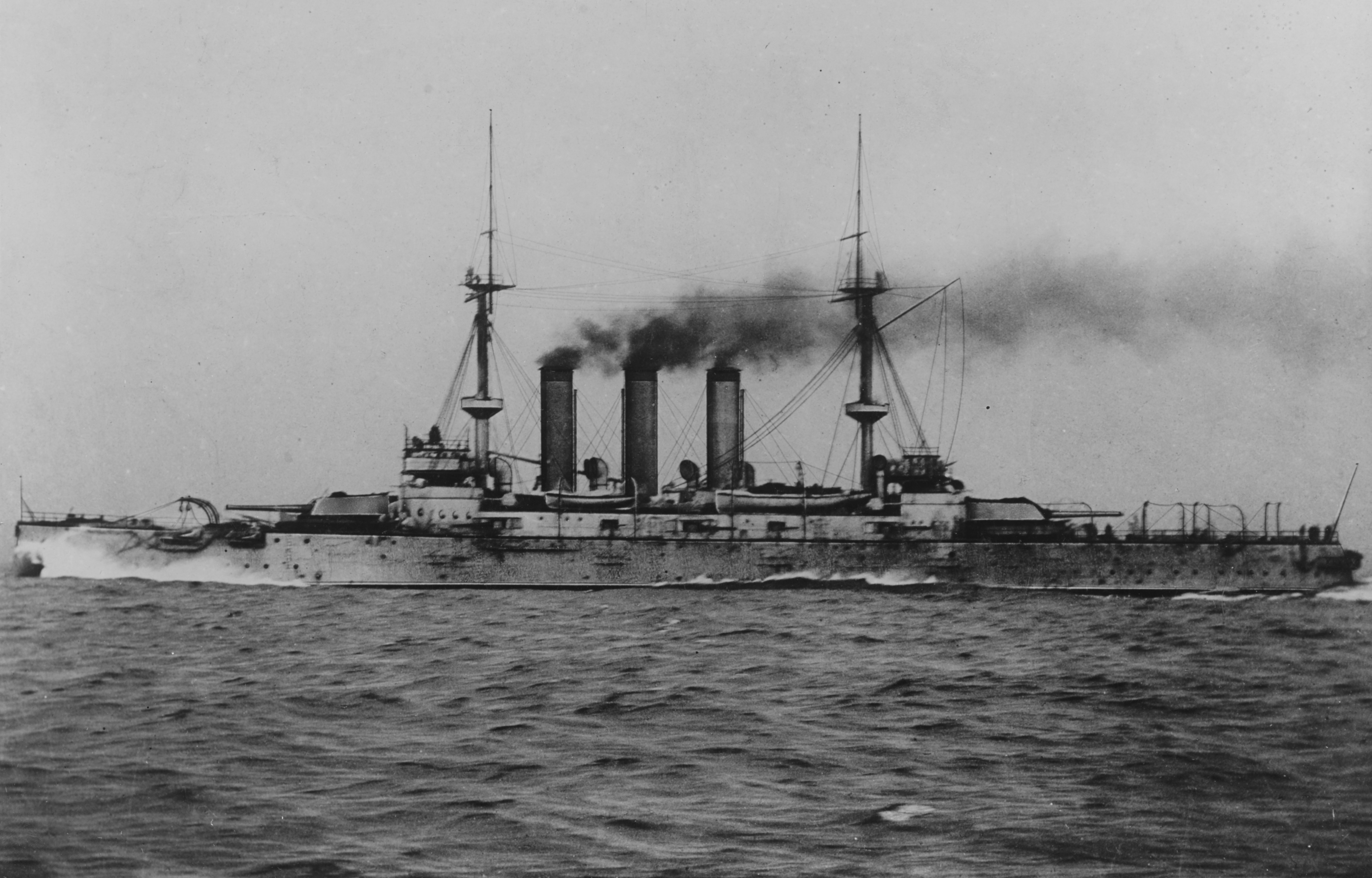
Japanese Battleship Hatsuse
On 2 February 1901, the Japanese battleship Hatsuse represented the Meiji Emperor at Queen Victoria's funeral in Britain. She was brand new, completed just two weeks earlier at the Armstrong Whitworth yard in Elswick -- 14,312 tons of British steel paid for with money extracted from China after the First Sino-Japanese War. Three years later, she would be at the bottom of the Yellow Sea, torn apart by Russian mines, with 496 of her crew dead. Between the funeral and the mines, Hatsuse lived the compressed, violent life of a warship in an age when empires were still learning what modern naval war actually meant.
Built with Chinese Money
Hatsuse was ordered as part of Japan's ten-year Naval Expansion Programme, funded by the 30 million pounds China had been forced to pay as indemnity after losing the war of 1894-1895. Japan lacked the shipyards to build battleships of this size, so the contract went to Armstrong Whitworth, the same British firm that was simultaneously selling warships to China, Argentina, Chile, and half a dozen other navies. Hatsuse was a Shikishima-class ship, an improved version of the Royal Navy's Majestic class, carrying four 12-inch guns in twin turrets fore and aft. Her Harvey armor belt was up to 14 inches thick at the waterline. Her crew of 849 included the staff of Rear Admiral Nashiba Tokioki, who would fly his flag from her bridge.
Opening Shots at Port Arthur
When the Russo-Japanese War began in February 1904, Hatsuse was assigned to the 1st Division of the 1st Fleet. She participated in the Battle of Port Arthur on 9 February, when Admiral Togo Heihachiro led his fleet against Russian ships anchored outside the fortress. The engagement was a confused affair -- Togo split his fire between the coastal defenses and the ships, which diluted his effectiveness, and the Russians concentrated their return fire to good effect. Hatsuse was hit twice, losing seven killed and seventeen wounded. It was a modest introduction to combat, but the battle taught Japanese commanders that modern steel warships could absorb punishment that would have destroyed wooden ships of an earlier era.
The Lure That Killed Makarov
On 13 April, Hatsuse participated in one of the war's most consequential actions. Admiral Togo successfully lured a portion of the Russian Pacific Squadron out of Port Arthur, including Vice Admiral Stepan Makarov's flagship, the battleship Petropavlovsk. When Makarov spotted the five Japanese battleships of the 1st Division bearing down on him, he turned back for the harbor -- and Petropavlovsk struck a minefield the Japanese had laid the previous night. The Russian battleship's magazine exploded, and she sank in less than two minutes, killing Makarov and 676 others. The death of Russia's most capable naval commander was a strategic blow from which the Pacific Squadron never recovered. Emboldened, Togo resumed long-range bombardment missions, which prompted the Russians to plant more mines of their own.
Two Mines, Ninety Minutes
Those Russian mines would exact their revenge on 15 May 1904. Hatsuse put to sea with a squadron to relieve the blockading force off Port Arthur and encountered a minefield laid by the Russian minelayer Amur. At 10:50, Hatsuse struck a mine that disabled her steering. The battleship Yashima, moving to assist, struck another mine. Then, at 12:33, Hatsuse drifted onto a second mine. This time, the explosion detonated one of her magazines. The blast was catastrophic -- 496 of her crew died, and the ship sank almost immediately. Less than ninety minutes separated the first mine strike from the final plunge. Yashima, also fatally damaged, capsized later that day while under tow. In a single morning, Japan lost two of its six battleships -- a disaster the navy managed to keep secret from the Russians for more than a year.
Lessons Paid in Lives
Hatsuse's destruction taught the world's navies a lesson they would relearn repeatedly over the following century: mines are the great equalizer. The Russian minelayer Amur, a modest vessel with none of the firepower or armor of the ships she destroyed, had achieved what an entire fleet of Russian battleships had failed to do -- sinking a Japanese capital ship. The loss forced Japan to conduct the rest of the war with a dangerously reduced battle line, a handicap that shaped tactics at the decisive Battle of Tsushima a year later. Named for an ancient place in Nara Prefecture where the Hase-dera temple stands beside the Hatsuse River, this battleship carried a name that evoked deep time and continuity. Her career lasted barely three years. The mines did not care about names.
From the Air
The sinking site is located at approximately 38.62N, 121.33E in the Yellow Sea, off the Liaodong Peninsula near Port Arthur (modern Lushunkou). Open water with no visible landmarks at the wreck site. Nearest airport: Dalian Zhoushuizi International Airport (ZYTL), approximately 30 km east-northeast. Best observed from altitude as part of the broader Port Arthur approach, with the Liaodong Peninsula visible to the north.