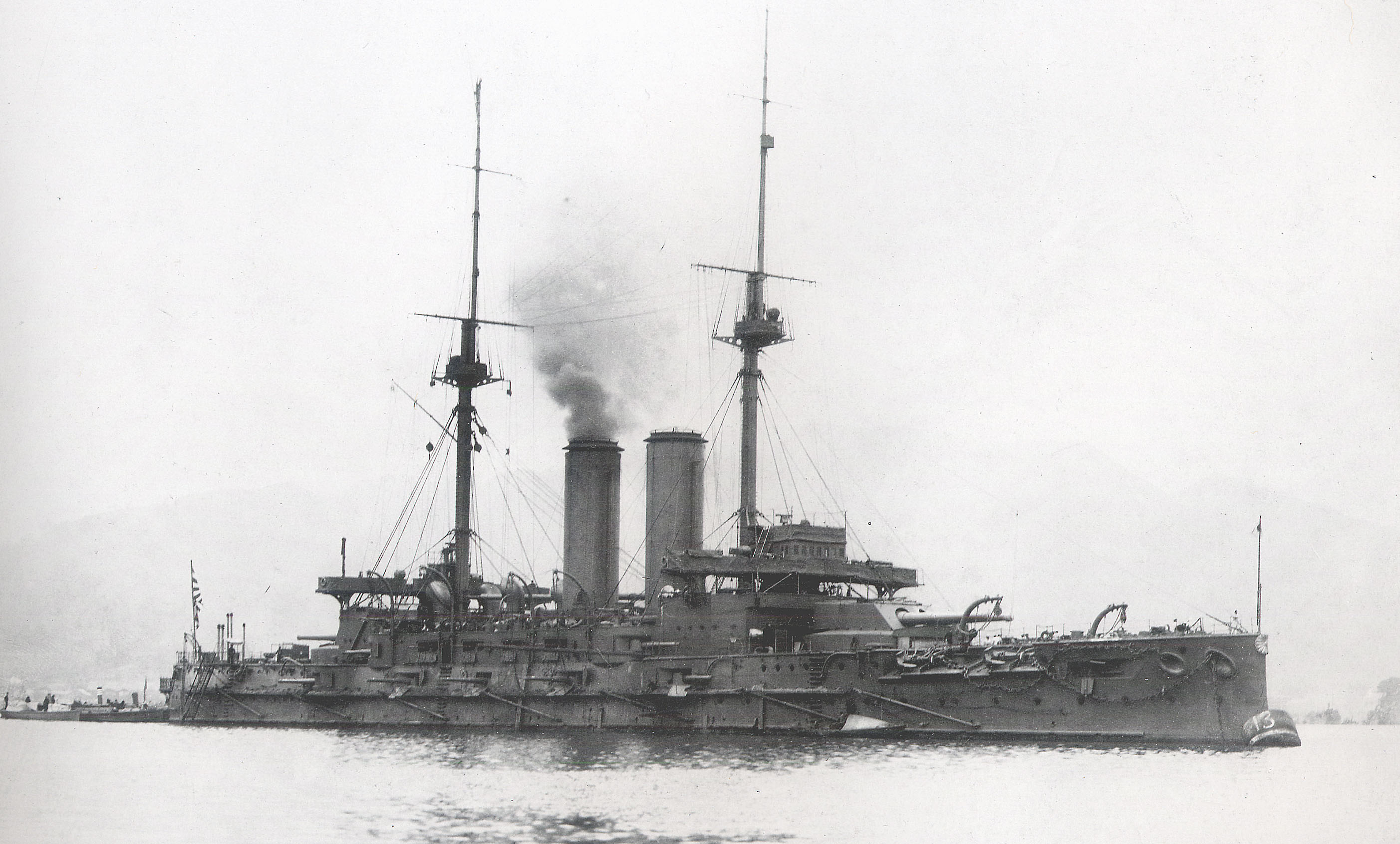
Japanese Battleship Mikasa
Before she became a museum, before she was a nightclub, before the atomic tests and the occupation, Mikasa was the most important warship in Asia. On May 27, 1905, Admiral Togo Heihachiro stood on her compass deck as the Z flag climbed the halyard -- his signal that the fate of the empire hung on this battle. What followed at Tsushima was the most decisive naval engagement since Trafalgar, and the ship that led the Japanese line through it all still sits in Yokosuka, encased in concrete up to her waterline, the last pre-dreadnought battleship left on earth.
Built in England, Bound for War
Japan could not yet build its own battleships in the 1890s. After the First Sino-Japanese War of 1894-1895, the Imperial Japanese Navy used its share of the 30 million pound indemnity from China to fund an ambitious ten-year program: six battleships and six armored cruisers, all ordered from foreign shipyards. Mikasa, the last and most advanced of the six battleships, was laid down by Vickers at Barrow-in-Furness on January 24, 1899. Baroness Hayashi, wife of the Japanese minister to Britain, launched the hull on November 8, 1900. Completed on March 1, 1902, Mikasa carried four 12-inch guns in twin turrets, fourteen 6-inch quick-firing guns in casemates, and a crew of about 830. She left Plymouth on March 13, 1902, bound for Yokohama and the war that everyone in Tokyo knew was coming.
Trial by Fire at Port Arthur
The Russo-Japanese War began on February 9, 1904, and Mikasa was in the thick of it from the first day. As flagship of the 1st Fleet under Admiral Togo, she led the attack on Russian ships anchored outside Port Arthur. Togo split his fire between coastal defenses and the Russian fleet -- a decision he later regretted, as his secondary guns inflicted little damage while Russian shells found Japanese hulls with disturbing regularity. Mikasa took two 10-inch hits that wounded seven crewmen. In April, Togo lured Russian Vice Admiral Stepan Makarov's flagship Petropavlovsk over a Japanese minefield; the battleship sank in under two minutes, killing 677 men including Makarov. At the Battle of the Yellow Sea on August 10, Mikasa led the column and drew concentrated Russian fire: twenty hits, her aft 12-inch turret knocked out, 125 casualties among her crew. She absorbed punishment and kept fighting.
Twenty-Seven Minutes that Changed Asia
Tsushima was the battle that made Mikasa immortal. On May 27, 1905, the Russian Second and Third Pacific Squadrons -- having sailed 18,000 miles from the Baltic -- met Togo's fleet in the strait between Japan and Korea. Mikasa opened fire on the Russian flagship Knyaz Suvorov at 14:10. Within an hour, Japanese shells had started fires aboard the Russian ship, wounded fleet commander Vice Admiral Zinovy Rozhestvensky, knocked out a turret, and jammed her steering. Togo crossed the T of the Russian formation, the textbook maneuver that allows one fleet to concentrate broadside fire on an enemy that can only reply with forward guns. Mikasa was hit more than 40 times during the battle, including ten 12-inch shells, yet none caused serious damage. She fired 124 twelve-inch rounds, second only to Asahi's 142. The battle was a catastrophe for Russia: the Japanese sank or captured virtually the entire fleet. Mikasa suffered 113 casualties, but the entire Japanese force lost only 117 killed in the engagement.
Sunk by Peace, Saved by an Admiral
Six days after the Treaty of Portsmouth ended the war, Mikasa's magazine exploded at her moorings in Sasebo, killing 251 crewmen. She sank at dockside -- not from enemy action but from an accidental fire. Refloated in August 1906 and rebuilt over two years with upgraded 45-caliber guns, she returned to service in 1908, served coast-defense duty in World War I, and supported the Siberian Intervention in 1921. The Washington Naval Treaty of 1922 required her decommissioning, and she was preserved as a memorial, opened to the public in 1926 in the presence of Crown Prince Hirohito and the now-elderly Admiral Togo. After Japan's surrender in 1945, American occupation forces stripped her superstructure, planted a Quonset hut on her deck, and turned her into an aquarium and "Club Mikasa" -- a nightclub for GIs.
Resurrection in Concrete
The restoration of Mikasa became a cause that united former enemies. Fleet Admiral Chester W. Nimitz, the man who had commanded the U.S. Pacific Fleet against Japan, championed the effort to save the ship. When restoration began in the 1950s, much of her original superstructure had been carted away. Workers sourced replacement parts from the decommissioned Chilean battleship Almirante Latorre and possibly the Argentine battleship ARA Moreno, both British-built dreadnoughts whose steel could pass for the original Vickers craftsmanship. The restored Mikasa reopened in 1961, set in concrete at Mikasa Park in Yokosuka. Her guns and turrets are replicas, but the hull is original -- the last pre-dreadnought battleship surviving anywhere in the world, and the last remaining example of a British-built battleship of any era. In Barrow-in-Furness, the English town where she was born, a street on Walney Island still bears her name.
From the Air
Located at 35.29N, 139.67E at Mikasa Park in Yokosuka, on the western shore of Tokyo Bay at the base of the Miura Peninsula. The ship is set in concrete and visible from low altitude as a distinctive warship shape in a waterfront park. Yokosuka's extensive naval facilities (both JMSDF and U.S. Navy) are immediately adjacent to the south. Nearest airports include Tokyo Haneda (RJTT) approximately 25nm north and Naval Air Facility Atsugi (RJTA) approximately 15nm west. The Uraga Channel, Tokyo Bay's main shipping lane, passes just to the east.