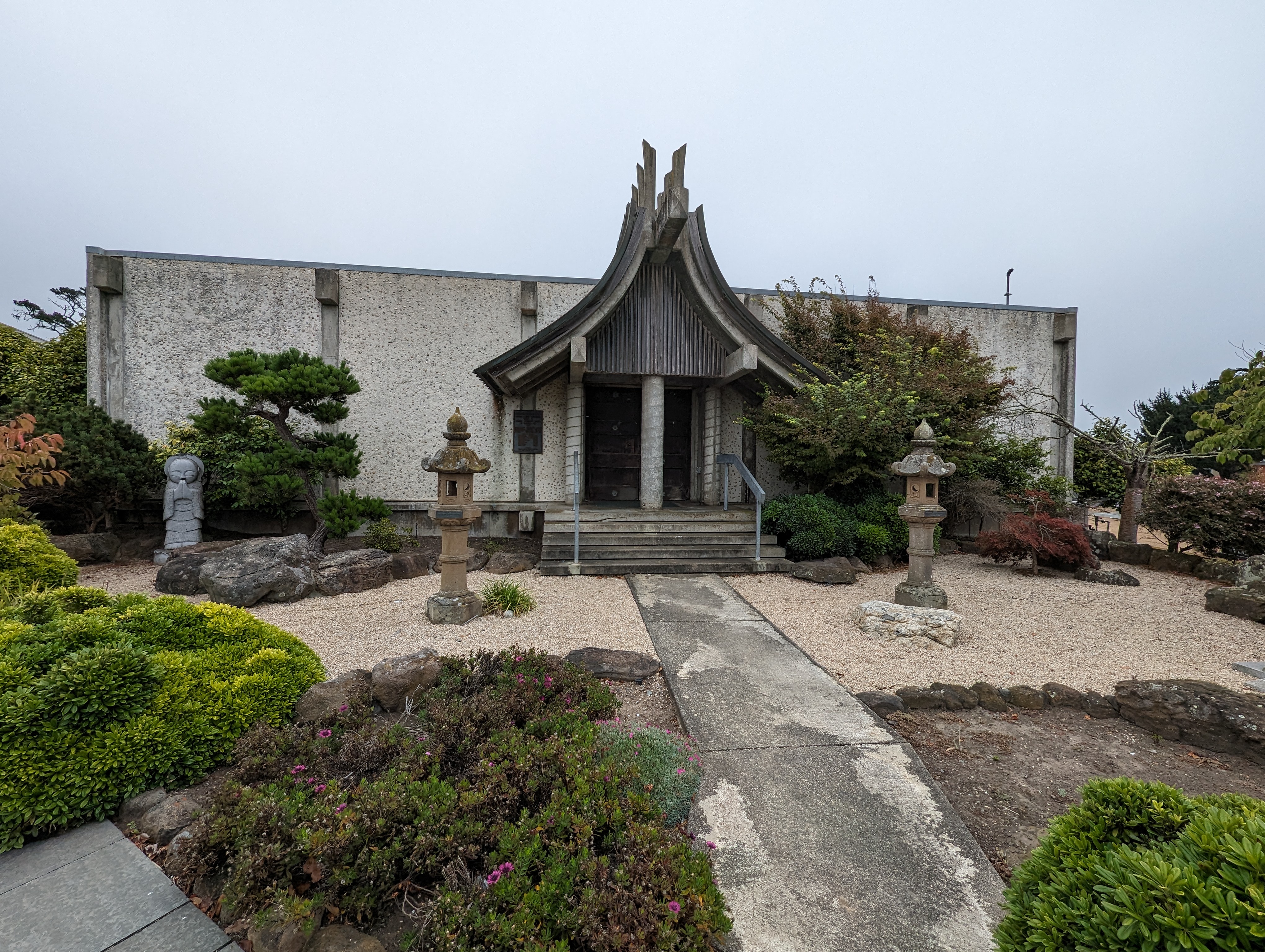
Japanese Cemetery (Colma, California)
The oldest graves at the Japanese Cemetery in Colma predate the cemetery itself by four decades. Three sailors from the warship Kanrin Maru, who died during Japan's first diplomatic mission to the United States in 1860, were originally buried at San Francisco's Marine Hospital Cemetery. When that cemetery closed in 1870, they were moved to Laurel Hill Cemetery, and in 1926 they were moved again to this hillside on the peninsula. Their journey mirrors the journey of every body interred here: displaced, relocated, but ultimately gathered into a community that refused to let its dead be forgotten.
When San Francisco Banished Its Dead
At the turn of the twentieth century, most Japanese residents of San Francisco were buried in either the Masonic Cemetery or Laurel Hill Cemetery in the Lone Mountain neighborhood. But the city was running out of room for the living, let alone the dead. In 1901, San Francisco passed a law forbidding all new burials within city limits, forcing every community to find ground elsewhere. For the Japanese community, that ground was a plot at 1300 Hillside Boulevard in Colma, a town that would eventually hold more dead than living residents. On March 17, 1903, Jodo Shinshu cleric Rev. Nishijima Kakyuro officiated the opening ceremony. The cemetery became a rare unifying space for a community divided by religion, serving Buddhist, Shinto, and Christian families alike.
Pioneers Beneath the Headstones
The names on the markers read like a roster of Japanese American firsts. George Shima, buried here after his death in 1926, was known as the Potato King, the first Japanese American millionaire, who built an agricultural empire in the Sacramento-San Joaquin Delta despite laws designed to prevent Japanese immigrants from owning land. Makoto Hagiwara, who died in 1925, was the landscape designer who transformed a temporary World's Fair exhibit into Golden Gate Park's permanent Japanese Tea Garden, tending it for three decades. Kyutaro Abiko, who lived from 1865 to 1936, founded the Nichi Bei Times and worked to establish Japanese farming colonies in California's Central Valley. Keisaburo Koda, founder of Koda Farms, helped make California a rice-growing power. These were people who built livelihoods and institutions in a state that frequently tried to exclude them.
A Community's Anchor
What makes this cemetery remarkable is not just who lies here but what it represents. When anti-Japanese sentiment surged during World War II and families were sent to internment camps, the cemetery remained. When Japanese Americans returned from the camps to find their businesses seized and their neighborhoods changed, the cemetery was still there, a fixed point in a landscape of loss. The graves of the Kanrin Maru sailors, moved three times across six decades before finding this final resting place, embody the persistence of a community that kept honoring its own regardless of the obstacles. Today, walking the rows of headstones inscribed in both Japanese and English, you encounter more than a century of immigration, discrimination, resilience, and contribution, carved in stone on a quiet hillside just south of a city that once tried to push its dead, and its Japanese residents, out of sight.
From the Air
Located at 37.68°N, 122.46°W in Colma, California, on Hillside Boulevard. The cemetery sits on the eastern slopes of the coastal hills south of San Francisco. Nearest airport: SFO (KSFO, 3 nm southeast). Best viewed at 1,500-2,000 ft AGL. Colma's numerous cemeteries are visible as distinct green spaces amid the suburban landscape.