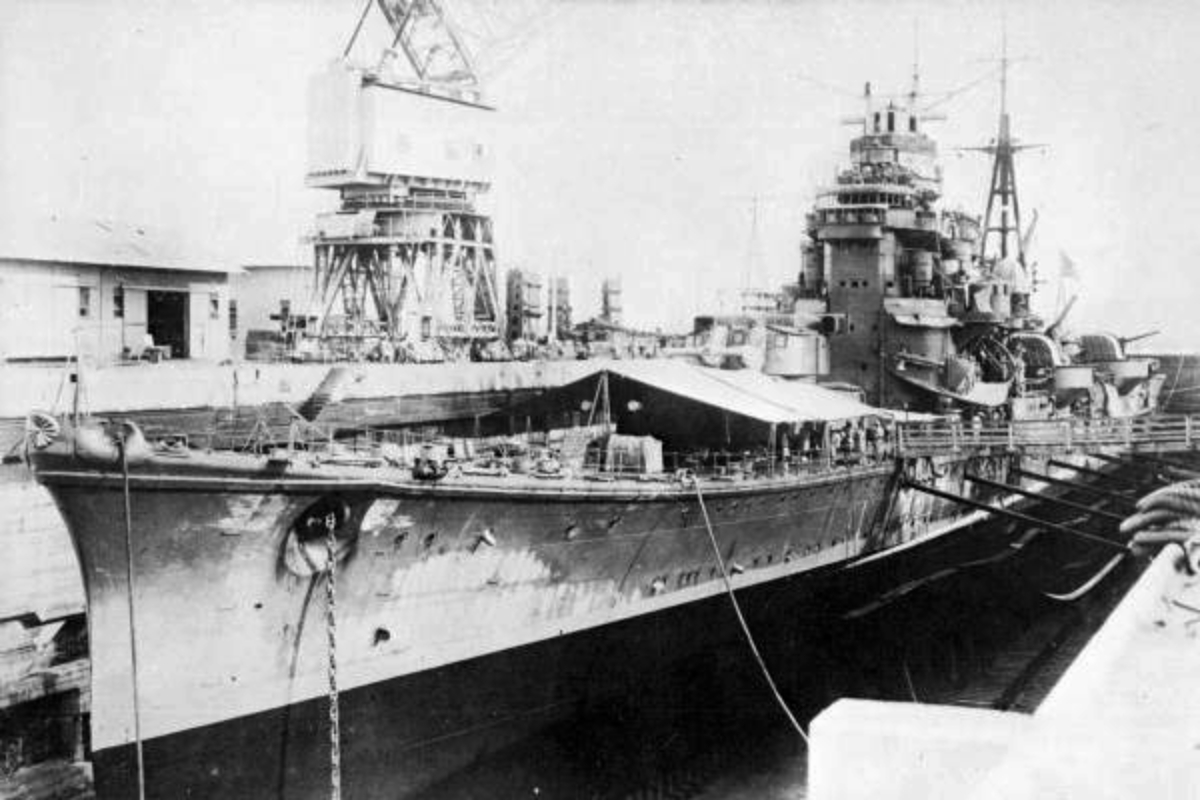
Japanese Cruiser Ashigara
In May 1937, a Japanese warship sailed into Portsmouth harbor for the coronation of King George VI. Her crew dined with the Royal Navy, then crossed to Kiel, where Adolf Hitler received her senior officers in Berlin. The ship was Ashigara, a heavy cruiser of the Imperial Japanese Navy, and within five years she would be hunting Allied warships through the same waters where she had once been a diplomatic guest. Eight years after that Portsmouth visit, she would lie on the bottom of the Bangka Strait, torpedoed by a Royal Navy submarine, with over 1,300 souls trapped inside her hull.
Built to the Limit
Ashigara was the last of four Myoko-class heavy cruisers, approved under Japan's 1922 Fleet Modernization Program to operate within the constraints of the Washington Naval Treaty. The treaty capped cruiser displacement at 10,000 tons, and naval architect Vice Admiral Yuzuru Hiraga fought to keep the design within bounds, repeatedly rejecting demands from the Imperial Japanese Navy General Staff to pile additional equipment onto the upper decks. His caution prevented the dangerous top-heaviness that plagued other warships of the era. But the discipline did not last. Through modifications and rebuildings during the 1930s, Ashigara's displacement ballooned to 15,933 tons -- well beyond what the treaty permitted. At 203.8 meters long with a top speed of 35.5 knots, she was a formidable instrument of war, if technically an illegal one.
From Diplomacy to Destruction
The 1937 European tour was Ashigara's most peculiar chapter. She departed Yokosuka on April 3, calling at Singapore, Aden, the Suez Canal, and Malta before reaching Portsmouth for the coronation naval review on May 20. From there she sailed to Kiel for German Kriegsmarine Day, where her presence celebrated the supposed German "victory" at the Battle of Jutland. The senior staff met Hitler on May 24. She returned to Japan via Gibraltar, Port Said, and Colombo -- a grand tour of an imperial world that would soon consume itself in war. When that war came, Ashigara was in the thick of it. During the aftermath of the Battle of the Java Sea on March 1, 1942, she joined her sister ships in hunting down the damaged British heavy cruiser HMS Exeter and her escorts, helping to sink a destroyer while her sisters finished off Exeter herself. She led the invasion of Christmas Island, served as flagship for the Second Southern Expeditionary Fleet, and spent much of 1942 racing between ports as a troop transport.
Surigao Strait and the Retreat
By October 1944, Ashigara was assigned to Vice Admiral Kiyohide Shima's force for the Battle of Leyte Gulf, the largest naval engagement in history. With Captain Hayao Miura in command, she entered Surigao Strait on October 25 behind Admiral Shoji Nishimura's First Raiding Force -- which had already been destroyed by Rear Admiral Jesse Oldendorf's fleet. Ashigara and her sister Nachi fired their torpedoes and retreated, Nachi limping away after a collision. Ashigara escaped to Palawan, then Brunei, then the Spratly Islands, her war becoming a series of withdrawals across a shrinking empire. In December, she joined a raiding force against the American beachhead at Mindoro in the Philippines. B-25 Mitchell bombers scored a direct hit with a 500-pound bomb, but Ashigara completed her mission, firing over 200 shells at American positions before returning to Cam Ranh Bay.
Trapped in the Strait
On June 7, 1945, Ashigara departed Batavia for Singapore carrying 1,600 troops, escorted by the destroyer Kamikaze. The American submarine Blueback spotted them and radioed their position but could not attack. Two Royal Navy submarines, Trenchant and Stygian, waited at the northern end of the Bangka Strait between Sumatra and Bangka Island. On the morning of June 8, Kamikaze and Trenchant exchanged fire, then lost contact. While Kamikaze chased Stygian northward, Trenchant submerged and found Ashigara heading straight toward her. The firing position was poor -- abaft the cruiser's starboard beam -- but Commander Arthur Hezlet launched eight torpedoes at 12:12 from his bow tubes. Ashigara was hemmed in between the Sumatran shore to port and a shoal to starboard. She tried to turn into the torpedo tracks but could not complete the maneuver in time. Five torpedoes struck home at a range of 4,700 yards. By 12:39, Ashigara was gone. Kamikaze returned too late to catch Trenchant, which escaped submerged. Rescue vessels pulled 400 troops and 853 crewmen from the water, including Captain Miura. Over 1,200 troops and 100 crewmen went down with the ship. Ashigara was struck from the Navy List on August 20, 1945 -- five days before Japan's formal surrender.
From the Air
The wreck of Ashigara lies at approximately 1.98S, 104.93E in the Bangka Strait between Sumatra and Bangka Island. The strait is clearly visible from altitude as the narrow channel separating the two landmasses. Nearest major airports are Sultan Mahmud Badaruddin II (WIPP) in Palembang to the west and Depati Amir Airport (WIPK) on Bangka Island to the east. The waters are shallow and tropical, with typical equatorial weather patterns including afternoon thunderstorms.