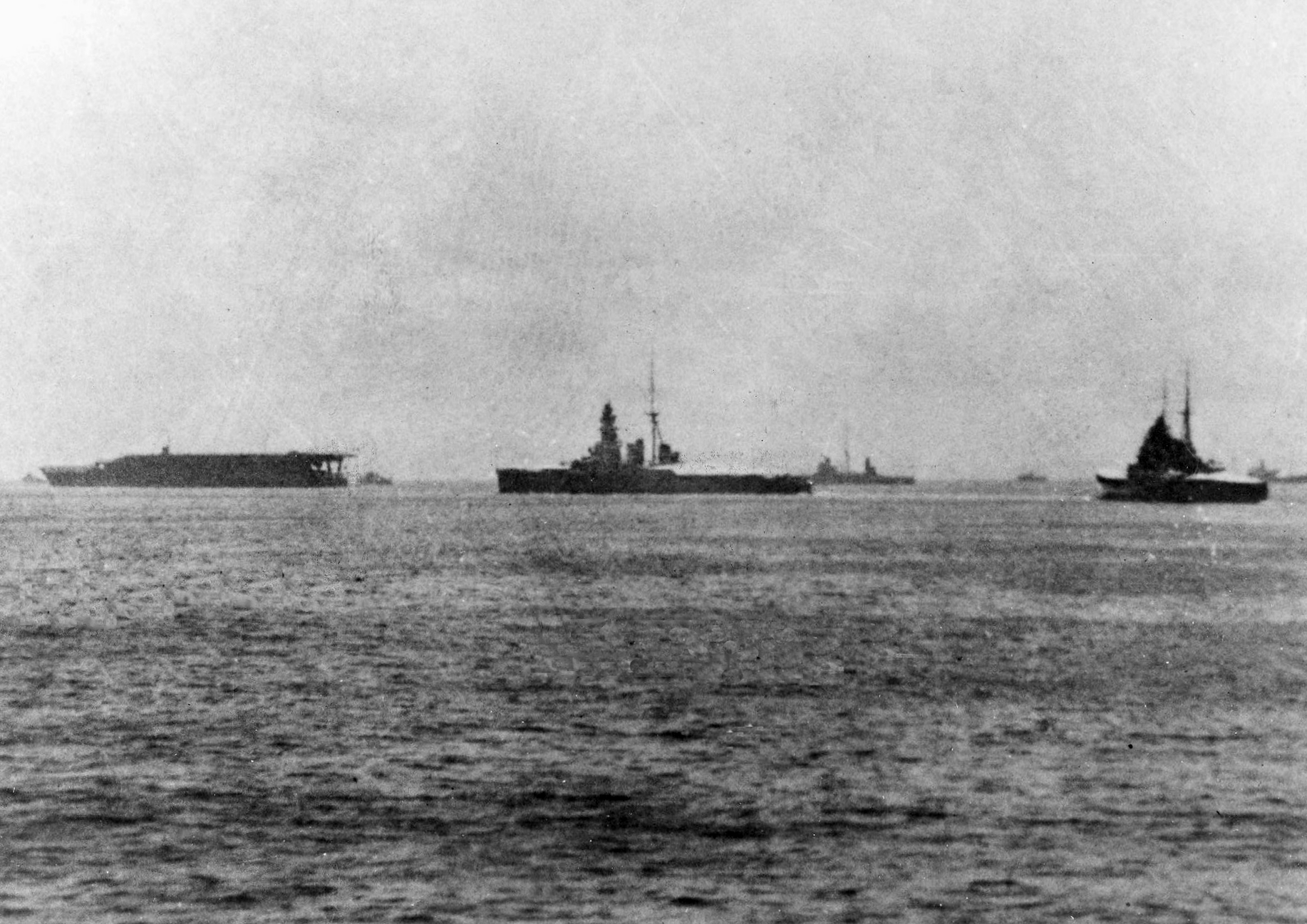
Japanese Cruiser Kasuga
Before she ever fired a shot, the warship that would become Kasuga had already lived three lives. Laid down in Genoa in 1902 as Mitra for the Italian Navy, sold within months to Argentina as Bernardino Rivadavia, then purchased by Japan in December 1903 for the staggering sum of 14,937,390 yen -- the cruiser's identity shifted with the tides of global power politics. Japan's government was so determined to acquire her that it delayed its planned surprise attack on Port Arthur until Kasuga and her sister ship Nisshin had safely passed Singapore, beyond the reach of any foreign power that might impound them. By February 1904, both ships reached Yokosuka just as the first shots of the Russo-Japanese War were being fired.
A Warship on the Auction Block
The story behind Kasuga's construction reads like an arms dealer's chess match. She was one of the last Giuseppe Garibaldi-class armored cruisers, a design that had proved so successful it was exported across the globe. Italy ordered her in December 1901, then sold her the following year to Argentina, which was locked in a naval arms race with Chile. But when tensions with Chile eased and money grew tight, Argentina put Bernardino Rivadavia and her sister Mariano Moreno back on the market. The Argentines first tried selling to Russia, but negotiations collapsed over price. Japan, watching its own tensions with Russia escalate toward the breaking point, stepped in and paid a premium -- 1,530,000 British pounds for the pair. It was a calculated gamble: without these cruisers, Admiral Togo's fleet would lack the firepower to challenge the Russian Pacific Squadron. The keel had been laid on March 10, 1902, the hull launched on October 22 of that year, and by January 7, 1904, she was commissioned into the Imperial Japanese Navy, renamed Kasuga after the ancient Shinto shrine in Nara.
The Guns of Port Arthur
Kasuga earned her place in naval history during the Russo-Japanese War of 1904-1905. On April 12, 1904, she and Nisshin served as bait in a trap set by Admiral Togo Heihachiro, showing themselves at the mouth of Port Arthur harbor to lure out the Russian fleet. The gambit worked devastatingly. Vice Admiral Stepan Makarov's flagship struck a freshly laid Japanese mine and sank in under two minutes, killing 677 men including Makarov himself. Kasuga's long-range guns then bombarded Port Arthur from Pigeon Bay, firing blindly over the Liaodong Peninsula at distances that pushed the limits of early 20th-century gunnery. The war's darker side touched Kasuga too: on May 15, 1904, she collided in fog with the protected cruiser Yoshino, which capsized and sank with the loss of 318 lives. With a third of Japan's battleships already lost to Russian mines, Togo placed Kasuga and Nisshin directly in his battle line -- a desperate promotion for ships designed as cruisers, not capital ships.
Tsushima and Beyond
At the decisive Battle of Tsushima on May 27, 1905, Kasuga sailed fifth in the Japanese battle line. She opened fire on the Russian battleship Oslyabya and during the engagement loosed 50 ten-inch and 103 eight-inch shells. One of the battle's future statesmen, Kantaro Suzuki -- a former executive officer of Kasuga who had commanded the ship during the Battle of the Yellow Sea in 1904 -- fought at Tsushima commanding Destroyer Division 4. He would later serve as Prime Minister of Japan and announce Japan's surrender in 1945. Kasuga emerged from Tsushima with only minor damage: one 12-inch hit, one 6-inch hit, and one unidentified shell, none causing serious harm. After the war, her career stretched across decades and oceans. During World War I, she escorted Allied convoys between Colombo, Ceylon, and Fremantle, Australia, hunting German commerce raiders in the Indian Ocean. In January 1918, she ran aground on a sandbank in the Bangka Strait and remained stuck for five months before being refloated.
Prime Ministers and Solar Eclipses
Kasuga's peacetime years reveal a ship of unexpected versatility. In 1920, she crossed the Pacific to visit Portland, Maine, for the centennial celebrations of that state, then made port calls in New York City, Annapolis, and Panama. During Japan's Siberian Intervention in 1922, she transported troops and supplies under the command of Mitsumasa Yonai -- yet another future Prime Minister of Japan. Two prime ministers serving aboard the same vessel is a remarkable distinction in any navy's history. Perhaps the most charming chapter came in early 1934, when Kasuga ferried 40 scientists to the remote atoll of Truk in the Pacific to observe a total solar eclipse on February 14. In 1926, she had participated in the rescue of a wrecked freighter's crew, and two of her sailors earned silver medals for gallantry from Britain's King George V.
Final Resting Place
From 1927 onward, the aging cruiser served as a training vessel for navigators and engineers. By July 1942, Kasuga was finally disarmed and hulked, spending her last years as a floating barracks at Yokosuka. On July 18, 1945, American carrier aircraft from Task Force 38 raided Yokosuka, and the old ship capsized at her mooring. She lay on her side for three years before being salvaged in August 1948 and broken up for scrap by the Uraga Dock Company. Today, nothing remains of the cruiser that served under three flags and carried two future prime ministers, but the waters of Yokosuka harbor where she finally came to rest still lap against the same piers where Japan's modern naval forces berth their warships.
From the Air
Yokosuka harbor at 35.30N, 139.67E, on the western shore of Tokyo Bay. The harbor and naval facilities are clearly visible from 3,000-5,000 feet. Kasuga capsized here on July 18, 1945. Nearby airports include RJTY (Yokota AB) approximately 40nm northwest, and RJTT (Tokyo Haneda) approximately 20nm north. The Miura Peninsula coastline and Uraga Channel provide excellent visual references.