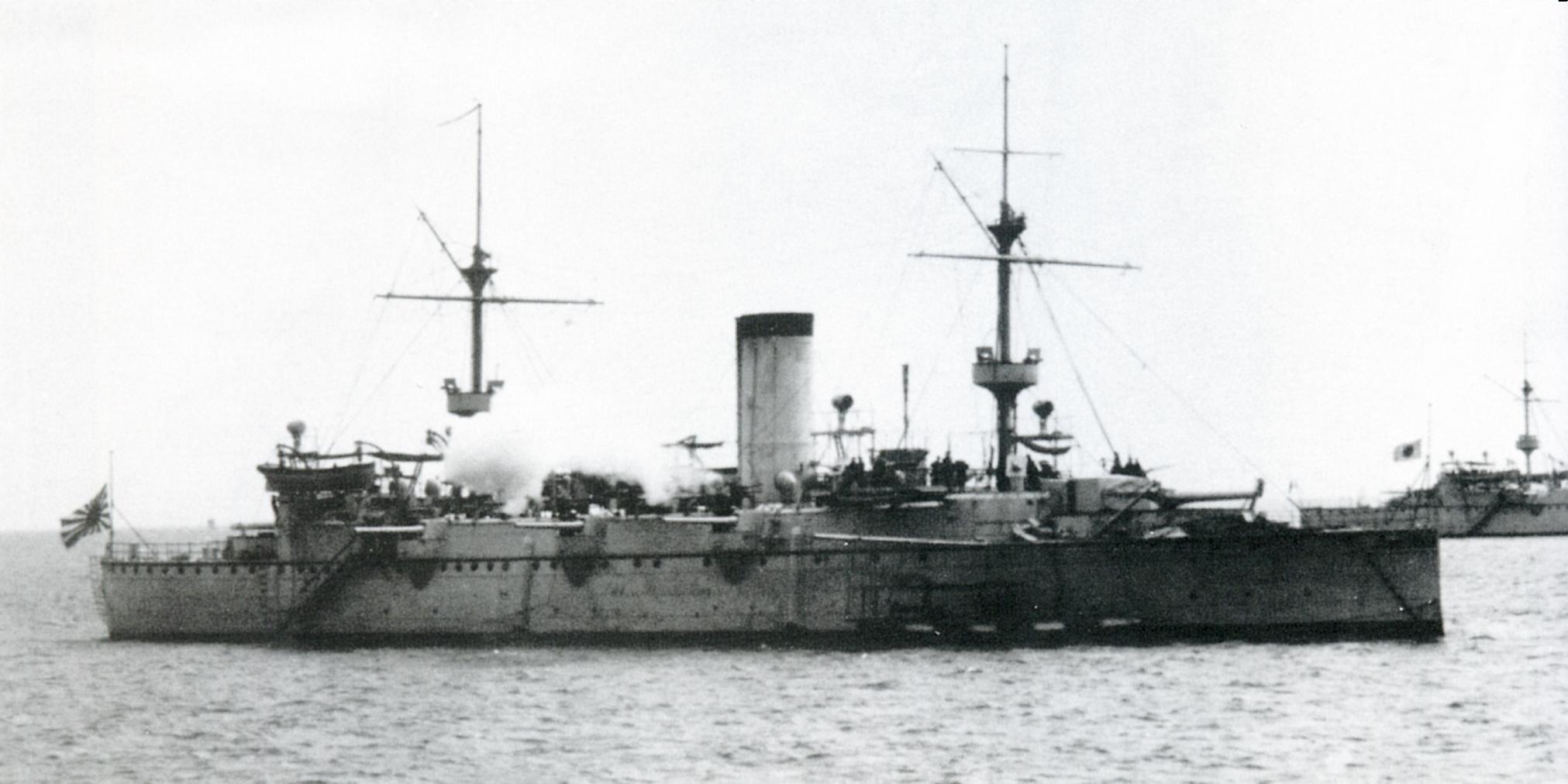
Japanese Cruiser Naniwa
On the morning of July 25, 1894, Captain Togo Heihachiro — the man who would one day become Japan's greatest admiral — stood on the bridge of the protected cruiser Naniwa and ordered his gunners to fire on a Chinese warship passing too close for comfort. Those were the first shots of the First Sino-Japanese War. By the time Naniwa ran aground on a Kuril Islands reef in 1912, she had participated in nearly every major naval engagement of Japan's rise as a Pacific power.
Born in Newcastle, Bound for Tokyo
Japan in the 1880s lacked the industrial capacity to build modern warships, so the Imperial Japanese Navy turned to Britain. Naniwa was ordered from Armstrong Mitchell on March 22, 1884, and laid down at the company's Low Walker shipyard in Newcastle upon Tyne. Designed by William White, Armstrong's chief naval architect, she and her sister ship Takachiho were considered the most advanced and most powerful cruisers in the world upon completion. Naniwa displaced 3,727 long tons, stretched 320 feet overall, and could make 18.7 knots on her steam trials. Her main armament consisted of two 26-centimeter Krupp cannon in barbettes fore and aft. She was completed on February 15, 1886, and sailed for Japan with an entirely Japanese crew under Captain Ito Sukeyuki — the first foreign-purchased warship to make that voyage without a single European hand at the helm.
The Kowshing Incident
Naniwa's most infamous action came before the Sino-Japanese War was even officially declared. On the morning of July 25, 1894, while patrolling off Pungdo Island near the Korean coast, Togo encountered the British-flagged steamer Kowshing, chartered by China to transport 1,100 troops to Asan. Togo ordered the ship to heave to and declared it seized. When he ordered the crew and passengers to abandon ship, the Chinese soldiers refused and took control of the vessel. After failed negotiations — including an attempt by a German officer in Chinese service — Togo opened fire at 1:10 PM. A torpedo passed beneath the steamer's keel, but Naniwa's guns struck home, disabling the boiler room and hitting below the waterline. The ship sank at 1:47 PM. Japanese boats rescued the British captain and two other Europeans but ignored the Chinese soldiers struggling in the water. The incident nearly provoked a diplomatic crisis with Britain.
Two Wars, One Warship
Naniwa fought at the Battle of the Yalu River in September 1894, where the First Flying Squadron helped destroy or damage multiple Chinese warships. She took nine hits during the battle but suffered only two wounded — a testament to her protective deck design. The cruiser went on to participate in the blockade and capture of Port Arthur, the campaign against Weihaiwei, the seizure of the Pescadores Islands, and the invasion of Taiwan. Between the wars, Naniwa's armament was repeatedly upgraded: the original 15-centimeter Krupp guns gave way to quick-firing 6-inch Armstrong guns in 1896, and her main battery was replaced entirely by 1900. When the Russo-Japanese War erupted in 1904, Naniwa was assigned to Rear Admiral Uryu Sotokichi's Fourth Division. She helped force the Russian cruiser Varyag and gunboat Korietz to scuttle at Chemulpo Bay on February 9, 1904, and later fought at the Battle off Ulsan and the decisive Battle of Tsushima in May 1905.
From Hawaii to Tsushima
Between the great battles, Naniwa's logbooks read like a catalogue of late 19th-century geopolitics. In early 1893, she steamed to Honolulu to protect Japanese citizens during the overthrow of the Hawaiian monarchy by American marines and colonists. Captain Togo refused to hand over a Japanese murder convict who had escaped prison and sought refuge aboard the cruiser, nearly sparking a diplomatic incident between Japan and the United States. She hosted Emperor Meiji for torpedo-firing exercises and transported Prime Minister Ito Hirobumi to the Korean port of Pusan. She visited Vladivostok, patrolled the Yellow Sea during the Boxer Rebellion, and cruised to the Republic of Hawaii on a training voyage. Every port of call mapped the expanding reach of imperial Japan.
The Reef at the End
After the Russo-Japanese War, Naniwa was relegated to auxiliary duty — survey work and fisheries protection, the quiet assignments that come to aging warships. In 1912, while operating in the waters north of the Japanese home islands, she ran aground on a reef in the Kuril Islands. Salvage crews tried for a month to refloat her, but the Pacific had the final word. The cruiser that had fired the first shots of one war and helped win the climactic battle of another was broken apart by waves on a volcanic reef at the edge of the empire she had helped build. Salvage rights to the wreck were sold the following year. Naniwa's resting place, somewhere in the cold waters off the Kurils, marks the spot where a warship's twenty-six-year career ended — not in battle, but in fog and rock.
From the Air
The wreck site is located at approximately 46.50°N, 150.17°E in the Kuril Islands chain, between Iturup and Urup. The area is characterized by volcanic islands, cold waters, and frequent fog. No active airport exists at the wreck site. Nearest airfields include Iturup Airport (UHSI) on Iturup Island to the south and Yuzhno-Sakhalinsk (UHSS) on Sakhalin Island to the northwest. Expect subarctic weather conditions and poor visibility, particularly in summer. The Kuril chain runs NE-SW and is visible from cruising altitude as a string of volcanic peaks separating the Sea of Okhotsk from the Pacific Ocean.