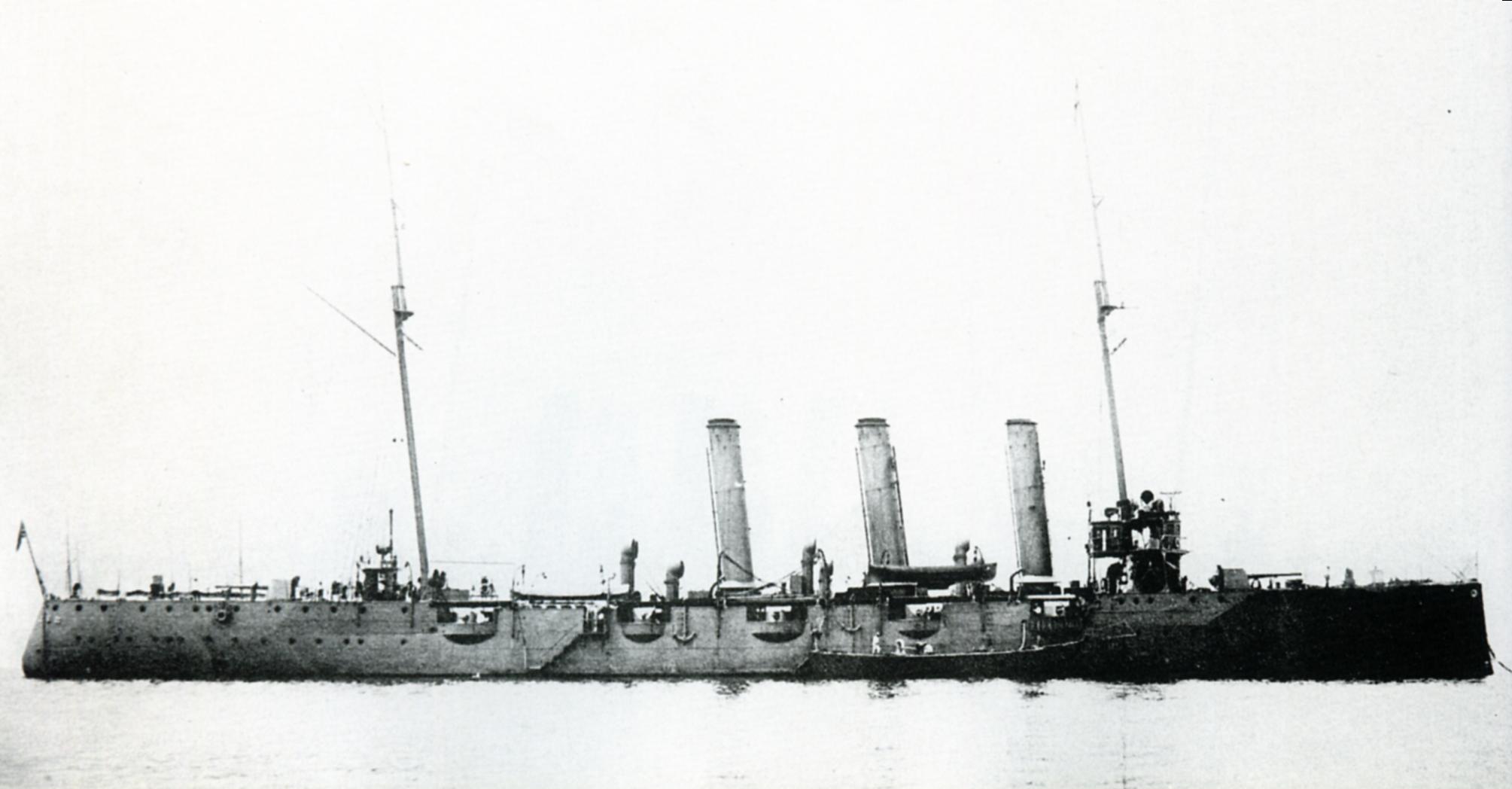
Japanese Cruiser Otowa
On July 25, 1917, a dense curtain of fog swallowed the waters off Daiozaki on the Shima Peninsula, and the cruiser Otowa never emerged. She ran hard aground, and despite weeks of salvage attempts, the sea broke her apart by August 10. It was an inglorious end for a warship named after something beautiful: Mount Otowa in Kyoto, the peak behind Kiyomizu-dera temple, whose waterfall was believed to cure all illnesses. The cruiser bearing that name had served Japan through two wars, crossed oceans, and survived the guns of the Russian Imperial Navy. But fog, not firepower, proved to be her undoing.
Built in Record Time
Authorized under Japan's 2nd Naval Expansion Program of 1897, Otowa was originally planned as the third vessel in the Niitaka class. Budget constraints forced a redesign: 10 percent smaller displacement and considerably lighter armament. What the builders at Yokosuka Naval Arsenal lacked in funding, they made up for in speed of construction. Laid down on January 3, 1903, launched on November 2 of that same year, and completed by September 6, 1904, Otowa's construction time of less than 20 months set a new record for Japanese shipbuilding. She was also the first vessel equipped with the Japanese-designed Kampon water-tube boiler, a technological milestone that marked Japan's growing independence from foreign engineering. The vertical triple-expansion steam engines were adapted from the Niitaka class with a slight increase in power, giving the smaller cruiser respectable performance for her size.
Fire and Steel at Tsushima
The defining moment of Otowa's career came on May 27, 1905, during the Battle of Tsushima, one of the most decisive naval engagements in modern history. Assigned to the 3rd squadron of the IJN 2nd Fleet, she engaged Imperial Russian Navy cruisers throughout the battle. On the first day, Otowa emerged unscathed. The second day proved bloodier. On May 28, Otowa and a companion ship intercepted the cruiser Svetlana, already heavily damaged and attempting to flee toward Korea with a destroyer escort. Svetlana's stern guns found their mark on Otowa, killing one officer and four sailors and wounding 23 others before the Russian cruiser finally sank. That afternoon, at 1600 hours, Otowa joined the battle's final engagement against another Russian cruiser, taking additional hits that injured two more sailors. After the battle, she patrolled the Tsushima Strait and escorted transports to Korea. In October, she captured the German merchant vessel Hans Wagner, suspected of carrying war materials to Beijing.
A World War on Distant Waters
The years between wars brought new assignments. In 1908 Otowa participated in Japan's first major post-war fleet maneuvers. From October 1910 through June 1912, she was stationed in northern China alongside fellow cruisers to protect Japanese citizens and economic interests during the upheaval of the Xinhai Revolution that toppled China's last imperial dynasty. Reclassified as a 2nd class cruiser in August 1912, Otowa found renewed purpose when World War I erupted. She became the flagship of Destroyer Squadron 1 of the Combined Fleet and fought at the Battle of Tsingtao against German forces in China. Afterward, she patrolled the vast sea lanes stretching from Singapore through Polynesia to the Philippines, operating from Manila Bay as part of Japan's contribution to the Allied war effort under the Anglo-Japanese Alliance.
First to Answer the Call
One of Otowa's most remarkable chapters unfolded far from Japanese waters. In February 1915, Indian Sepoy troops garrisoned in Singapore mutinied against British colonial authority. When the British government sent an urgent request for military assistance, Otowa was the first ship to respond. Together with cruisers Niitaka and Tsushima, she landed marines who helped quell the disturbances. It was a testament to the Anglo-Japanese Alliance in action and to Otowa's readiness despite being far from her home port. The 1915 Singapore Mutiny remains one of the more unusual episodes of World War I, and Otowa's rapid response demonstrated the reach and reliability of Japan's growing naval power in the Pacific and Indian Ocean regions.
Lost in the Fog
The waters off Daiozaki, at the tip of the Shima Peninsula in Mie Prefecture, are known for sudden, thick fogs that roll in from the Pacific. On July 25, 1917, Otowa was making the routine transit from Yokosuka to Sasebo Naval District when visibility collapsed. She ran aground on the rocky coast. Salvage crews worked for two weeks, but the sea proved stronger than their efforts. By August 10, Otowa had broken apart and slipped beneath the surface. She was 14 years old. Today, her wreck site at approximately 34.23 degrees north, 136.88 degrees east lies in waters along one of Japan's most scenic coastlines, where the rugged Pacific shoreline meets the sheltered beauty of Ise Bay. The mountain in Kyoto that gave her a name associated with healing waters could not, in the end, save her from the sea.
From the Air
The wreck site lies off Daiozaki at approximately 34.23N, 136.88E, at the southeastern tip of the Shima Peninsula in Mie Prefecture, Japan. From the air, the rocky headland of Daiozaki is clearly visible jutting into the Pacific. The nearest major airport is Chubu Centrair International Airport (RJGG) approximately 80 nautical miles to the northeast. The smaller Nanki-Shirahama Airport (RJBD) lies to the southwest. At low altitude, the dramatic coastline of craggy capes and offshore rocks gives a sense of why fog and currents made these waters treacherous for ships. The Shima Peninsula's rias coastline, with its deep indentations and scattered islands, is visible at cruise altitude on clear days.