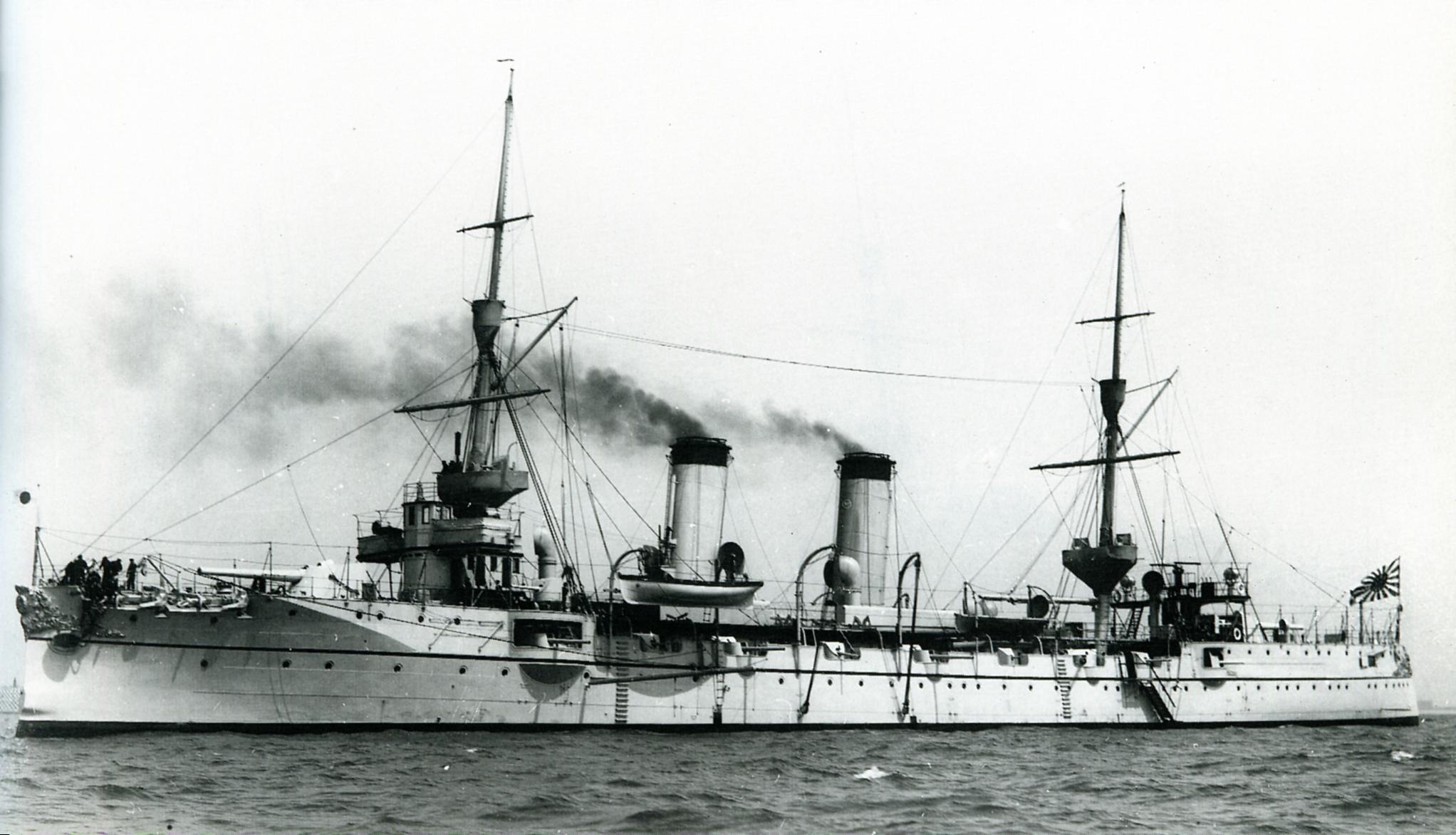
Japanese Cruiser Takasago
The mine that sank Takasago was laid by a man who would later command an army, lose a civil war, and be executed by firing squad. In December 1904, Aleksandr Kolchak was a young Russian minesweeper captain at Port Arthur, planting mines in the approaches to the besieged fortress. One of those mines found its mark on the night of 13 December, triggering a magazine explosion aboard the Japanese protected cruiser Takasago that killed 273 officers and crew. Kolchak received the Order of St. Anna for the action. Fifteen years later, he would be shot on a frozen riverbank in Irkutsk as the last leader of the White Russian movement.
An Elswick Cruiser for Japan
Takasago was built by Armstrong Whitworth at their famous Elswick shipyard in northern England, laid down in April 1896 as a private venture before being sold to Japan in July. She was a typical product of the Elswick works -- the same yard that exported warships to navies from Argentina to Chile to China -- designed by Sir Philip Watts as an improvement on the Argentine cruiser Veinticinco de Mayo. Her steel hull was divided into 109 waterproof compartments, and she carried Harvey armor designed to defeat 8-inch armor-piercing shells. Two 8-inch guns on bow and stern provided her main armament, backed by ten quick-firing 6-inch guns, twelve 12-pounders, and five torpedo tubes. Completed on 6 April 1898, she represented the cutting edge of protected cruiser design.
A Grand Tour of Empires
Before war found her, Takasago served as a traveling advertisement for the Anglo-Japanese Alliance. In 1902, she participated in a naval review at Spithead and then embarked on a remarkable world tour with the armored cruiser Asama. The two Japanese warships visited Singapore, Colombo, Suez, Malta, and Lisbon on the way to Europe, then called at Antwerp, Cork, and Cardiff before returning via Gibraltar, Naples, Aden, Bangkok, and Hong Kong. They arrived home on 28 November 1902 -- a voyage that demonstrated Japan's growing confidence and its navy's ability to operate across oceans, far from home waters.
Flagship at Port Arthur
When the Russo-Japanese War opened with a surprise attack on the Russian fleet at Port Arthur in February 1904, Takasago was there, serving as flagship for Admiral Dewa Shigeto. She participated in the bombardment the morning after Japanese destroyers had struck the first blow, an attack that set fires in the town and damaged several Russian warships. In the weeks that followed, Takasago joined the blockade that bottled up the Russian Pacific Squadron, capturing the merchant ship Manchuria as a prize of war. On 15 May, she helped rescue survivors when the Japanese battleships Hatsuse and Yashima struck Russian mines -- an event that demonstrated how quickly mines could reshape a naval campaign. Takasago fought again at the Battle of the Yellow Sea on 10 August 1904, one of the first modern engagements between steel battleship fleets.
Mine and Blizzard
After returning to Japan for overhaul in October, Takasago sailed back to the war zone in December. On the night of 13 December 1904, she was returning from a reconnaissance mission that had provided cover for a squadron of destroyers when she struck a mine 37 nautical miles south of Port Arthur. The explosion detonated her ammunition magazine, and the ship began to flood uncontrollably. The disaster was compounded by a blizzard that raged through the darkness, making it impossible to launch lifeboats in the heavy seas and zero visibility. Takasago went down at her position, taking 273 officers and crew with her. The 162 survivors were rescued by an accompanying cruiser. She was the last major Japanese warship lost in the Russo-Japanese War, destroyed not by enemy gunfire but by a device placed by a man whose own fate would prove equally dramatic.
From the Air
The sinking site is located at approximately 38.17N, 121.25E in the Yellow Sea, south of the Liaodong Peninsula and Port Arthur (modern Lushunkou). Open water with no visible landmarks at the wreck site. Nearest airport: Dalian Zhoushuizi International Airport (ZYTL), approximately 50 km to the northeast. Best observed from altitude as part of the broader Port Arthur / Dalian coastal approach.