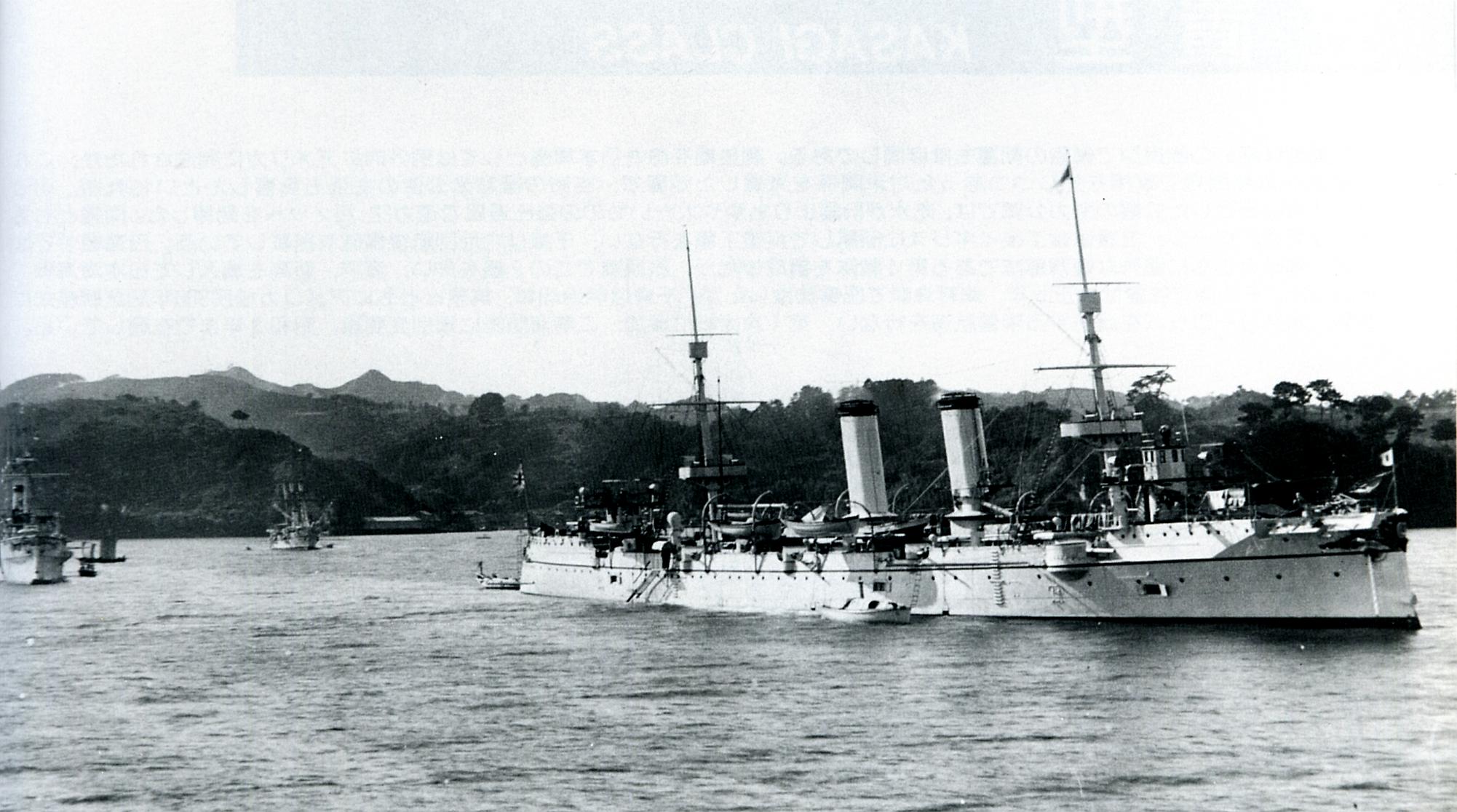
Japanese Cruiser Yoshino
She was killed by a design feature her own builders had insisted upon. The Japanese cruiser Yoshino, the fastest warship afloat when she entered service in 1893, survived the furious naval battles of the First Sino-Japanese War only to be rammed and sunk during the Russo-Japanese War by a friendly ship, the armored cruiser Kasuga. The ram that pierced Yoshino's hull was the same type of reinforced prow that Yoshino herself carried, a weapon that naval architects of the 1890s considered essential and that Yoshino's loss would help make obsolete.
Elswick's Finest
Yoshino was built at the Armstrong Whitworth shipyards in Elswick, England, designed by Sir Philip Watts as an improved version of the Argentine Navy cruiser Veinticinco de Mayo. Named for the Yoshino mountains in Nara Prefecture, she was laid down in February 1892, launched that December, and completed by September 1893. When she entered service, Yoshino was both the largest ship in the Imperial Japanese Navy and the fastest cruiser in the world. A typical Elswick cruiser design, she featured a steel hull divided into waterproof compartments, a low forecastle, twin funnels, two masts, and a prow reinforced for ramming. Her triple-expansion steam engine drove two screws. Four 6-inch quick-firing guns served as main armament, supplemented by eight 4.7-inch guns and 22 QF 3-pounder Hotchkiss guns.
First Blood off Korea
Yoshino drew blood before war was even declared. On 25 July 1894, she was part of a Japanese squadron that encountered two ships of the Chinese Beiyang Fleet off the Korean coast in the Yellow Sea. The Chinese cruiser Guangyi and gunboat had sortied from Asan to escort reinforcements. Although neither nation had formally declared hostilities, the two sides exchanged fire in what became known as the Battle of Pungdo. Guangyi was driven onto rocks and destroyed, and another Chinese vessel was captured. Yoshino chased the damaged cruiser Jiyuan but lost her quarry in a fog bank, a frustrating outcome for the world's fastest warship. The transport Kowshing, carrying 1,100 Chinese troops, was sunk by the Japanese cruiser Naniwa during the same engagement.
The Flying Squadron
After the formal declaration of war, Yoshino continued to serve as the speed-built spearhead of the Japanese fleet. At the Battle of the Yalu River on 17 September 1894, the largest naval engagement of the First Sino-Japanese War, she served as flagship for Admiral Tsuboi Kozo's flying squadron. This fast division, operating semi-independently from the main battle line, exploited its speed advantage to circle and rake the slower Chinese ships. The battle demonstrated the tactical value of speed and quick-firing guns over the heavy armor and large-caliber weapons that the Chinese Beiyang Fleet relied upon. Japan's victory at the Yalu River confirmed its emergence as a naval power capable of challenging the established order in East Asia.
Killed by Friendly Fire
Yoshino survived the First Sino-Japanese War and served through the following decade of Japanese naval expansion. When the Russo-Japanese War began in 1904, she returned to combat. But her end came not from enemy action. In dense fog, the Japanese armored cruiser Kasuga collided with Yoshino, her reinforced ram striking the older cruiser's hull. Yoshino sank rapidly. The irony was precise: she was destroyed by exactly the kind of weapon she herself carried, a weapon that naval architects had considered vital when they designed her. As a direct result of this accident, the Imperial Japanese Navy ordered the rams removed from the bows of all its warships. Yoshino's loss helped end a naval design philosophy that had endured since antiquity. She rests in the Yellow Sea, where she had won her greatest victories a decade earlier.
From the Air
Located at 38.12N, 122.55E in the Yellow Sea, between the Shandong and Liaodong Peninsulas. The wreck site is in open water, not visible from the surface. The broader area is the same stretch of the Yellow Sea where the Battle of the Yalu River was fought. Nearest airports include Dalian Zhoushuizi International (ZYTL) to the north and Yantai Penglai International (ZSYT) to the south. The waters here are relatively shallow and heavily trafficked by commercial shipping.