First Blood in the Makassar Strait
A single torpedo struck just aft of the second funnel, flooding the engine room and the number three boiler room in seconds. The Natsushio -- one of the Imperial Japanese Navy's newest and most powerful destroyers -- folded at the point of impact and began to sink. Six minutes later, on the morning of February 9, 1942, she slipped beneath the waters of the Makassar Strait, 22 miles south of the city whose invasion she had been escorting. The submarine that killed her was USS S-37, an obsolete American boat from the 1920s with a crew working in conditions barely fit for peacetime. It was the first time a U.S. submarine had sunk a Japanese destroyer in the war, and the Natsushio -- designed to dominate the Pacific -- never fired a shot in return.
Built for a War That Never Was
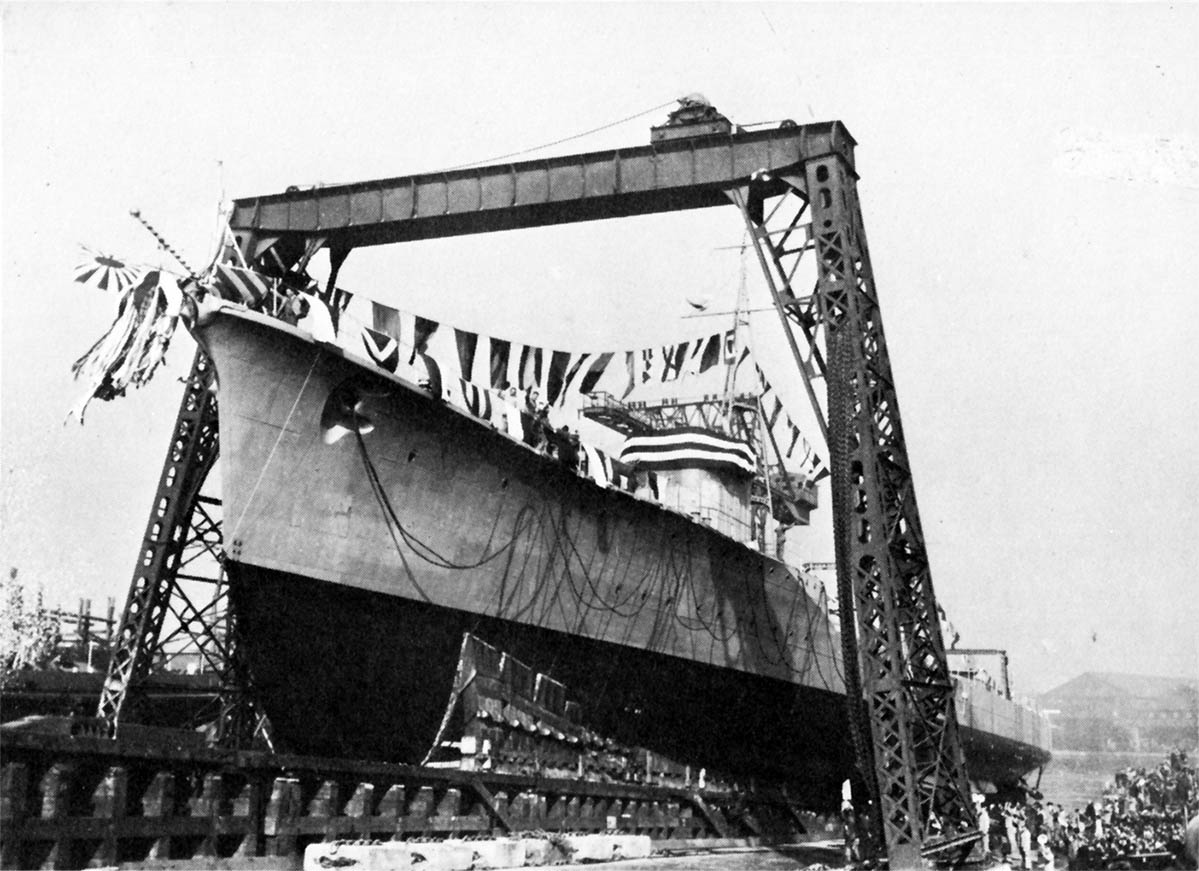
The Kagero class was the Imperial Japanese Navy's answer to a strategic problem: how to defeat the United States Navy as it advanced across the Pacific. Japanese planners envisioned a decisive fleet engagement -- destroyers racing ahead in coordinated day and night attacks, launching salvos of the fearsome Type 93 torpedo, the "Long Lance," whose 40-kilometer range far exceeded anything the Americans possessed. The Natsushio, laid down at the Fujinagata Shipyards on December 9, 1937, and commissioned on August 31, 1940, embodied this doctrine. At 2,065 tons standard displacement, she carried six 127mm guns in three twin turrets and eight torpedo tubes in two quadruple mounts. Her turbines produced 52,000 shaft horsepower, driving her past 35 knots. Only one of her 19 sister ships would survive the Pacific War -- but that attrition lay ahead. In late 1941, the Natsushio was assigned to Destroyer Division 15, part of the 2nd Fleet's Destroyer Squadron 2, ready for the campaign that would sweep south across the Pacific.
The Drive South
When Japan struck Pearl Harbor on December 7, 1941, the Natsushio was already deployed from Palau, escorting carriers and transports for the invasion of the southern Philippines. The grand offensive unfolded with startling speed. In January 1942, the Natsushio screened invasion forces as they seized Menado, Kendari, and Ambon -- stepping stones through the vast Netherlands East Indies that Japan needed for their oil, rubber, and strategic position. By early February, the target was Makassar, the principal city of Celebes and home to an airfield the Japanese needed as a base for further operations. Destroyer Division 15 steamed north in column through the Makassar Strait, the narrow sea corridor separating Borneo from Sulawesi. Visibility was poor. Somewhere in those dark waters, an American submarine was waiting.
The Old Boat's Kill
USS S-37 was everything the Natsushio was not. Commissioned in 1923, she was an S-class submarine -- cramped, slow, mechanically unreliable, and by 1942 standards, obsolete. Her crew endured tropical heat in a hull designed for temperate waters, with no air conditioning and ventilation that barely functioned. But she carried torpedoes, and her skipper had positioned her in the path of the Japanese advance. On the night of February 8-9, S-37 detected the approaching destroyer column. She fired a single torpedo that found the Natsushio's port side, striking with devastating precision between the funnels. The warhead detonated in the forward engine room, breaking the destroyer's back. The Natsushio buckled at the impact point, her middle section submerging as seas flooded in. Ten crewmen died. The survivors were pulled from the water by a sister ship. At 0843 hours, six minutes after she broke apart, the Natsushio was gone.
A Footnote with Weight
The Natsushio holds a peculiar set of distinctions. She was the first Japanese destroyer sunk by an American submarine in the war -- a milestone that would be repeated hundreds of times as the U.S. submarine force grew into the most effective commerce and warship destroyer in naval history. She was the first Kagero-class destroyer lost, and because she sank in February 1942, she was the only ship of her class that did not fight at the Battle of Midway four months later. For USS S-37, the Natsushio was the only confirmed kill of the submarine's career. The S-boat would continue patrolling the dangerous waters of the East Indies before eventually being withdrawn from combat and scrapped in 1945. The encounter distilled something essential about the early Pacific War: Japan's surface fleet was modern and formidable, but the underwater threat -- delivered by boats the U.S. Navy itself considered outdated -- would prove far more dangerous than anyone in Tokyo had anticipated.
Beneath the Strait
The Natsushio was struck from the Imperial Japanese Navy list on February 28, 1942, less than three weeks after she sank. Her wreck lies in the Makassar Strait, roughly 35 kilometers south of the city, in waters that had been contested for centuries before the Pacific War brought its own particular violence. The Makassar Strait had seen Portuguese traders, Dutch warships, Bugis pirates, and the merchant fleets of the Gowa Sultanate. The Natsushio joined a long roster of vessels claimed by these waters. Above her resting place, the strait remains one of the busiest shipping lanes in Southeast Asia, connecting the Java Sea to the Celebes Sea. Cargo ships and tankers pass overhead daily, their crews unaware of the broken destroyer 22 miles off the coast -- a ship built for a decisive battle that found, instead, a single torpedo in the dark.
From the Air
The Natsushio sank approximately 22 miles (35 km) south of Makassar at roughly 5.17S, 119.40E in the Makassar Strait. Sultan Hasanuddin International Airport (WAAA) is the nearest major airfield, approximately 20 km to the northeast. The sinking location is in open water south of the Jeneberang River delta. The Makassar Strait stretches northwest between Sulawesi and Borneo. Best context at 5,000-10,000 feet looking southwest from the Makassar coastline over the strait. The waters here are deep and busy with modern shipping traffic.