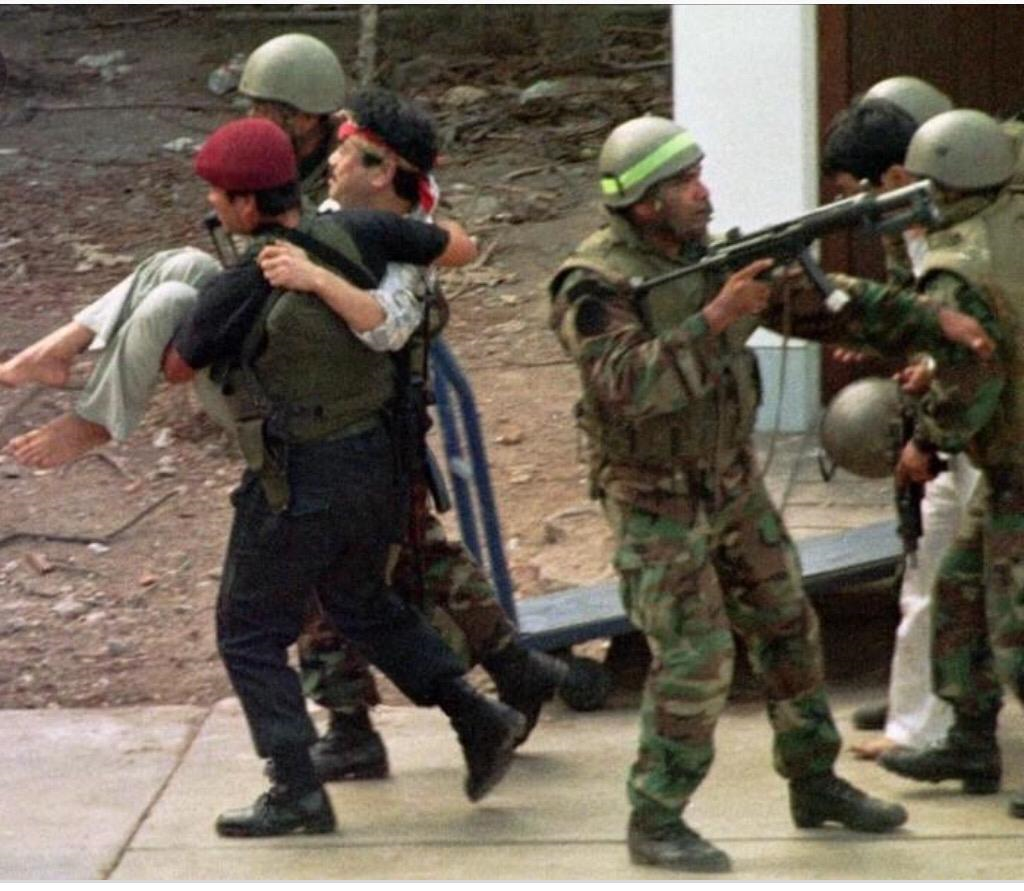
Japanese Embassy Hostage Crisis
The party was in full swing when the garden wall exploded. On the evening of December 17, 1996, hundreds of Peru's most powerful people -- diplomats, generals, business executives, government ministers -- had gathered at the Japanese ambassador's residence in Lima's upscale San Isidro district to celebrate Emperor Akihito's 63rd birthday. At 8:20 pm, fourteen guerrillas from the Tupac Amaru Revolutionary Movement blasted through the compound wall and seized every person inside. What followed would become one of the longest and most closely watched hostage crises of the late twentieth century, stretching 126 days and ending in a military operation that raised as many questions as it answered.
A Fortress Turned Prison
The Japanese government had fortified the ambassador's residence against exactly this kind of attack. Twelve-foot walls surrounded the compound. Windows were grated and fitted with bullet-proof glass. Doors could withstand grenade blasts. But these defenses, designed to keep intruders out, now worked in reverse -- they kept the world out and the hostages in. The MRTA fighters, led by Nestor Cerpa Cartolini, had chosen their target carefully. The guest list read like a directory of Peruvian power: supreme court justices, military commanders, foreign ambassadors, and the president's own mother and brother. Lima's stock exchange closed three hours early as news spread, domestic stocks plummeting. One columnist wrote that the country had been set back four years, returned to the era of terror that President Alberto Fujimori had claimed to have ended.
The Long Negotiation
The rebels demanded the release of their imprisoned comrades, including American activist Lori Berenson and Cerpa's own wife. They called for revisions to Peru's free-market economic reforms and protested conditions in Peruvian prisons, which they called cruel and inhumane. Over the following days and weeks, hostages were released in stages -- foreign women first, then most foreigners within five days. But 72 men remained. Fujimori refused all demands. He did not rule out force, but publicly explored peaceful options, even traveling to London in February 1997 to seek a country willing to grant the rebels asylum -- a curious move, observers noted, for a president who insisted the MRTA were terrorists, not political actors deserving of asylum. Behind the scenes, something else was underway. Reports surfaced of a secret military plan involving tunnels being dug beneath the compound. Peruvian intelligence had smuggled listening devices inside, including one hidden in a guitar delivered to a hostage.
Operation Chavin de Huantar
On April 22, 1997 -- day 126 -- 140 Peruvian commandos stormed the residence through tunnels that had been excavated over months beneath the building. The raid lasted roughly forty minutes. When it was over, all fourteen MRTA fighters were dead. One hostage, Supreme Court Justice Carlos Giusti, died of cardiac complications during the assault. Two commandos also lost their lives. Seventy-one hostages walked out alive. The operation was initially celebrated as a masterpiece of military planning, and Fujimori's approval ratings soared. He personally toured the ruined compound, showing visitors a scale model of the residence that his military had used to plan the assault. But the triumph soon grew complicated.
Questions Without Answers
In the years that followed, testimony from hostages and commandos themselves challenged the official narrative of a clean military victory. Japanese diplomat Hidetaka Ogura testified that three rebels had been tortured. Two commandos stated they had seen Eduardo "Tito" Cruz alive and in custody before he was later found dead with a bullet wound in his neck. The Inter-American Court of Human Rights ruled in 2015 that Cruz had been the victim of an extrajudicial killing, and that Peru had violated international law. The court also identified 25-year-old Victor Peceros and 17-year-old Herma Melendez as victims whose human rights were denied. These findings placed the crisis within the broader pattern of rights abuses that defined the Fujimori era -- the same era that produced the Barrios Altos massacre and the disappearance of students from La Cantuta University. The residence itself was later demolished, replaced by a park. The Clinica Italiana next door, closed during the crisis, never reopened and was torn down in 2013.
The Weight of Memory
The site where the ambassador's residence once stood in San Isidro is quiet now. The compound that held the world's attention for four months has been replaced by open space, its walls and bullet-proof windows gone. But the crisis reverberates through Peruvian memory and international law. It forced uncomfortable questions about the line between counterterrorism and extrajudicial violence -- questions that Peru, like many nations confronting insurgency, has never fully resolved. The MRTA never recovered from the loss of its leadership in the raid. Fujimori, for his part, would flee Peru in 2000 amid corruption and human rights scandals, eventually facing trial for crimes that extended far beyond a single night in San Isidro.
From the Air
Located at 12.09S, 77.05W in the San Isidro district of Lima, Peru. The former site of the Japanese ambassador's residence is now a park. Visible from low altitude over Lima's upscale southern districts. Nearest major airport: Jorge Chavez International (SPJC). The broader Lima metropolitan area stretches from the Pacific coast inland along the Rimac River valley.