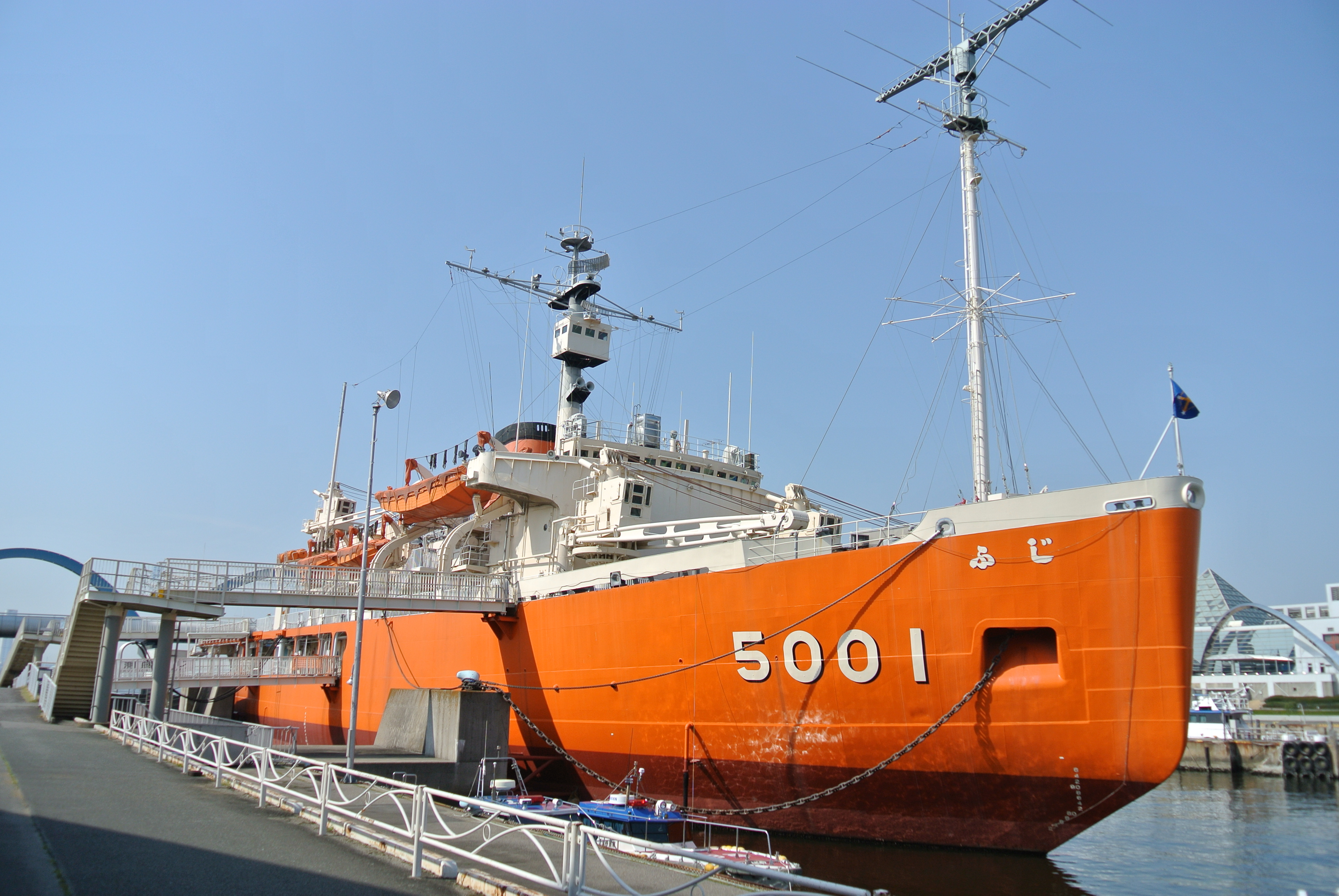
Japanese Icebreaker Fuji
The mannequins in the barber shop are frozen mid-haircut. Down the corridor, two sailors play an eternal game of checkers while another writes a letter that will never be mailed. Aboard the Fuji, time stopped somewhere around 1983, the year Japan's second-generation Antarctic research ship completed her final polar voyage and surrendered her duties to a younger vessel. Painted in the unmistakable orange of polar service, the 100-meter icebreaker now rests at Nagoya Port's Garden Wharf, a Sikorsky Sea King helicopter still perched on her aft deck as if waiting for one more supply run to Syowa Station. She carried 245 crew members and scientists through some of the harshest conditions on Earth for 18 consecutive years, and the wear shows -- not as neglect, but as hard-earned character.
Born for the Ice
Fuji was laid down on August 28, 1964, at the Nippon Kokan shipyard in Yokohama and launched the following March. Commissioned on July 15, 1965, she was Japan's answer to a problem that had plagued earlier Antarctic missions: the previous research vessel, Soya, simply was not powerful enough for the job. At 5,250 tons displacement, Fuji dwarfed her predecessor and could crack through ice up to 80 centimeters thick. Her diesel-electric propulsion system pushed her to 17 knots in open water, fast enough to outrun the worst of the Southern Ocean's storms. Homeported at Yokosuka, she was purpose-built for a single mission -- resupplying and rotating personnel at Japan's Syowa Station on the coast of Antarctica's Queen Maud Land.
140 Days South
Her maiden Antarctic voyage set the pattern for 18 years of grueling service. On November 20, 1965, Fuji departed Tokyo's Harumi Pier. During the southward transit, the crew held an offshore memorial service for Japan's World War II dead as they passed the Philippines. After a resupply stop in Fremantle, Australia, she crossed 55 degrees south and entered the Antarctic Circle on December 17. By late December, she was charging into drift ice off Syowa Station. Full-scale air transport operations began on January 3, 1966, and by the end of January, Fuji had berthed directly at the station to offload snowmobiles and heavy supplies -- 435 tons in all. She reopened Syowa Station, established the 7th Wintering Corps, visited Soviet and Belgian bases, then steamed north through Cape Town and Colombo before returning to Tokyo on April 8. The round trip took 140 days.
The Toll of Polar Service
Eighteen Antarctic expeditions extract a price. Over her career, Fuji logged 2,869 days of active operations, transported 800 personnel, and hauled 8,529.5 tons of supplies through waters that would shatter lesser hulls. She charged into ice fields 23,416 times. From her 7th through 11th expeditions, she managed to berth directly at Syowa Station every time. But on the return leg of the 11th mission, all four starboard propeller blades shattered -- a catastrophic failure that signaled the beginning of the ship's physical decline. After that, successful berthing at the station became the exception rather than the rule; of her remaining 18 attempts, she managed it only six times. Yet even when the ice kept her at a distance, Fuji completed every mission as planned, relying on helicopter supply runs when the ship herself could not close the final miles.
Passing the Torch
On November 25, 1982, Fuji received the ceremonial whistle from her predecessor Soya in front of Tokyo's Museum of Maritime Science, then escorted the brand-new icebreaker Shirase and the 37th Escort Flotilla out of Tokyo Bay for what would be Fuji's final Antarctic deployment. When she returned to Harumi Wharf on April 20, 1983, her role as Japan's Antarctic research ship officially transferred to Shirase. By December 1982, Fuji had been ranked the 12th most capable icebreaker in the world under Canadian classification standards. In 1985, she was towed to Nagoya Port for her final chapter -- not as scrap, but as a floating museum dedicated to Japan's polar exploration legacy.
A Ship That Remembers
Today, visitors walk three decks of meticulously preserved spaces. The bridge instruments are set as they were during polar operations. Below, the crew quarters, galley, medical room, and recreation areas have been staged with lifelike mannequins that give an uncanny sense of daily life at sea -- sailors relaxing in bunks, eating meals, getting haircuts. Outside on the dock, a tracked snow vehicle used in Antarctic field research sits alongside Fuji's massive anchor and propeller shaft. In the adjacent Fuji Hiroba park, a bronze statue honors Taro and Jiro, the two sled dogs famously left behind during a 1958 expedition and found alive a year later. The orange hull, visible from across Nagoya's waterfront, stands as both a monument to Cold War-era polar science and a reminder that Japan's relationship with Antarctica began not with flags and claims, but with supply runs and endurance.
From the Air
Located at 35.09N, 136.88E at Nagoya Port's Garden Wharf in Minato Ward. The bright orange hull is visible from altitude against the gray port infrastructure. Nagoya Port sits on the eastern shore of Ise Bay. The ship is berthed near the Port of Nagoya Public Aquarium and the distinctive Nagoya Port Building observation tower. Nearest airport: Chubu Centrair International Airport (RJGG) approximately 20nm south across Ise Bay. Nagoya Airfield/Komaki (RJNA) lies approximately 12nm to the north. Expect clear visibility over the bay on most days, with occasional sea haze in summer months.