I-400: The Submarine That Carried Airplanes
Four trained men could prepare a floatplane for launch from a submarine in seven minutes. In 45 minutes, the crew could assemble, fuel, arm, and catapult all three aircraft from the deck. This was the operational tempo demanded by the I-400, an Imperial Japanese Navy submarine commissioned in 1944 that was less a conventional warship than a mobile airfield lurking beneath the Pacific. Carrying three Aichi M6A1 Seiran torpedo bombers inside a watertight cylindrical hangar mounted on her top deck, I-400 was built for a single audacious purpose: to sail undetected across the world's largest ocean and launch a surprise air strike against the Panama Canal. She carried enough fuel to circumnavigate the globe one and a half times. Until 1965, nothing bigger had ever submerged.
A Figure Eight Beneath the Waves
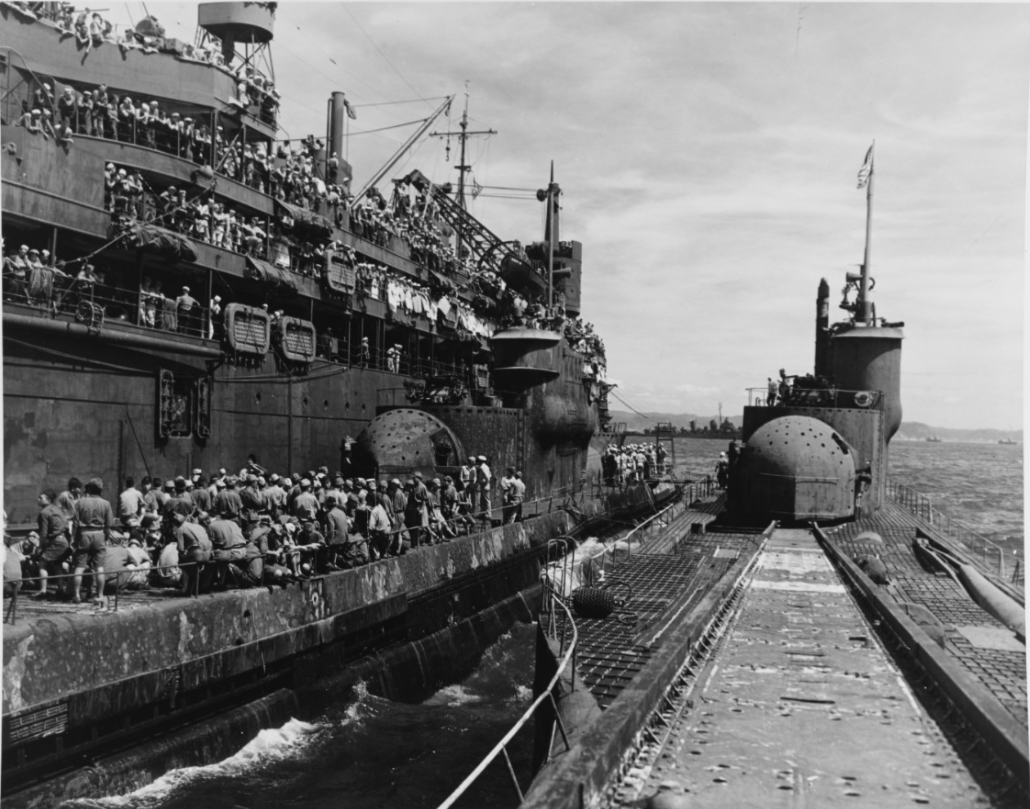
The I-400-class submarines were engineering marvels born of desperation. Their pressure hull had a unique figure-of-eight cross-section that provided the strength and stability to support the weight of an aircraft hangar on the top deck -- a cylindrical, watertight tube running along the centerline. The conning tower was offset to port to make room for the three folded Seiran floatplanes. A catapult on the forward deck launched them; a collapsible crane retrieved them from the sea. The boats displaced more than double their typical American contemporaries and carried an arsenal beyond the aircraft: eight torpedo tubes in the bow loaded with 20 Type 95 torpedoes, a deck gun mounted aft of the hangar, and multiple antiaircraft gun positions. An anechoic coating absorbed sonar pulses. Demagnetization cables nullified the magnetic field to defeat magnetic mines. These were submarines designed to cross oceans, attack continents, and vanish.
The Panama Canal Plan
The mission was straightforward in concept and staggering in ambition: Submarine Division 1 would sail four submarines -- I-13, I-14, I-400, and I-401 -- across the Pacific and launch ten floatplanes against the Gatun Locks of the Panama Canal. Six torpedoes and four bombs would drain Gatun Lake and block the canal to Allied shipping for months. Training began in Nanao Bay on the western coast of Honshu in June 1945, with the submarines and six Seiran aircraft from the 631st Naval Air Group rehearsing night launch operations. The results were impressive: the crews achieved their seven-minute aircraft preparation time consistently. But the war was collapsing around them. The fall of Okinawa and intensifying Allied air strikes against the Japanese Home Islands prompted Imperial General Headquarters to cancel the Panama Canal strike on June 12, 1945, redirecting the submarines toward the Allied fleet anchorage at Ulithi in the Caroline Islands instead.
Operation Arashi and the Race Against Surrender
The new mission, Operation Arashi -- Mountain Storm -- called for I-400 and I-401 to launch six Seiran floatplanes in a nighttime attack on Allied ships at Ulithi under a full moon. Each pilot would receive a hormone injection to sharpen his night vision. The aircraft had their Japanese markings replaced with American insignia. But the plan unraveled in pieces. I-400 weathered a typhoon on July 28. On August 5, an electrical fire east of Saipan forced her to surface, where lookouts spotted an American convoy and she crash-dived, her crew fighting the fire while submerged as smoke filled the interior. On August 14, I-401 changed the rendezvous coordinates, but I-400 never received the coded message. On August 15, Emperor Hirohito announced Japan's surrender. The attack on Ulithi -- scheduled for August 17 -- never happened. I-400 was two days from launching what would have been among the last offensive operations of the war.
Black Flag and Three Torpedoes
On August 26, 1945, I-400 received orders to hoist a black flag of surrender and disarm. Her crew assembled all three Seiran aircraft and catapulted them unmanned into the sea, dumped their bombs, fired off every torpedo, and destroyed all logs, charts, and codebooks. The next day, a U.S. Navy aircraft spotted her, and destroyers intercepted and accepted her surrender northeast of Tokyo. A prize crew of four officers and 40 enlisted men took command. I-400 was present in Tokyo Bay during the formal surrender ceremony on September 2, 1945, where Vice Admiral Charles A. Lockwood ordered his personal flag hoisted aboard her -- an acknowledgment of just how remarkable the captured submarine was. After evaluation at Pearl Harbor, Cold War anxiety sealed her fate: fearing the Soviets would demand access to the advanced Japanese submarine designs, the U.S. Navy ordered all captured Japanese submarines sunk. On June 4, 1946, the submarine Trumpetfish put three Mark 18 torpedoes into I-400 off Pearl Harbor. She sank by the stern at 12:10 PM.
Found at the Bottom
For 67 years, I-400 lay undiscovered on the Pacific floor. On August 1, 2013, the Hawaii Undersea Research Laboratory's deep-diving submersible Pisces V located the wreck southwest of Oahu at great depth. The hull was completely intact, but the entire superstructure -- conning tower and aircraft hangar -- had torn away during the long descent to the bottom in 1946, ripped free by the implosion of internal spaces as water pressure crushed the air out of them. What Pisces V initially identified as the bow turned out to be a point well aft of the actual bow, a testament to how dramatically the wreck had been distorted. The submarine that was designed to carry aircraft across the Pacific now rests in darkness, her hangar somewhere nearby on the ocean floor, separated from the hull she was built to protect.
From the Air
The article coordinates of 38.67°N, 143.20°E place this in the Pacific Ocean east of the Tohoku coast of Japan, near where I-400 operated during her final missions. The submarine was built at Kure Naval Arsenal (34.23°N, 132.55°E) on the Inland Sea and trained in Nanao Bay (37.12°N, 136.97°E) on Honshu's western coast. Her wreck lies southwest of Oahu, Hawaii. From the air over the Tohoku coast, the deep Pacific waters to the east are where I-400 surrendered in August 1945. The nearest airports to the article coordinates are Hanamaki (RJSI) and Sendai (RJSS) on the Japanese mainland. The open Pacific in this area offers no visual landmarks -- only the vast ocean that I-400 was designed to cross unseen.