The Japanese Sword Museum: Blades Saved from the Furnace
In the months after Japan's surrender in August 1945, American occupation authorities issued an order that threatened to erase a thousand years of metalworking tradition in a single stroke: all swords were to be confiscated. To the occupiers, a sword was a weapon. To Japanese craftsmen and collectors, it was something else entirely -- a fusion of metallurgy, art, and spiritual practice refined across centuries. On February 24, 1948, a group of sword enthusiasts established the Nihon Bijutsu Token Hozon Kyokai -- the Society for Preservation of Japanese Art Swords, known as NBTHK -- with permission from the Ministry of Education. Their mission was straightforward and urgent: save what could be saved. The Japanese Sword Museum, which NBTHK opened in 1968 and relocated to its current home beside the former Yasuda Garden in Sumida ward in 2018, is the physical expression of that rescue.
Forged in Crisis
The occupation-era confiscation was indiscriminate. Family heirlooms, battlefield relics, and artworks of extraordinary craftsmanship were swept up together. NBTHK's founders understood that without a systematic effort to identify, certify, and preserve the finest blades, Japan risked losing irreplaceable examples of swordsmithing from the Heian period through the Edo period. By September 1948, the society had launched a certification system to distinguish art swords from ordinary weapons. In 1955, it organized the first sword technology presentation, bringing together smiths and scholars. By 1958, NBTHK had established an important designation system for blades of exceptional quality. The work was painstaking: each sword examined, its lineage traced, its craftsmanship assessed against centuries of tradition.
Steel, Flame, and Folded Layers
The museum's collection of approximately 190 items spans the full spectrum of the Japanese sword tradition. The core holdings are katana -- the curved, single-edged blades that define the form -- but the collection extends to tosogu (sword mountings and fittings), yoroi (armor), and documents tracing the history of metalworking techniques. Some blades carry national treasure or important cultural property designations from the Japanese government. The oldest pieces date to the Heian and Kamakura periods, when Japanese swordsmiths developed the distinctive folded-steel techniques that produced blades of legendary sharpness and resilience. The raw material itself -- tamahagane, a specialized steel smelted from iron sand in a traditional tatara furnace -- was recognized as a preservation-worthy technology in 1977, when NBTHK certified its manufacturing process as a selected preservation technology.
From Shibuya to the Garden at Ryogoku
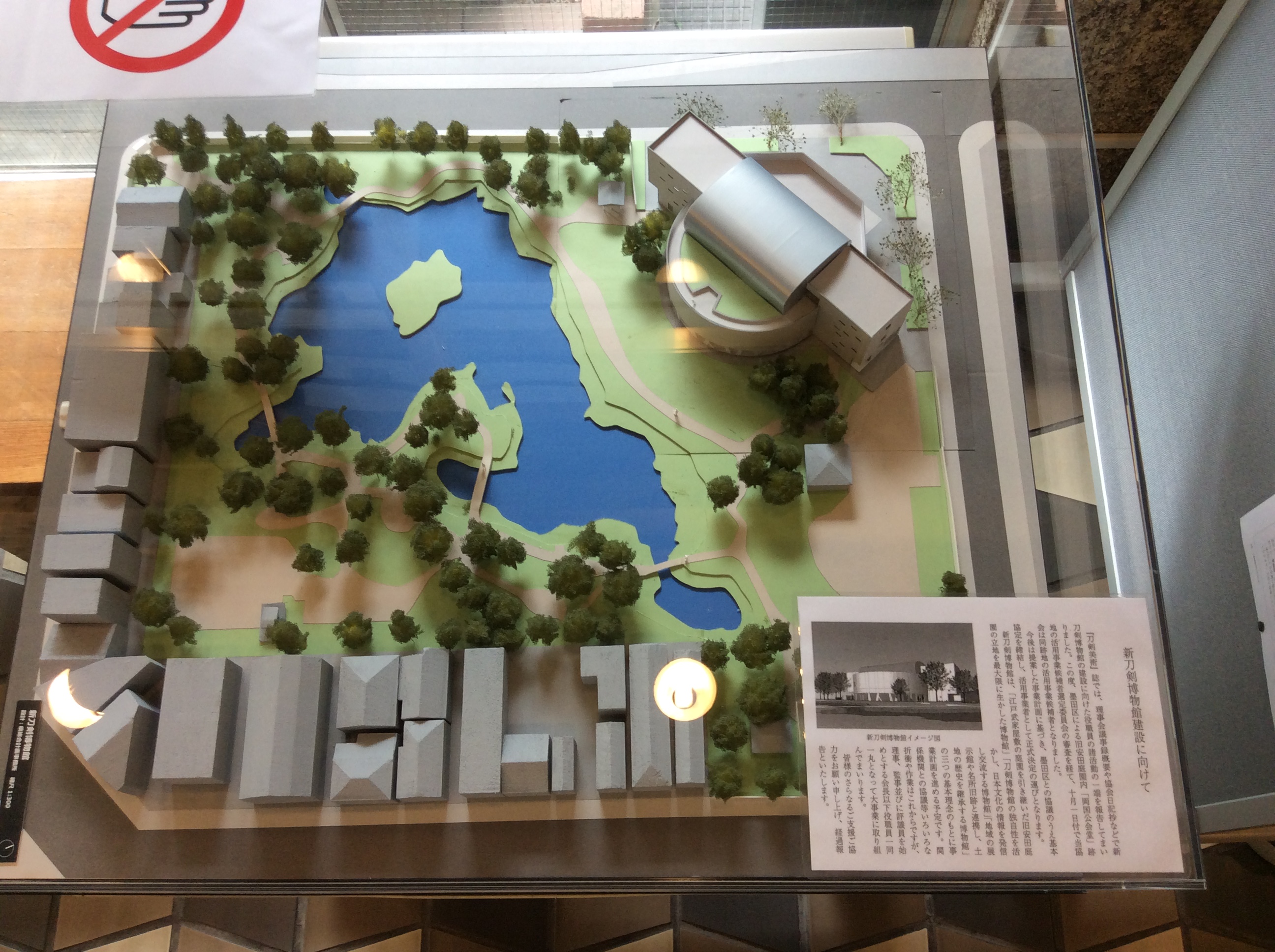
For nearly five decades, the Japanese Sword Museum occupied a building in Yoyogi, Shibuya ward. It closed on March 31, 2017, for relocation, and reopened on January 19, 2018, in a purpose-built three-story reinforced concrete structure in Sumida ward. The new building, designed by the Maki General Planning Office and constructed by Toda Corporation, sits on the grounds of the former Yasuda Garden -- a beautifully preserved Edo-period strolling garden near the Ryogoku Kokugikan sumo arena. The museum rises 15.6 meters across a total floor area of 2,620 square meters, modest in scale but thoughtfully designed. The site area covers 2,158 square meters, and visitors enter through a lobby where the geometry of modern architecture meets the contained precision of the blades displayed upstairs.
The Living Craft
NBTHK's mission extends beyond the museum walls. In 1977, the society helped certify the traditional tamahagane steelmaking process and supported the reconstruction of a working Japanese sword forge in Yokota Town, Shimane Prefecture. Since 1989, the Agency for Cultural Affairs has sponsored swordsmithing technology workshops at NBTHK's initiative, ensuring that the techniques preserved in the museum's oldest blades continue to be practiced by living smiths. The society refined its own standards over the decades, abolishing its original certification system in 1982 in favor of a more rigorous sword appraisal system. Today, the museum serves as both archive and advocate -- a place where a blade forged eight centuries ago and a blade completed last year can be compared side by side, their steel judged by the same unbroken standard of craft.
From the Air
Located at 35.681N, 139.691E in Sumida ward, near the Ryogoku district along the east bank of the Sumida River. The museum sits adjacent to the former Yasuda Garden, near the distinctive circular roof of Ryogoku Kokugikan sumo arena, which serves as a useful visual landmark. Tokyo Skytree, approximately 1 nautical mile to the north-northeast, provides an unmistakable reference point. Tokyo Haneda International Airport (RJTT) lies approximately 9 nautical miles to the south-southwest. The Sumida River running north-south through the area is a strong navigational aid.