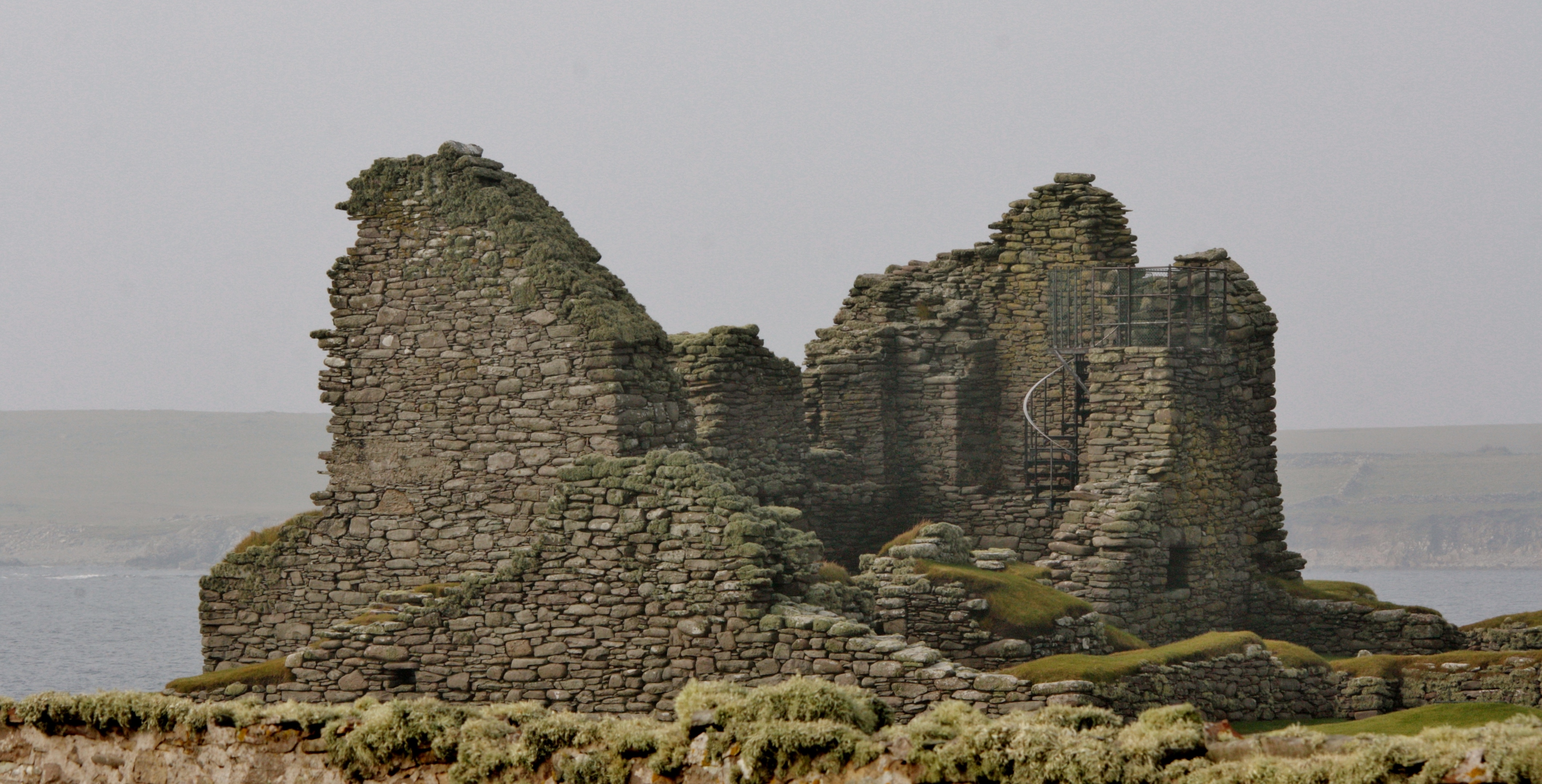
Jarlshof
The name is a lie, and a beautiful one. Walter Scott coined 'Jarlshof' for his 1821 novel The Pirate, imagining a Norse earl's mansion on this windswept headland at the southern tip of Shetland. No jarl ever lived here. But when storms stripped away the sand in the late 19th century and archaeologists began to dig, they found something far more extraordinary than any novelist had invented: layer upon layer of human settlement stretching back 4,500 years, from Bronze Age oval houses to a 17th-century laird's mansion, all stacked on the same patch of ground like pages in a book that no one had thought to close.
The Earliest Rooms
The oldest structures at Jarlshof date to around 2500 BC. Bronze Age settlers built small oval houses with thick stone walls, structures that bear a family resemblance to Skara Brae on Orkney but are smaller and several centuries younger. Evidence suggests these earliest buildings may have been partly subterranean, sunk into the ground for structural stability and insulation against Shetland's relentless wind. A smithy stood among them, and broken clay moulds recovered from the site reveal that the metalworker produced axes, knives, swords, and pins -- trained, the artifacts suggest, in an Irish style of working. A whale vertebra was found set into a wall, probably used as a tethering post for cattle. Among the most puzzling finds is a decorated bone plaque, just five centimetres long, with three holes bored into its ends and elaborate linear patterns carved across its surface. Its function remains unknown. When this Bronze Age community eventually abandoned the site, clean sand blew across their buildings and sealed them, creating a sterile layer that separates their world from everything that came after.
Towers, Wheels, and Painted Stones
The Iron Age inhabitants built directly on top of their predecessors. Their most imposing structure was a broch -- a circular stone tower that probably rose 40 feet or more, commanding views of the surrounding seas. Part of the broch has since been lost to coastal erosion, and modern sea defences now protect what remains. Around and within the broch's shadow, later settlers constructed wheelhouses: circular dwellings with internal stone piers radiating from the walls like the spokes of a wheel, creating a series of corbelled bays that served as living spaces. The best-preserved wheelhouse at Jarlshof retains much of its stone roof and displays the developing architectural style across three successive periods of construction. Unlike wheelhouses elsewhere in Scotland, which were typically dug into the earth, the Jarlshof structures were built from ground level upward. The Pictish period, running roughly from the 5th to the 9th centuries, left subtler but evocative traces: a bone pin with a rounded head, a rectangular slate fragment painted with a cross and S-shaped scrolls suggesting early Christian belief, and one of only two Pictish symbol stones ever found in Shetland, carved with the enigmatic double-disc-and-Z-rod motif.
The Norse Longhouse
Excavations in the 1930s by Alex Curle uncovered the first confirmed Norse longhouse in the British Isles, a discovery that transformed understanding of Viking settlement in Scotland. Seven Norse-era houses have since been identified at the site, though no more than two were occupied simultaneously. The Norse inhabited Jarlshof continuously from the 9th to the 14th century, farming the relatively fertile land of southern Shetland while fishing for Atlantic cod, saithe, and ling in the surrounding waters. One hundred and fifty loom weights attest to the importance of wool production. A small square outbuilding with a large hearth has been interpreted as a sauna. Among the most intriguing artifacts is a bronze-gilt harness mounting made in Ireland in the 8th or 9th century, evidence of the long-distance connections these island dwellers maintained. The rectangular Norse buildings look nothing like the rounded Pictish structures beneath them, yet their basement courses are constructed in exactly the same local tradition -- a quiet reminder that conquerors learn from the people they displace.
Sand, Storm, and Story
Above the Norse layers stands the 'Old House of Sumburgh,' a fortified manor house from the Scottish medieval period whose crumbling walls inspired Walter Scott's fictional name. When Scott visited in 1814, most of the site lay buried beneath drifting sand. It took a violent storm in the late 19th century to tear away the shore and reveal the ancient walls beneath. Formal excavation began in 1925, but the most systematic work was carried out between 1949 and 1952, making Jarlshof one of the first broch sites excavated using modern scientific techniques. Remarkably, no further excavation has been undertaken since, and no radiocarbon dating has ever been attempted. The site remains, in a sense, only partially read. In 2012, Jarlshof was added to the UK's tentative list for UNESCO World Heritage status, combined with the nearby Broch of Mousa and Old Scatness under the title 'Zenith of Iron Age Shetland.' Today, the ruins overlook the West Voe of Sumburgh, just a mile from the airport runway, where visitors walk through rooms that span from the Bronze Age to the Enlightenment -- each generation building on, and sometimes cannibalizing, the work of those who came before.
From the Air
Located at 59.87N, 1.29W near the southern tip of the Shetland Mainland, adjacent to Sumburgh Airport (EGPB). The archaeological site is visible from the air as a complex of stone ruins overlooking the West Voe of Sumburgh. The runway of Sumburgh Airport is approximately 0.5 nm to the east. Best viewed at 1,000-2,000 ft AGL on approach to or departure from Sumburgh.