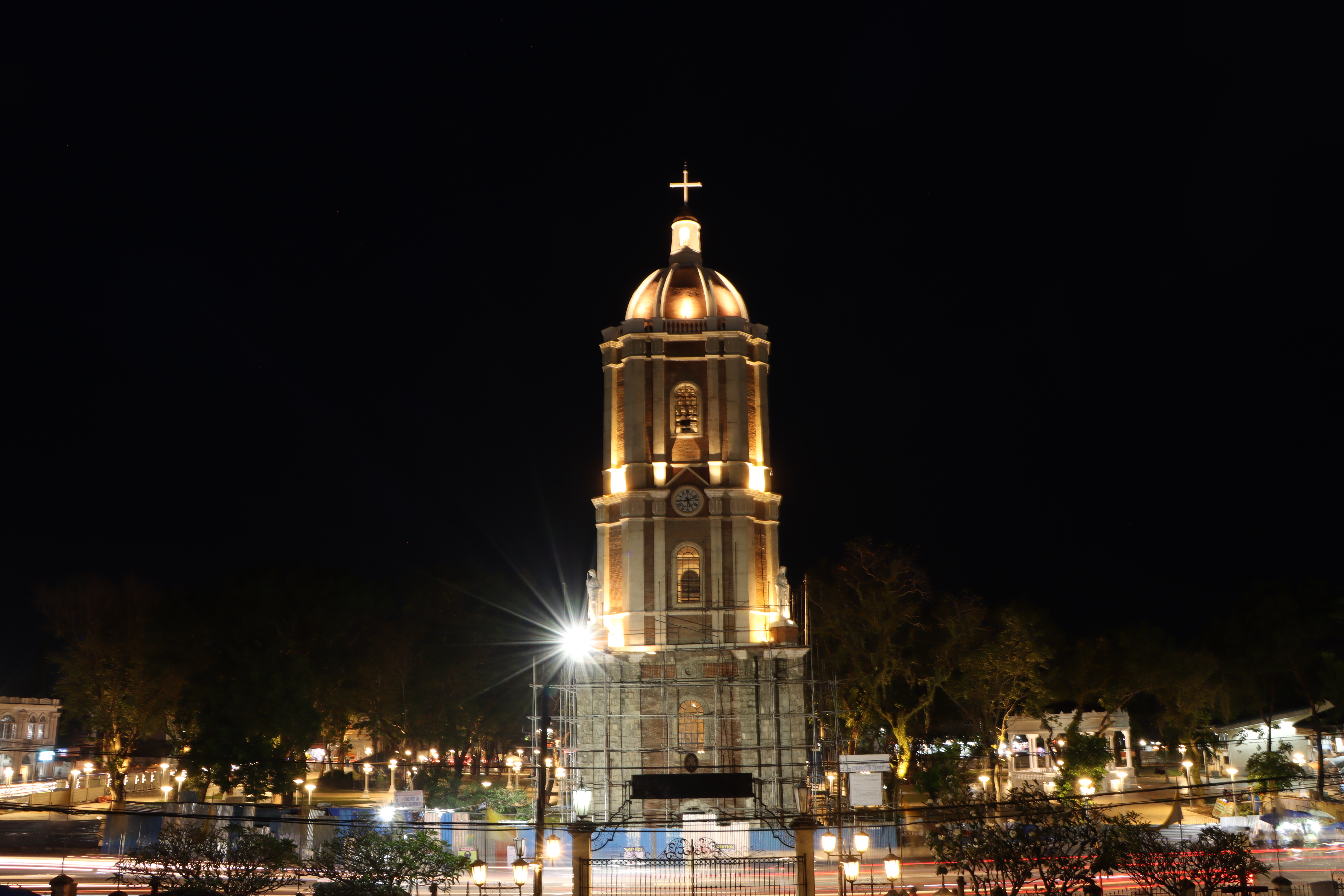
Jaro Belfry
On November 27, 2022, a sound returned to the Jaro district of Iloilo City that no living resident had ever heard in its original context. The bells of the Jaro Belfry rang for the first time in 74 years, their restored voices carrying across a plaza where the octagonal tower had stood in various states of ruin and repair since 1744. Three earthquakes had tried to bring it down. Each time, the tower came back. This time, four statues representing the cardinal virtues -- temperance, prudence, fortitude, and justice -- watched from its corners as if they had been waiting all along.
Watchtower and Campanile
Built in 1744 from bricks and limestone blocks, the Jaro Belfry served a dual purpose from the start. It was a campanile for the adjacent Jaro Metropolitan Cathedral, but it also functioned as a military watchtower during the Spanish colonial period, scanning the horizon for Moro raiders who periodically attacked settlements across the Visayas. The tower stands separately from the cathedral, one of only a handful of free-standing belfries in the Philippines, and the oldest bell tower in the entire Visayan island group. Its four-tier octagonal form rises from a limestone base through brick upper tiers, capped with a conical roof and cupola designed to house the bells. Four clocks, one on each side, were part of the original design, giving the tower a civic as well as religious identity.
Three Earthquakes, One Tower
The seismic history reads like a stress test. On July 17, 1787, a powerful earthquake heavily damaged the belfry. Reconstruction did not begin until 1833, nearly half a century later, when Augustinian friar Fr. Jesse Alvarez supervised the rebuilding. On June 29, 1868, another earthquake struck. Msgr. Mariano Cuartero, the first bishop of Jaro, ordered a complete restoration that was finished in 1881. Then came January 25, 1948, and the Lady Caycay earthquake that swept across Panay. This time, the second and third floors collapsed entirely, leaving only the ground floor standing as the sole surviving original structure. The belfry would remain truncated for decades, its bells silent, its clocks stopped.
Decades of Unfinished Restoration
Recognition came in 1984 when the National Historical Institute declared the Jaro Belfry a National Historical Landmark. The agency began reconstruction in the 1990s with plans to create a viewing deck and tourist center. But the project stalled. A conflict between the restoration authorities and the Archdiocese of Jaro left the tower in administrative limbo, restored in structure but never opened as intended. The belfry sat in this half-finished state for years, a monument that had survived earthquakes only to be stymied by bureaucracy. It was not until February 2022 that the National Historical Commission of the Philippines launched a fresh restoration, this time committing to return the tower to its original design.
Virtues Restored
The 2022 restoration brought back elements that had been missing for years. Four statues representing the cardinal virtues -- temperance, prudence, fortitude, and justice -- were placed at each corner of the tower's podium, recreating the original decorative program. The clocks, silent since 1948, were repaired and reset. Workers preserved the tower's original brick and limestone materials while reinforcing its structural stability against future seismic events. The turnover ceremony on November 27, 2022, included the unveiling of a new historical marker, but the moment that mattered most was the sound: the bells of the Jaro Belfry ringing across the plaza for the first time since the Lady Caycay earthquake had silenced them 74 years earlier. The tower had been given back its voice.
From the Air
Located at 10.724°N, 122.557°E in the Jaro district of Iloilo City, on the southeastern coast of Panay Island. The octagonal belfry stands separately from the Jaro Metropolitan Cathedral and is visible as a prominent vertical structure in the urban landscape. Nearest airport is Iloilo International Airport (RPVI), approximately 8 km to the west. Best viewed at 1,500-2,500 ft AGL. The Iloilo River meanders through the city to the south, and the Guimaras Strait is visible beyond.