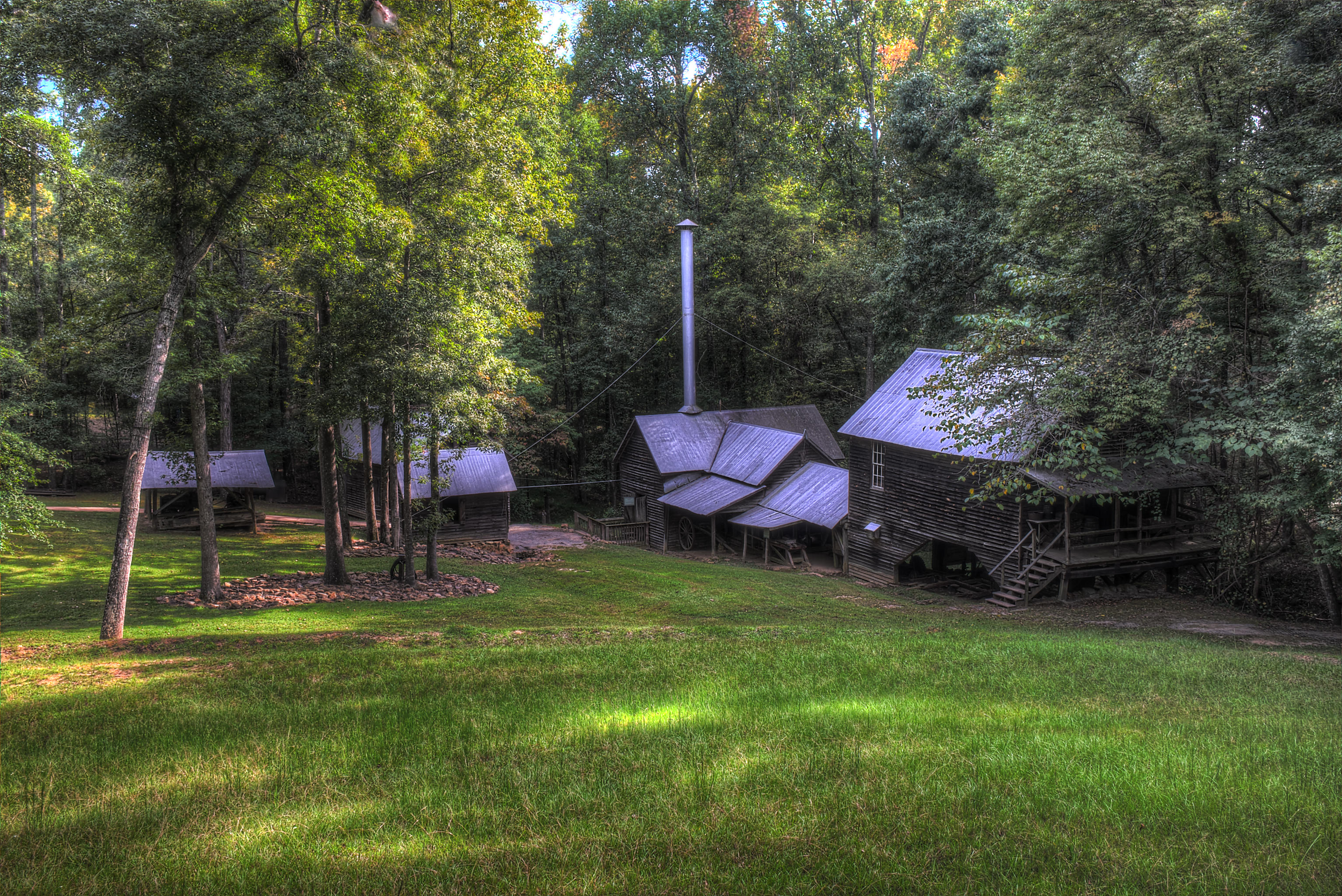
Jarrell Plantation
The cotton gin still stands. So does the sawmill, the gristmill, the shingle mill, the sugar cane press, and the syrup evaporator. At Jarrell Plantation in Jones County, Georgia, the machinery of a working farm survives not as a museum reconstruction but as the real thing, passed down through five generations of one family who never threw anything away. Most Southern plantations left behind only columns and legend. This one left behind the tools.
A Half-Million Cotton Farms
Before the Civil War, John Fitz Jarrell's operation was one of roughly half a million cotton farms across the American South that collectively produced two-thirds of the world's cotton supply. Jarrell was not a wealthy planter in the grand antebellum tradition. He was what historians call "middle class" -- a small-scale operator who built his first permanent structure on the property in 1847 and relied on the forced labor of enslaved African Americans to work the red clay hills of Georgia's piedmont region. By 1860, Jarrell was enslaving 39 people on the farm. The development of Eli Whitney's cotton gin in 1793 had made it practical to cultivate short-staple cotton even in the hilly, inland terrain far from the coastal plantations, and families like the Jarrells seized that opportunity. The wealth they built came at an incalculable human cost.
What the Machines Remember
Walk the grounds today and you encounter an extraordinary collection of original structures and equipment. The 1847 farmhouse still stands alongside an 1895 house built by a later generation. The cotton gin that made the whole enterprise possible sits in its gin house, a physical link to Whitney's invention that reshaped the South. A sawmill cut the timber. A gristmill ground the corn. A shingle mill roofed the buildings. A planer smoothed the boards. A sugar cane press and syrup evaporator produced sweetener. Every building and artifact on the site came from the Jarrell family themselves -- nothing was imported from other collections or reconstructed from plans. This is what makes the site so rare: it is a complete, authentic record of how a working Southern farm actually operated, from field to finished product.
Five Generations, One Place
The Jarrells farmed this land for over 140 years, surviving the Civil War, Reconstruction, and the long economic struggles that followed. The family adapted as the world changed around them, but they never abandoned the property or demolished its aging structures. In 1974, Dick Jarrell's nine surviving adult children made a remarkable decision: they donated the entire plantation site to the State of Georgia. Their goal was preservation and education -- to ensure that future generations could see how their ancestors lived and worked, without pretense or polish. The Georgia Department of Natural Resources now operates the site as a state historic park, opening it to the public Thursday through Sunday. It was added to the National Register of Historic Places in 1973, the year before the family's donation.
The Uncomfortable Truth
Jarrell Plantation does not let visitors forget the foundation on which it was built. The site is described plainly as a forced-labor farm, and the 39 enslaved people who worked the land in 1860 are acknowledged as central to the story. This is not a plantation that trades in moonlight-and-magnolias nostalgia. The red clay hills, the simple farmhouse, the utilitarian machinery -- all of it speaks to a hardscrabble operation far removed from the columned mansions of popular imagination. The preservation of such a "middle class" plantation is itself historically significant, since most surviving plantation sites represent the wealthiest tier of Southern society. Jarrell Plantation offers a more representative, and more uncomfortable, window into the everyday workings of the cotton economy.
From the Air
Located at 33.05°N, 83.73°W in Jones County, Georgia, roughly 25 miles northeast of Macon. The site sits in the rolling red clay hills of the Georgia piedmont. Nearest airports include Middle Georgia Regional Airport (KMCN) in Macon, approximately 20 nm to the southwest. From cruising altitude, look for the forested rural landscape between Macon and Milledgeville. The plantation's cluster of historic structures is set among wooded terrain typical of this part of central Georgia.