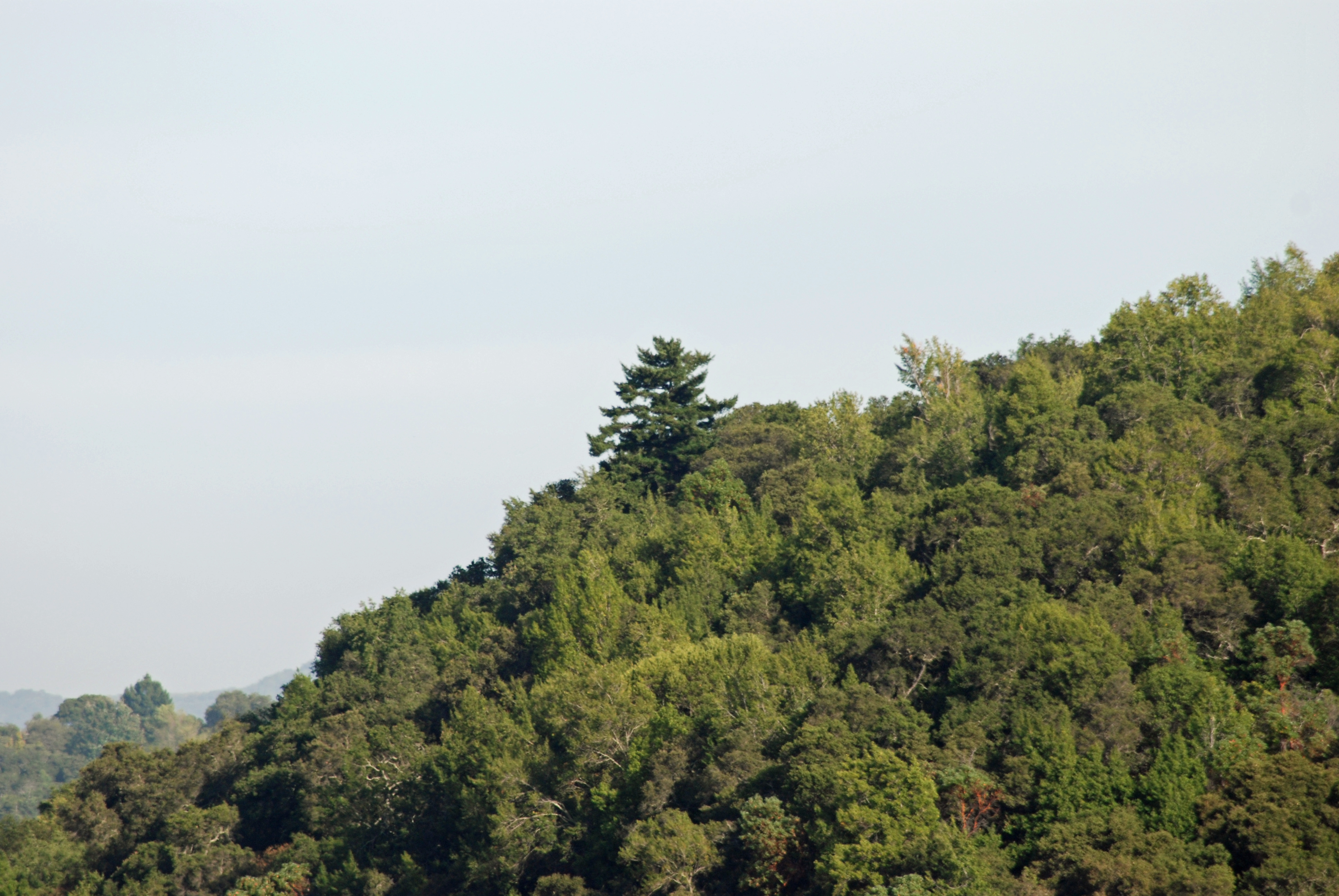
Jasper Ridge Biological Preserve
Pick up a rock at Jasper Ridge and you might be holding something squeezed from the ocean floor. Serpentinite, California's state rock, feels greasy to the touch -- polished smooth by millions of years of tectonic compression as deep-sea mantle rocks were forced toward the surface by plate movement. The Jasper Ridge Biological Preserve, a 1,200-acre nature reserve owned by Stanford University, sits atop this geological restlessness in the foothills northeast of the Santa Cruz Mountains. Formally established as a reserve in 1973, it serves as an open-air laboratory where students and researchers study everything from grassland responses to climate change to the migratory patterns of Argentine ants.
Geology Underfoot
Jasper Ridge is bounded by San Francisquito Creek, Corte Madera Creek, and Los Trancos Creek, though the preserve occupies only the northwestern half of the ridge. The hilly mass runs about ten kilometers from northwest to southeast and half that in width. The rocks tell a deep story: graywacke sandstone from the Franciscan formation dates to 138 million years ago. Greenstone, chert, serpentinite, and sandstone all surface here, each a chapter in the tectonic history of the Pacific margin. Ohlone people once ground acorns in mortars carved into the bedrock -- stone pestles have been found at the preserve, connecting its geological deep time to its more recent human past.
Living Laboratory
The preserve encompasses Searsville Lake, actually a reservoir, and the upper reaches of San Francisquito Creek along with its Corte Madera Creek and Bear Creek tributaries. Within this relatively compact area, the landscape shifts from coast redwood groves to chaparral to annual grasslands. The Global Change Experiment, one of the preserve's signature research programs, studies how California's annual grasslands respond to elevated atmospheric CO2, temperature changes, altered precipitation patterns, and increased nitrogen deposition. Researchers track Argentine ants, an invasive species that has displaced native ant populations across California. A monitoring station near the lake records bat echolocation calls at night, building a picture of the nocturnal ecosystem that most visitors never see.
Chaparral to Grassland
In 1922, botanist William Skinner Cooper argued that Jasper Ridge was historically chaparral -- dense, woody shrubland -- and had been cleared in the nineteenth century to create open grasslands dominated by Eurasian wild oats. That transformation, typical of California's coastal hills, means the preserve's current landscape is itself an artifact of human alteration. The grasslands are now the focus of some of the most important climate research in the state. Located just south of Sand Hill Road and west of Interstate 280, the preserve sits within minutes of the venture capital offices and tech campuses that define modern Silicon Valley. That proximity makes it something rare: a place where deep geological time and cutting-edge ecological science coexist a short drive from the most future-obsessed region on Earth.
From the Air
Jasper Ridge Biological Preserve is at 37.41°N, 122.23°W in Portola Valley, west of Interstate 280. The preserve's mix of grasslands and forested hills is visible from the air. Searsville Lake (reservoir) is a recognizable feature within the preserve. Nearby airports: Palo Alto (KPAO), San Carlos (KSQL). Best viewed at 2,000-4,000 ft AGL.