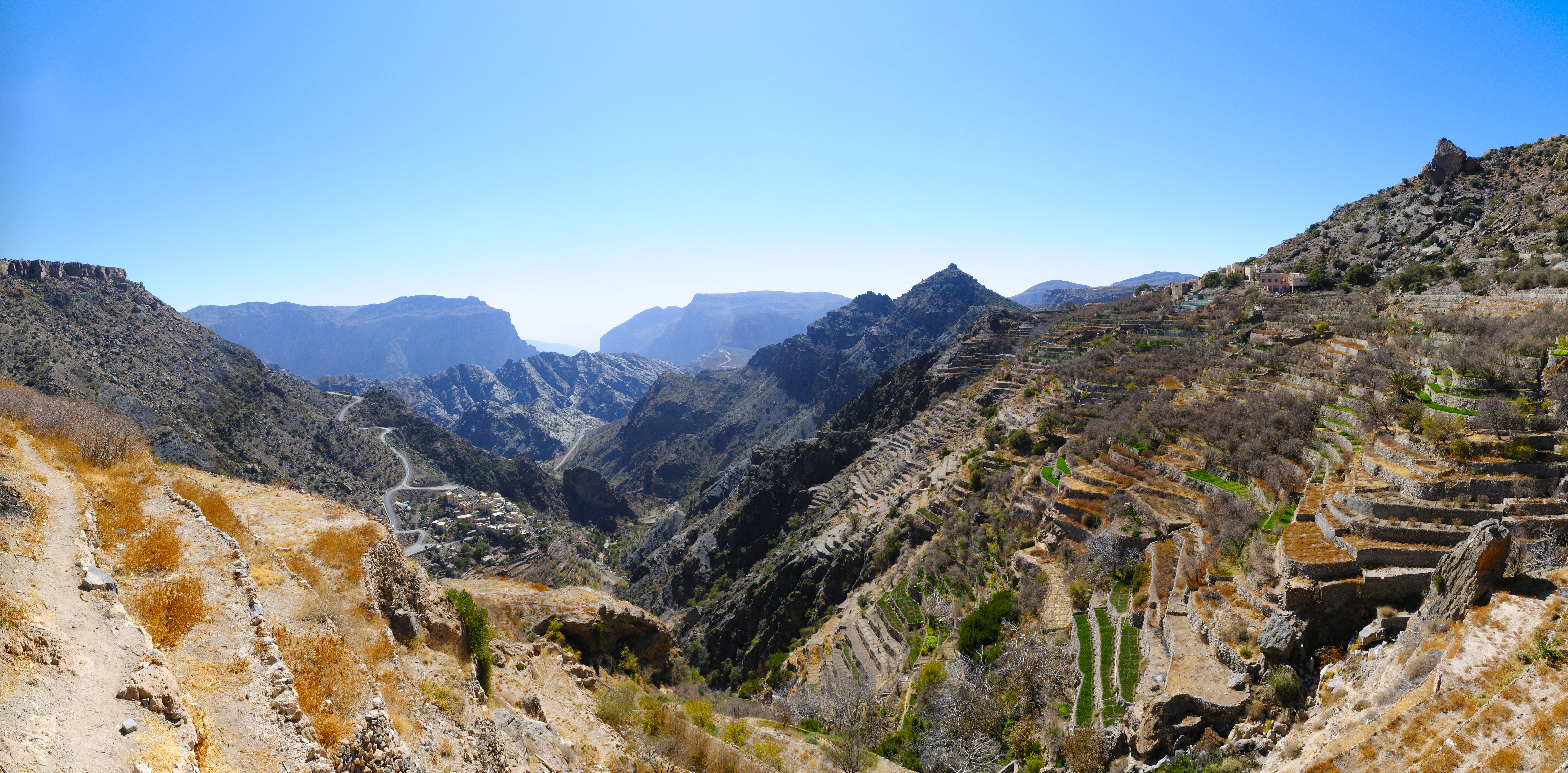
Jebel Akhdar (Oman)
In a country defined by desert, one mountain range decided to be different. Jebel Akhdar -- the Green Mountain -- rises to 3,018 meters in the heart of Oman, catching just enough rain at altitude to support what the lowlands cannot: terraced orchards of pomegranates, apricots, and walnuts, groves of olives and peaches, and the Damask roses from which Oman's famous rose water is distilled. At its base, the land is bare rock and sand. At its summit, the air smells of fruit blossoms. The transition happens in the space of a 45-minute drive from Nizwa -- a drive that is only possible in a four-wheel-drive vehicle.
Where Green Is Earned
The name is not exaggeration. Jebel Akhdar earns its greenness through altitude. At lower elevations, the range is desert like everything around it. But above 1,300 meters, the mountain begins to catch roughly 300 millimeters of annual precipitation -- modest by global standards, transformative in eastern Arabia. Shrublands give way to semi-evergreen woodlands of wild olives, junipers, and myrtles between 1,350 and 2,350 meters. The Saiq Plateau, at 2,000 meters, supports the terraced agriculture that has sustained mountain communities for centuries. Farmers of the Bani Riyam tribe, who have inhabited the Jebel for generations, use falaj irrigation channels and stone terraces to cultivate crops that would be impossible on the plains below. The honey bees they raise supply much of Oman's honey production.
Rock Art and Rose Water
Human habitation on Jebel Akhdar stretches back at least 6,000 years, evidenced by rock art sites discovered across the range. The historic village of Al Sogara was carved directly into the mountainside. But the mountain's most celebrated tradition is more fragrant than ancient. Each spring, farmers harvest Damask roses from terraced gardens and extract rose water using a process passed down through generations. The distillation is both craft and ceremony, carried out in small batches by families who understand their particular microclimate and soil. Alongside the roses grow black grapes, walnuts, and the apricots for which the Saiq Plateau is known throughout Oman.
The SAS on the Green Mountain
Between 1954 and 1959, Jebel Akhdar became a battlefield. The rebel Imamate of Oman, backed by Saudi Arabia, used the mountain's natural fortress to resist the British-supported Sultan of Oman. The terrain made conventional military operations nearly impossible: the mountain's wadis and cliffs provided perfect defensive positions. Britain deployed the Special Air Service to break the stalemate. The SAS conducted a series of mountain operations that became legendary within the regiment's history. The war ended with the Imamate's defeat in 1959, but the destruction included deliberate British air strikes on the aflaj irrigation systems that sustained the mountain's population -- damage to infrastructure that had been maintained for centuries.
A Reserve for the Future
In August 2011, Sultan Qaboos designated Jebel Akhdar a nature reserve, establishing the Jebel Akhdar Sanctuary for Natural Sceneries. The declaration recognized what scientists had been arguing: the mountain's biodiversity, adapted to its unique position as a green island in an arid sea, is both rare and fragile. In 2025, UNESCO designated the mountain as a biosphere reserve. Since 2011, Jebel Akhdar has also served as the signature climb of the Tour of Oman professional bicycle race, bringing international cyclists up the same roads that once required mule trains. The mountain that sheltered rebels and roses now balances conservation, agriculture, and tourism on a slope where the margin between abundance and aridity is measured in meters of elevation.
From the Air
Located at 23.26N, 57.39E in Oman's Ad Dakhiliyah Governorate. Jebel Akhdar rises to 3,018 m (Jebel Shams peak), making it the highest point in Oman and eastern Arabia. Exercise extreme caution due to mountain terrain and potential turbulence. Nearest major airport is Muscat International (OOMS), approximately 150 km northeast. The Saiq Plateau at 2,000 m is a notable landmark. Four-wheel drive only on surface roads.