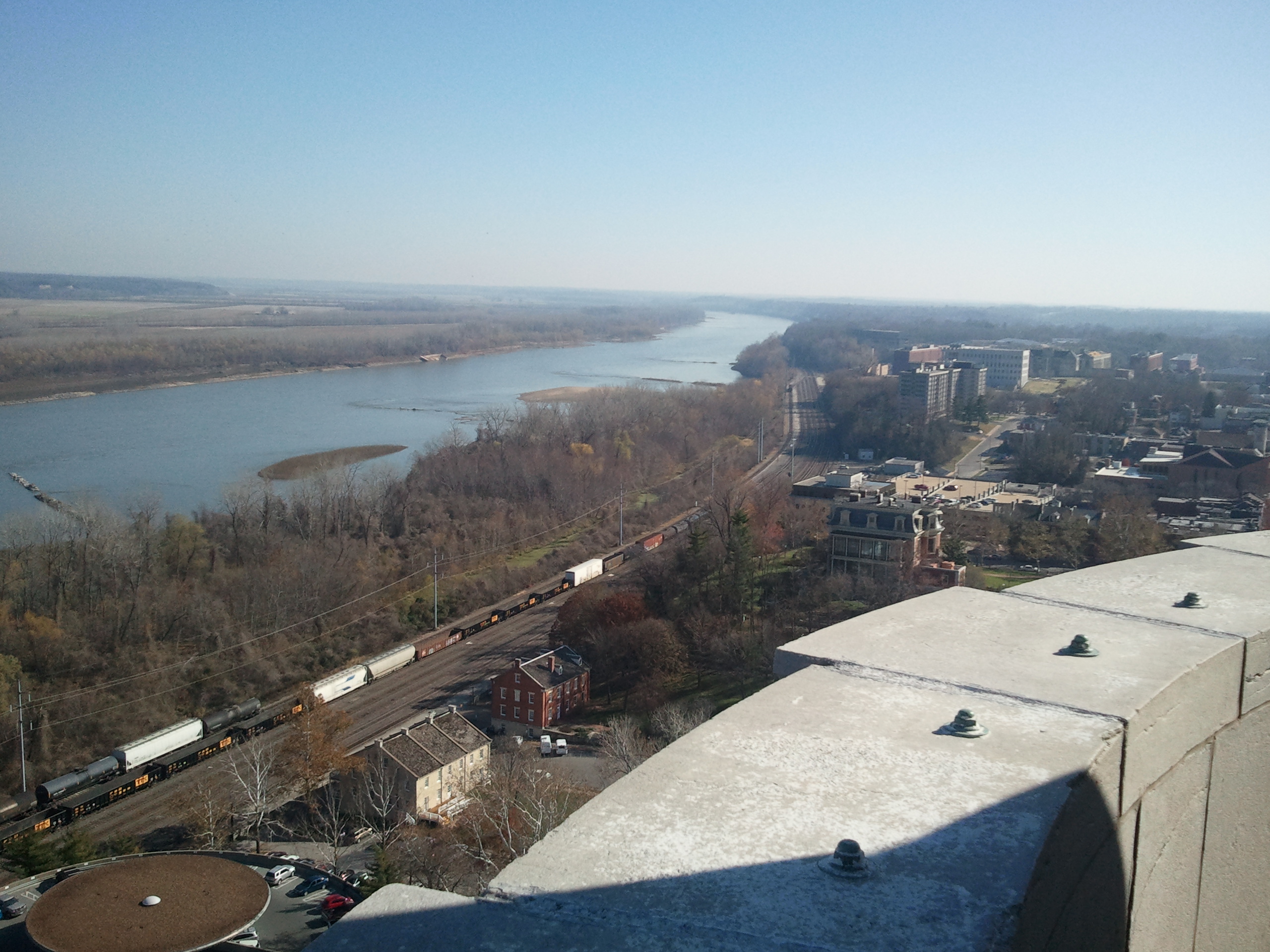
Jefferson City, Missouri
They almost called it Missouriopolis. When Missouri's new state legislature decided in 1821 to move the capital from St. Charles to a trading post on the southern bank of the Missouri River, that was one of the names proposed. Fortunately, cooler heads prevailed and they honored Thomas Jefferson instead, who was still alive at Monticello at the time. The village was barely a village -- Lohman's Landing, locals called it -- but it occupied a strategic bluff overlooking the river, roughly midway between St. Louis and Kansas City, at the northern edge of the Ozark Plateau. Two centuries later, Jefferson City remains one of America's least populous state capitals, with 43,228 residents as of 2020, yet its domed capitol building commands the river bluffs with an authority that belies the city's modest size.
A Son of Boone Draws the Lines
Before European settlers, the region belonged to the Osage people, who succeeded the ancient Mound Builders likely connected to Mississippian cultures. French frontiersmen including Louis Jolliet and Jacques Marquette explored the Missouri River valley in the late 17th century, but it was Daniel Boone who left the deepest mark on the region. His son, Daniel Morgan Boone, laid out and platted Jefferson City in the early 19th century. When the Missouri Territory was organized in 1812, St. Louis served as the seat of government, followed by St. Charles. Jefferson City was chosen as the permanent capital in 1821, the year Missouri joined the Union as the 24th state. The settlement was formally incorporated in 1825, and the legislature moved there the following year. Lewis and Clark's Corps of Discovery had passed this very bluff in 1804 on their journey upriver to the Pacific, long before anyone imagined a capitol dome rising from the spot.
A Capital Divided Against Itself
The Civil War tore Missouri apart, and Jefferson City sat at the fault line. Union General Nathaniel Lyon drove the elected state legislature from the capital. Some legislators reconvened in Neosho and passed an ordinance of secession, giving Missouri the bizarre distinction of being claimed by both the Confederacy and the Union simultaneously. The city was occupied by Federal troops throughout the war. The Missouri River valley between Jefferson City and Kansas City became the contested ground of 'Little Dixie,' where pro-Confederate sympathies ran deep. Meanwhile, German immigrants on both banks of the river east of the city were building vineyards that would earn the region the name 'Missouri Rhineland,' a wine-producing district that endures as part of the state's agricultural economy today.
Behind the Walls
Governor John Miller had a pragmatic idea when he proposed building the state's main prison in Jefferson City in the 1830s: it would help the young capital maintain its political status against rival towns trying to steal the seat of government. The Missouri State Penitentiary opened in 1836 and eventually became the oldest operating penal facility west of the Mississippi River before closing in 2004. Its inmate roster reads like a dark chapter of American history -- heavyweight boxing champion Sonny Liston, who learned to box behind its walls; James Earl Ray, who escaped in a bread box in 1967 and went on to assassinate Martin Luther King Jr.; and 1930s bank robber Pretty Boy Floyd. The old prison is now a tourist attraction, its stone walls a counterpoint to the gleaming capitol dome a few blocks away.
The Dome on the Bluff
The Missouri State Capitol dominates Jefferson City's skyline from every approach. The current building, dedicated on October 6, 1924, replaced earlier structures and rises from the same bluff that Lewis and Clark passed in 1804. The city sits at the western edge of the Missouri Rhineland wine country and just south of Columbia, home to the University of Missouri. Jefferson City is one of only four state capitals in the United States not served by an interstate highway -- the others being Dover, Juneau, and Pierre. Amtrak's Missouri River Runner stops at the Jefferson City station, housed in a former Union Hotel at Jefferson Landing State Historic Site, connecting the capital to Kansas City and St. Louis. Lincoln University, founded in 1866 by Black veterans of the Union Army's First and Second Missouri Regiments of Colored Infantry, anchors the city's educational identity.
Old Munichburg and the Rhineland
About 200 years ago, settlers from the Bavarian town of Munchberg established a neighborhood south of downtown that is still known as 'Old Munichburg.' Jefferson City remains sister city to Munchberg today. This German heritage extends beyond the city limits into the Missouri Rhineland, where vineyards established by mid-19th-century immigrants line the river bluffs from Jefferson City eastward toward Marthasville. On May 22, 2019, the city was reminded of its vulnerability to nature when an EF-3 tornado struck the southwest side just before midnight, injuring at least 20 people but killing none. The tornado was part of a severe weather outbreak that night, a reminder that life on the edge of the Ozark Plateau means sharing space with the thunderstorms common to Missouri springs and summers.
From the Air
Located at 38.5678°N, 92.1758°W on the southern bank of the Missouri River at approximately 700 feet MSL, on the northern edge of the Ozark Plateau. The monumental domed Missouri State Capitol is the most prominent landmark, visible on the river bluffs from considerable distance. Jefferson City Memorial Airport (KJEF) serves general aviation in Callaway County just north of the city. Columbia Regional Airport (KCOU) is approximately 25 nm north in Columbia. The Missouri River traces the city's northern boundary. Interstate 70 passes about 25 miles north through Columbia. The Missouri Rhineland wine country extends east along the river. Best viewed at 3,000-6,000 feet AGL to appreciate the capitol dome, river bluffs, and surrounding Ozark terrain.