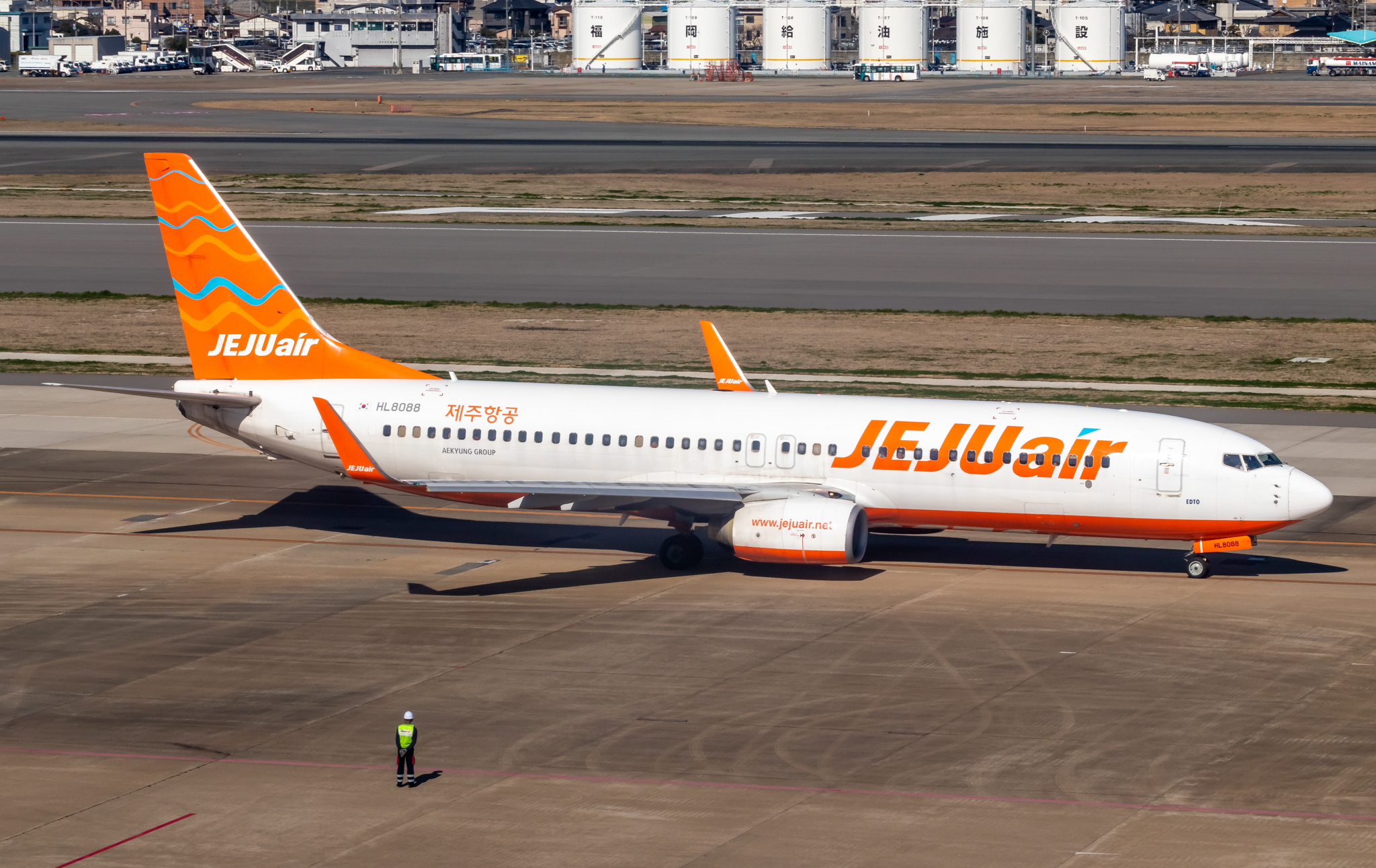
Jeju Air Flight 2216
Muan International Airport was never designed for what happened on December 29, 2024. The Boeing 737-800 operating Jeju Air Flight 2216 from Bangkok was on its second approach when it touched down without landing gear, belly-sliding at high speed past the normal touchdown zone. At the end of Runway 01, where the concrete should have given way to open ground, a berm encased a concrete structure supporting the instrument landing system's antenna array. The aircraft struck it at full speed. Of 181 people aboard, 179 died. Only two cabin crew members, seated in the rear section that broke away from the fuselage, survived.
Birds in the Engine
The flight from Suvarnabhumi Airport had been routine for most of its duration. The 737-800, a fifteen-year-old aircraft that had accumulated over 38,000 flight hours, carried 175 passengers and 6 crew members on the scheduled international service to Muan County in southwestern South Korea. As the aircraft approached Muan on that December morning, both engines ingested birds. The right engine suffered an apparent loss of thrust. The flight crew declared a mayday and attempted a go-around, circling back for a second approach to Runway 01. During that second attempt, the landing gear did not deploy. Whether the bird strike had damaged the hydraulic systems, or whether other factors prevented extension, became a central question for investigators. What is certain is that the aircraft made contact with the runway on its belly, without the wheels that might have slowed it to a stop.
The Wall at the End of the Runway
The Sewol disaster had taught South Korea hard lessons about institutional failures compounding a crisis. Jeju Air Flight 2216 delivered another. As investigators examined the wreckage, attention turned to the concrete structure at the end of Runway 01. Airport design standards typically call for runway end safety areas to be clear of solid obstacles, providing a buffer zone for aircraft that overshoot. At Muan, the localizer antenna for the instrument landing system was mounted on a structure encased in a concrete-reinforced berm positioned beyond the runway's end. The aircraft, sliding without landing gear at high speed, collided with this structure and disintegrated. Questions about whether the antenna placement met international safety standards became a focal point of the investigation. A frangible or relocatable localizer installation might have allowed the aircraft to pass through or over the obstacle, potentially giving passengers a chance at survival.
175 Passengers, 175 Lives
The passenger manifest told the story of an ordinary holiday flight. Travelers were returning to South Korea after vacations in Thailand, many of them heading home in the final days of the year. The crash killed all 175 passengers and four of the six crew members. The two surviving flight attendants, Lee Ji-won and Koo Jeong-won, were seated in the aft section of the cabin. When the fuselage broke apart on impact, the tail section separated and came to rest away from the main wreckage. Rescue workers pulled both women from the debris with injuries. Their survival, from the very rear of an aircraft that was otherwise completely destroyed, underscored both the violence of the impact and the randomness of who lives and who dies in a high-speed crash. Families of the victims gathered at Muan and in Seoul in the days that followed, their grief compounded by the timing: the crash occurred just three days before the new year.
Lessons Written in Concrete
The investigation, led by South Korea's Aviation and Railway Accident Investigation Board with assistance from the US National Transportation Safety Board and Boeing, examined multiple converging factors. The bird strike that initiated the emergency was not unprecedented; bird strikes occur at airports worldwide. But the chain of events that followed, from the apparent loss of thrust to the failure of the landing gear to the presence of a hardened structure in the overrun area, raised questions that extended well beyond a single flight. South Korea's transport ministry ordered inspections of localizer installations at airports across the country. The crash became the deadliest involving a Boeing 737-800, an aircraft type with over 5,000 units delivered worldwide, and the deadliest aviation disaster in South Korean history. For the families, the policy debates were secondary to an unanswerable question: how an airport's own navigation equipment became the instrument of destruction for the plane it was meant to guide safely to the ground.
From the Air
Located at 34.98°N, 126.38°E at Muan International Airport (RKJB) in South Jeolla Province, South Korea. The crash site is at the Runway 01 end. The airport sits on flat coastal terrain near Muan County. Gwangju Airport (RKJJ) is approximately 60 km to the east. The area is characterized by flat agricultural land and tidal flats along the coast.