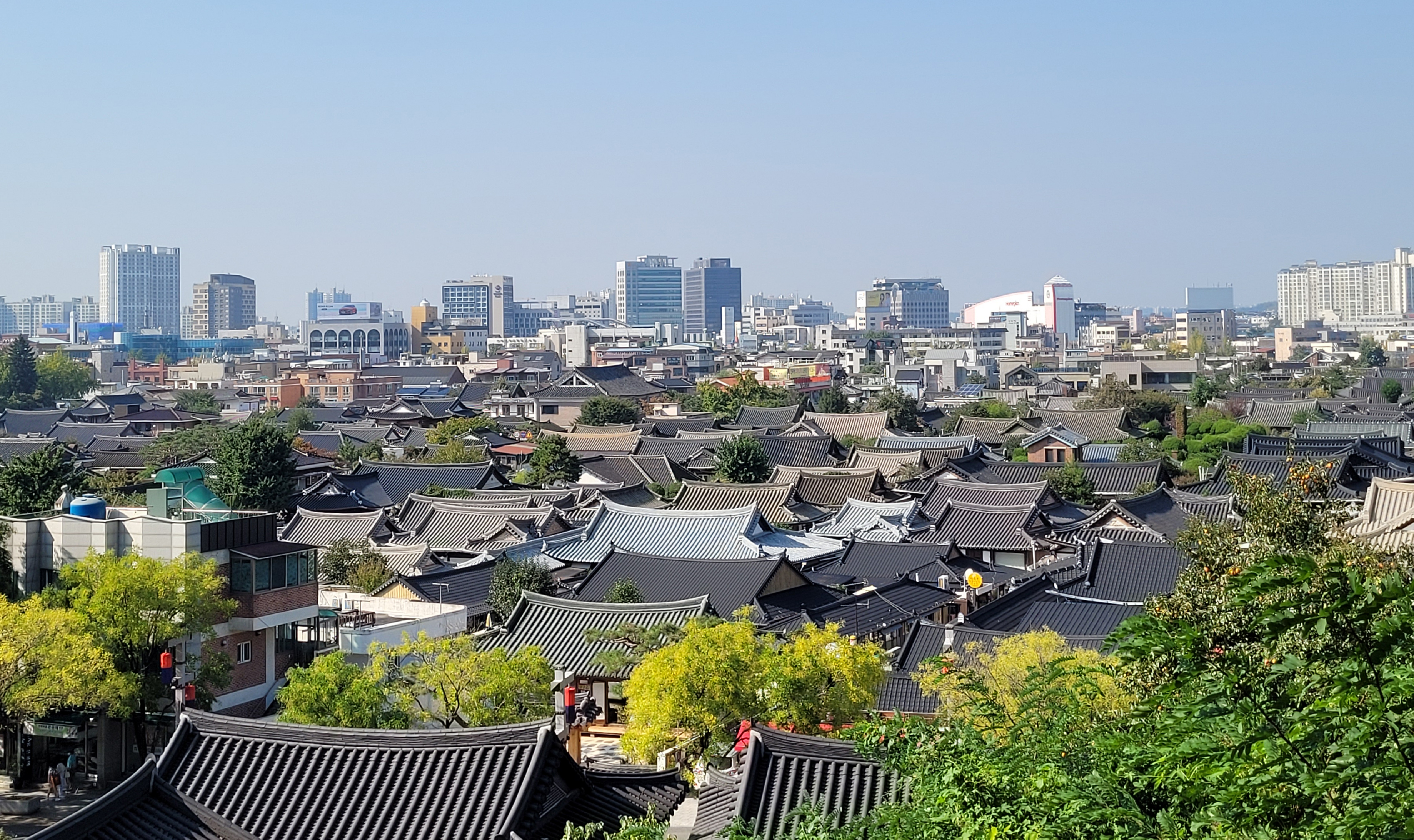
Jeonju Hanok Village
Step through the Pungnam Gate and the twenty-first century falls away. The curved clay rooflines of over 800 hanok -- traditional Korean houses -- rise in tight rows through the Pungnam-dong and Gyo-dong neighborhoods, their dark tiles and warm wood framing a village that has existed since the Joseon Dynasty planted its spiritual roots here. Jeonju Hanok Village was designated an International Slow City in 2010, which is ironic given that nearly eight million people visit each year, making it South Korea's third most popular tourist destination outside Seoul.
A Thousand Years of History
Jeonju's significance runs deeper than its architecture. The city served as the capital of the Hubaekje Kingdom, founded by Kyon Hwon in the early 900s, and later became the spiritual capital of the Joseon Dynasty because the Yi royal family traced its origins here. For centuries, Jeonju governed the entire Jeolla Province along with Jeju Island, functioning as the region's administrative center. This is why Koreans call it 'the ground of more than 1,000 years of history.' The village's landmark Gyeonggijeon hall, built in 1410 during King Taejong's reign, still enshrines the portrait of Joseon founder Lee Seonggae -- designated National Treasure #317. At the nearby Omokdae overlook, Lee Seonggae reportedly held an outdoor banquet to celebrate his victory over Japanese coastal invaders at Hwangsan Mountain, before the dynasty he would found had even begun.
Where Faiths and Dynasties Overlap
The village's layered history is visible in its buildings. The Jeonju Hyanggyo, a Confucian temple and school first constructed by King Gongmin in 1354 during the Goryeo Dynasty, contains 99 rooms arranged in an unusual configuration with the shrine hall in front and the lecture hall behind. It has been relocated twice after wars but continues to stand. Nearby, the Jeondong Cathedral -- completed in 1914 and designed by Priest Poinel, who also created Seoul's famous Myeongdong Cathedral -- blends Romanesque and Byzantine architecture on the very spot where Korea's first Catholic martyr, Yun Ji-chung, died in 1791. It remains the largest and oldest Western-style structure in the Jeolla provinces. These buildings sit within walking distance of each other, creating a landscape where Confucian, Catholic, and royal Korean traditions coexist in a few city blocks.
Walls and Gates
Pungnam Gate, the south gate of the city wall that once enclosed Jeonju, is the only one of the original four directional gates to survive. Designated National Treasure #308 in 1963, it was demolished along with the others during King Seonjo's reign in 1597, then rebuilt, and restored again after three years of repair work beginning in 1978. The column arrangement on its second story is considered a rare example of traditional Korean building technique. Elsewhere in the village, the Gyeonggijeon complex bears its own scars of history: its west side and annex were demolished during the Japanese colonial period to make room for an elementary school, reducing the compound to a fraction of its original size. What remains is a simple but graceful structure connecting outer and inner gates, its interior focused entirely on the portrait that has survived every disruption the centuries could deliver.
Tradition Under Pressure
The tension at Jeonju Hanok Village is one that traditional communities worldwide would recognize. Visitor numbers more than doubled between 2007 and 2014, from 3.17 million to 7.89 million, and the village's narrow lanes now absorb more foot traffic in a weekend than many neighborhoods see in a year. Over half of the 506 commercial facilities in the village opened after 2013, many of them small food and beverage stands. Traditional tea houses have declined from ten to six. Handicraft workshops have given way to souvenir shops. At the Traditional Hanji Center, artisans still produce authentic Korean paper using centuries-old techniques -- 80 percent of production is exported to Japan -- but the center exists alongside a commercial district that grows more tourism-focused each year. The village asks a question it cannot quite answer: how does a living neighborhood remain traditional when tradition itself becomes the attraction that transforms it?
From the Air
Located at 35.81N, 127.15E in the city of Jeonju, South Korea. The village's distinctive cluster of dark-tiled hanok rooftops contrasts visibly with the modern city surrounding it. Gunsan Airport (RKJK) is approximately 30 nm to the northwest; Cheongju International Airport (RKTU) is approximately 70 nm to the northeast. The Pungnam Gate and Gyeonggijeon complex are identifiable landmarks from lower altitudes. Best viewed at 2,000-4,000 ft.