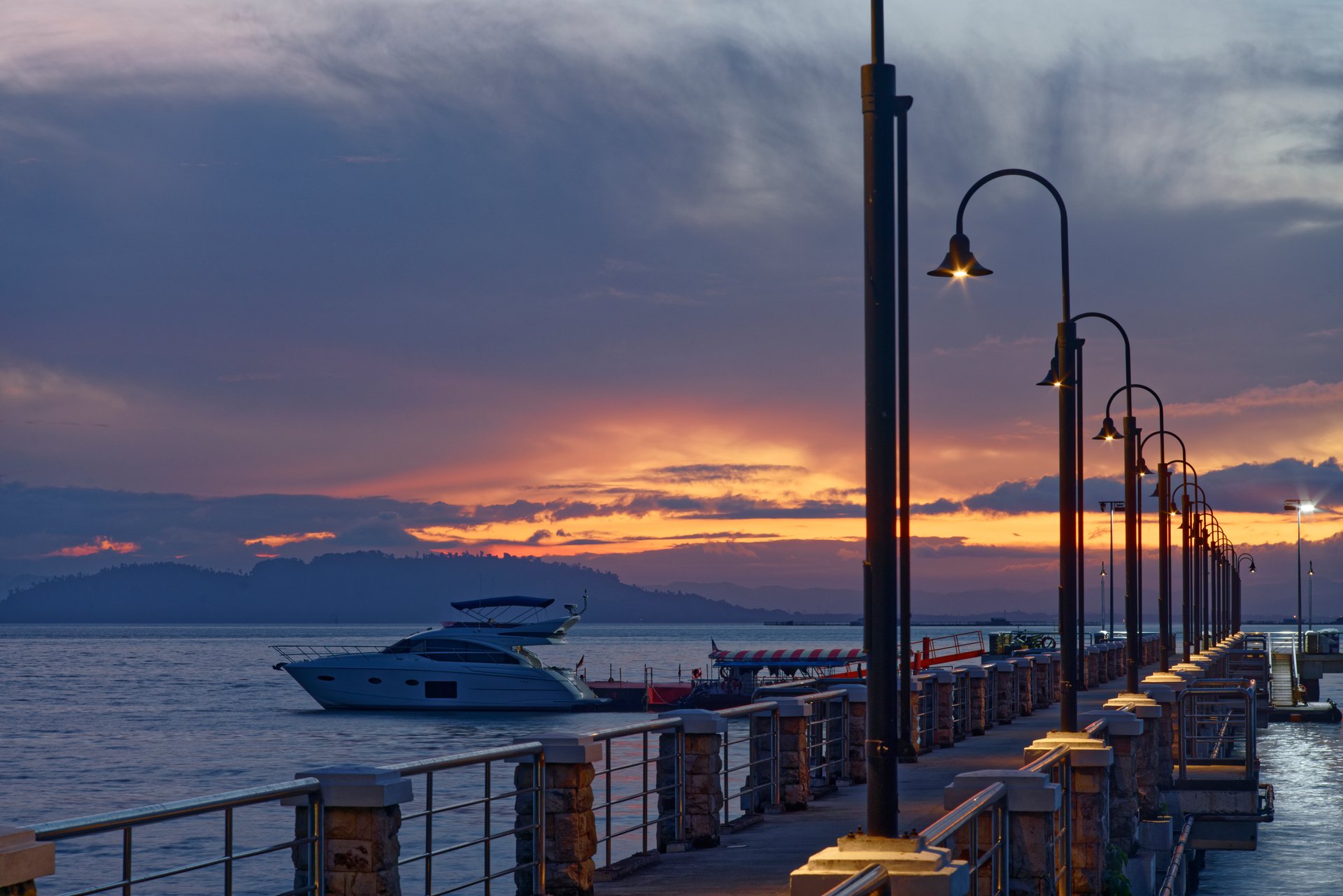
Jerejak Island
They called it the Alcatraz of Malaysia, though the prisoners who arrived at Jerejak Island in 1969 were not the first people confined here against their will. This small islet off the eastern coast of Penang had already spent a century as a place where the unwanted were sent: immigrants awaiting health clearance, leprosy patients isolated from society, tuberculosis victims with nowhere else to go. Each chapter erased the one before it, and today a resort occupies the ground where the leprosarium once stood. Jerejak's history is a case study in how societies deal with the people they fear.
Francis Light's First Landfall
Before Penang became a British possession, Francis Light, the founder of the colony, reportedly landed on Jerejak Island in early 1786 on his way to claim Penang for the East India Company. A decade later, Colonel Arthur Wellesley, the future Duke of Wellington, proposed building Fort Cornwallis on Jerejak rather than on Penang Island itself. His reasoning was practical: malaria had ravaged George Town since the jungle clearance that founded the settlement, killing many colonists, including Light himself in 1794. Wellesley envisioned a military post on Jerejak protecting a new township called Jamestown in present-day Bayan Lepas. But George Town was already becoming profitable as a port, and the plan was abandoned. Jerejak would not become a fortress. It would become something else entirely.
Island of Quarantine
Under Francis Light's open immigration policy, anyone who could clear land in Penang could claim it. Immigrants flooded in, and colonial authorities needed a way to screen them for disease before letting them onto the main island. Jerejak became that filter. By 1875, the eastern and northern portions of the island housed a quarantine station where new arrivals endured health inspections. In 1868, construction began on a leper asylum, which opened in 1871, funded not by the colonial government but by the local community. By 1880 it had expanded into the primary leprosarium for the entire Straits Settlements, receiving patients from across British Malaya. The people confined here lived in an isolation that was both medical and social, separated from families and communities by a short stretch of water that might as well have been an ocean. The leprosarium operated until the 1960s, when its residents were transferred to the Sungai Buloh settlement on the mainland.
A War Memorial in Unexpected Waters
On 28 October 1914, the German cruiser SMS Emden slipped into Penang harbor and sank the Russian cruiser Zhemchug in one of the few naval engagements fought in Malaysian waters during World War I. A memorial on Jerejak Island commemorates two crew members of the Imperial Russian Navy who died in the attack. It is a strange and quiet monument, tucked away on an island better known for its institutions of confinement, honoring sailors from a navy and an empire that would both cease to exist within four years of their deaths. After World War II, tuberculosis cases surged, and Jerejak added a sanatorium to its growing inventory of medical facilities. The island had become a repository for conditions that mainland society preferred to keep at arm's length.
The Alcatraz Years
On 12 June 1969, the Jerejak Rehabilitation Centre opened as a maximum-security prison, and the island earned its most dramatic nickname: the Alcatraz of Malaysia. The choice of location followed a grim logic. Jerejak was already isolated, already associated with confinement, and already equipped with infrastructure from its decades as a medical facility. For nearly a quarter century, the prison operated on the island until its closure in August 1993. The moniker stuck longer than the institution did, giving Jerejak a reputation that its small size and lush tropical vegetation seem to contradict. From a distance, it looks like any other green islet in the strait. Up close, the ruins of successive institutions tell a different story.
Resort Over Ruins
In 2000, plans emerged to redevelop Jerejak as a tourist destination. The sanatorium and prison were closed, and in January 2004, the Jerejak Resort and Spa opened for business, built directly over the site of the former leprosarium. The transformation was not universally celebrated. Critics raised concerns about the systematic removal of the island's historical remains, arguing that Jerejak's layered heritage of quarantine, medical care, and imprisonment deserved preservation rather than demolition. Environmental advocates pointed to the impact on the island's fragile ecosystem. Today, Jerejak is a ten-minute ferry ride from the Bayan Lepas jetty, close enough to Penang to feel like an extension of the suburb yet separate enough to maintain its island character. Whether it has found its final identity or is merely waiting for the next chapter remains an open question.
From the Air
Located at 5.32N, 100.32E, just off the southeast coast of Penang Island. Visible as a small forested islet in the channel between Penang and the mainland. Penang International Airport (WMKP) is approximately 3 km to the northwest at Bayan Lepas. Best viewed at 2,000-3,000 ft for scale against Penang Island. The ferry route from Bayan Lepas jetty is visible as a short crossing on the island's western side.