Jerome, Arizona
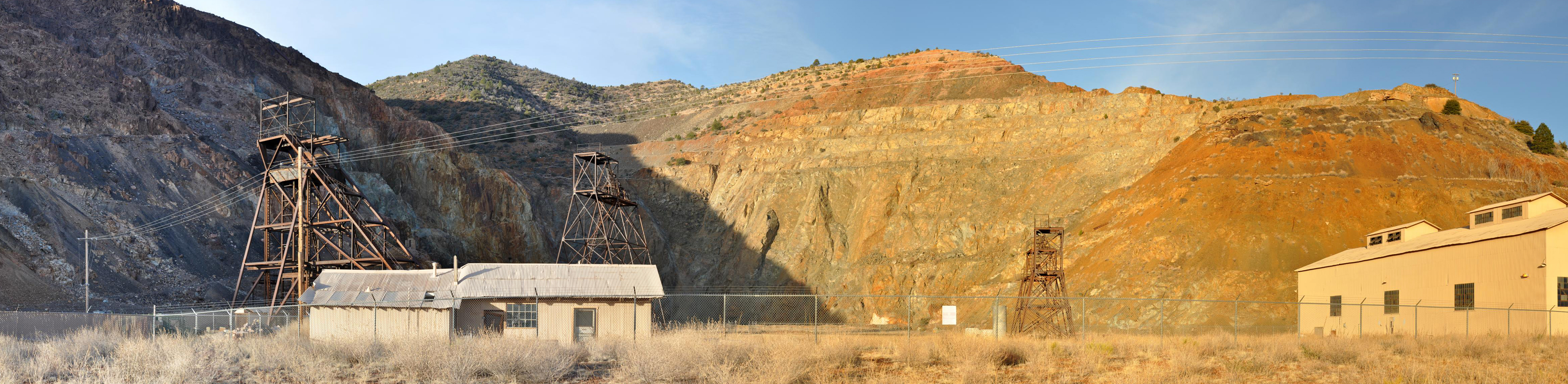
The jail moved two hundred and twenty-five feet without anyone inside it. Blasted off its foundation by a dynamite charge in the 1930s, Jerome's old town lockup slid slowly downhill across the road and simply stopped, as if it had decided that was far enough. The building still stands where it landed, and in a town where gravity has always been more suggestion than law, nobody bothered to move it back. This is Jerome, Arizona, a copper mining camp bolted onto the side of Cleopatra Hill at 5,000 feet, overlooking the Verde Valley. For seven decades it roared with industry and ambition. Then, almost overnight, it fell silent. Today, with a population hovering around 450, Jerome is one of America's most improbable second acts: a ghost town that refused to disappear.
Ore, Empire, and a Churchill Connection
The rock beneath Jerome is ancient, roughly 1.75 billion years old, forged by volcanic eruptions in Precambrian seas. When cold seawater seeped through cracks in the caldera and met rising magma, it returned to the surface loaded with dissolved copper, gold, silver, and zinc. Native peoples mined the colorful outcrops for pigments long before prospectors arrived. The first modern claims were staked in 1876, and within a decade the United Verde Copper Company was processing ore on Cleopatra Hill. The town took its name from New York investor Eugene Jerome, who helped finance the operation. Eugene happened to be a cousin of Jennie Jerome, the American socialite who became the mother of Winston Churchill. In 1888, Montana copper baron William A. Clark bought United Verde for $80,000 and turned it into one of the richest individual mines in the world. By 1900, Jerome's population had surged from 250 to more than 2,500. At its peak, the town claimed over 15,000 residents, a workforce drawn from Irish, Chinese, Italian, Slavic, and Mexican communities, and a reputation as the wickedest town in the American West.
A Town That Wouldn't Stay Put
Jerome was built for extraction, not permanence. Wooden buildings perched on steep terrain above honeycombed mine shafts, and underground blasting regularly rearranged the surface. The Sliding Jail is the most famous casualty, but entire blocks shifted over the decades as the earth beneath them hollowed out. Fires swept through the town repeatedly, destroying wooden structures that were rebuilt, burned again, and rebuilt once more. The mines produced over a billion dollars' worth of copper, gold, silver, and zinc during their seven decades of operation, but when the last mine closed in 1953, the exodus was swift. Jerome's population plummeted to around 50 people. Buildings stood empty, porches sagged, and the town earned its new title: the largest ghost city in America. The state of Arizona nearly let it all crumble.
The Artists Who Saved the Ghost
In 1956, a small group of determined locals formed the Jerome Historical Society and began blocking demolitions. They had an unlikely marketing pitch: come visit the world's largest ghost town. It worked. On April 19, 1967, the Jerome Historic District was designated a National Historic Landmark. Then the artists arrived. Through the 1960s and 1970s, painters, sculptors, and musicians discovered cheap rent and dramatic light on Cleopatra Hill. They restored crumbling buildings, opened galleries, and transformed Jerome from a relic into a creative colony. Maynard James Keenan, the singer for Tool and A Perfect Circle, settled here. Folk singer Katie Lee called it home. The Barenaked Ladies even wrote a song about the town's haunted reputation. By 2010, Jerome's population had climbed back to 444, with a median age of 54, suggesting a community of people who chose this place deliberately rather than stumbling into it.
Copper Dust and Gallery Light
Modern Jerome runs on art and tourism instead of ore. Over half the labor force works in arts, entertainment, retail, food, and recreation. Between 1990 and 2006, taxable sales tripled from $4.8 million to $15.5 million. Annual events anchor the calendar: a home tour called Paso de Casas in May, a reunion for former mining families in October, and a Festival of Lights in December. The town manages its own water system, fed by ten mountain springs, and publishes a bimonthly newsletter called Point of View. Children attend school down the hill in Clarkdale and Cottonwood. The old Jerome High School complex still stands as a landmark, a reminder of the 1950 football team that went undefeated, a last burst of community pride just before the mines closed and the bleachers emptied. Sandra Neil Wallace later turned their story into the novel Muckers.
Cleopatra Hill From the Air
From above, Jerome is unmistakable: a cluster of buildings clinging to a bare, rust-colored hillside like barnacles on a ship's hull. The town steps down the slope in terraces, its rooftops and switchback roads clearly visible against the surrounding high desert scrub. Below and to the east, the Verde Valley spreads out flat and green, threaded by the Verde River. The contrast between Jerome's vertical world and the valley floor is dramatic at any altitude. Look for the large concrete structure near the top of town, the former hospital now operating as the Jerome Grand Hotel. The Douglas Mansion, built in 1916 by mining executive James S. Douglas above his Little Daisy Mine, sits slightly apart and has served as Jerome State Historic Park since 1965.
From the Air
Jerome sits at 34.749°N, 112.108°W on the eastern slope of Cleopatra Hill at approximately 5,200 feet MSL. The town is visible as a tight cluster of buildings on a steep, bare hillside above the Verde Valley. Nearest airport is Sedona Airport (KSEZ), roughly 25 nm southeast. Cottonwood Airport (P52) is closer at about 10 nm east-southeast. Ernest A. Love Field (KPRC) in Prescott is about 30 nm southwest. Best viewed from the east at 7,000-8,000 feet to appreciate the hillside setting against the valley backdrop. Clear weather typical; watch for mountain turbulence along the Mingus Mountain ridge.