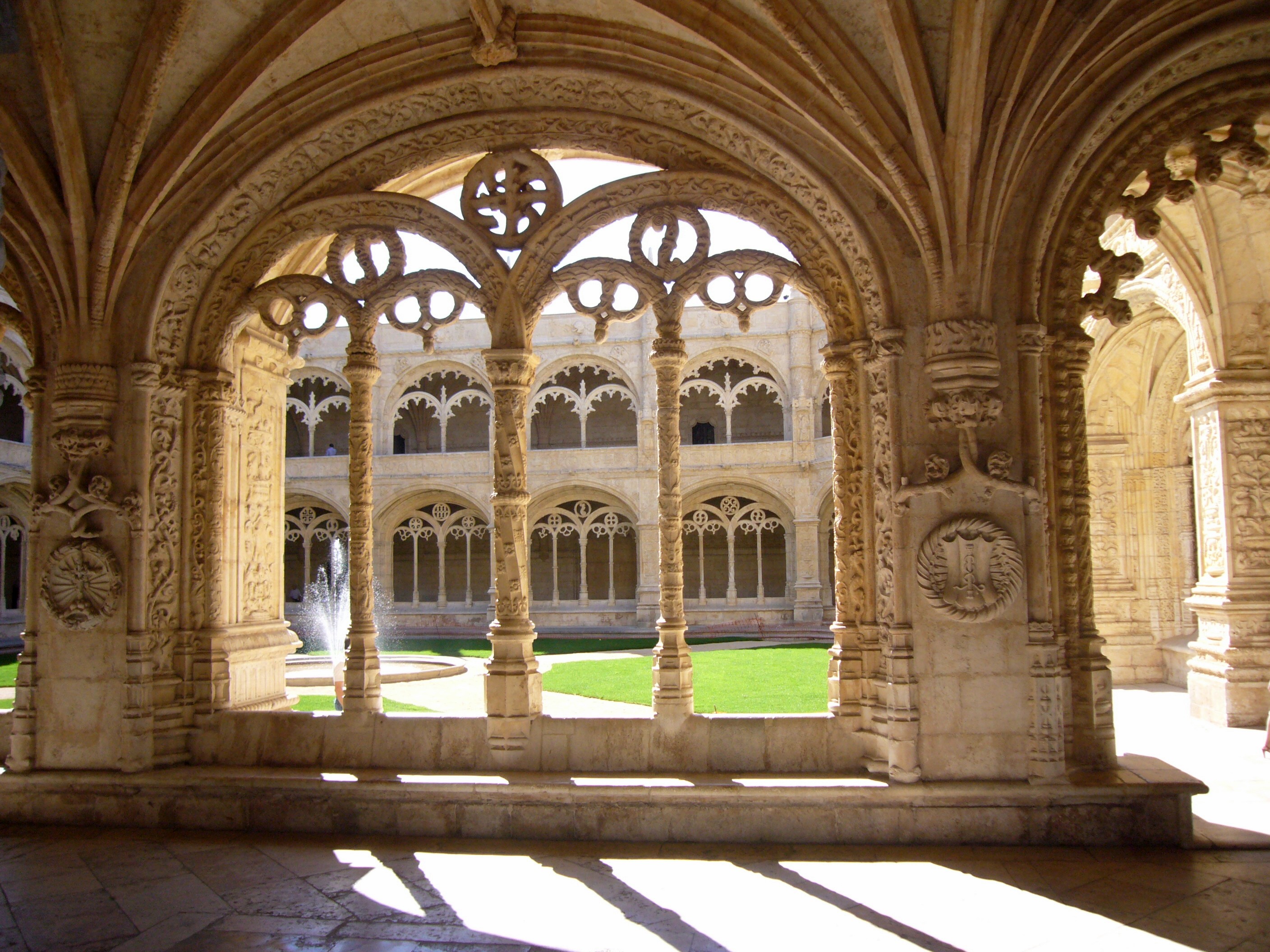
Jerónimos Monastery
Vasco da Gama sailed from this stretch of the Tagus in 1497. When he returned with a sea route to India and the riches that followed, King Manuel I poured the profits into stone. The Jerónimos Monastery rose on the Belém waterfront over the course of a century, beginning on 6 January 1501, its construction funded by a tax on the spice trade that was transforming Portugal from a small Atlantic kingdom into a global empire. The monastery replaced a small chapel where monks of the Order of Christ had once provided aid to sailors waiting for favorable winds. In its place, Manuel envisioned something far grander: a royal necropolis, a monument to exploration, and a statement of power carved in honey-colored limestone.
Stone Lace on the Tagus
The Manueline style that defines the Jerónimos is architecture in a state of exuberance. Part late Gothic, part something entirely Portuguese, it weaves ropes, anchors, armillary spheres, and exotic plants into the stonework — a maritime vocabulary turned decorative. The southern portal rises 32 meters, studded with pinnacles and carved niches sheltering figures beneath ornate baldachins, with Henry the Navigator standing on a pedestal between the double doors. Above it all, the Madonna of Belém watches from the archivolt, surmounted by the archangel Michael. Inside, the transept vault — a bold 1522 design — spans the space without a single supporting pier or column, creating the uncanny impression that the ceiling floats. Six octagonal columns rise 25 meters, their surfaces carved with grotesque and floral elements that blur the line between Gothic structure and Renaissance ornament.
Where Explorers and Poets Rest
The monastery's lower choir holds the stone tombs of two men who, between them, define Portugal's golden age. Vasco da Gama, who died in 1524 as Viceroy of India, lies here alongside Luís de Camões, the poet who immortalized da Gama's first voyage in his 1572 epic, The Lusiad. Their remains were transferred in 1880 to new neo-Manueline tombs sculpted by Costa Mota, placed just meters from the royal tombs of Manuel I and John III. The chancel, commissioned by Queen Catherine of Austria, holds these royal sarcophagi resting on marble elephants between Ionic and Corinthian pillars — a classical counterpoint to the exuberance beyond.
The Cloister's Quiet Grandeur
The square cloister stretches 55 meters on each side, a vast space begun by the architect Boitac and completed by Juan de Castilho. Boitac laid the groin vaults with wide arches and tracery windows on delicate mullions; Castilho added a classical overlay to the lower storey and a more restrained upper level. The inside walls carry a wealth of Manueline motifs — nautical elements mixed with European, Moorish, and Eastern designs — while the outer arcades feature Plateresque traceried arches that lend the stone a quality of filigree. In one arcade lies the sober tomb of Fernando Pessoa, Portugal's great modernist poet, alongside the remains of playwright Almeida Garrett, historian Alexandre Herculano, and two former presidents. The refectory across the chapter house preserves azulejo tiles from the 18th century, their blue-and-white patterns providing a cooler note against the warm limestone.
Survival and Reinvention
The monastery survived the devastating 1755 Lisbon earthquake that destroyed much of the city, though it did not escape unscathed. Secularized by state decree on 28 December 1833, its ownership passed to the charitable institution Real Casa Pia de Lisboa. The 19th century brought restoration and repurposing: the west wing now houses the National Archaeological Museum and the Maritime Museum, fitting companions for a building born of seafaring ambition. In 1983, UNESCO designated the Jerónimos Monastery a World Heritage Site alongside the nearby Tower of Belém. Today, it remains one of Portugal's most visited monuments, a place where the Age of Discovery is preserved not as abstraction but as carved stone, vaulted space, and the quiet presence of the explorers and artists who shaped a nation.
From the Air
Located at 38.698°N, 9.206°W on the Belém waterfront along the Tagus River in western Lisbon. The monastery's long limestone façade is clearly visible from the air, stretching parallel to the river. Recommended viewing altitude: 2,000-3,000 ft for architectural detail. The nearby Tower of Belém and Monument of the Discoveries provide additional visual reference points along the waterfront. Nearest airports: Lisbon/Humberto Delgado (LPPT) approximately 10 km east. Expect Atlantic maritime weather with frequent morning haze clearing by midday.