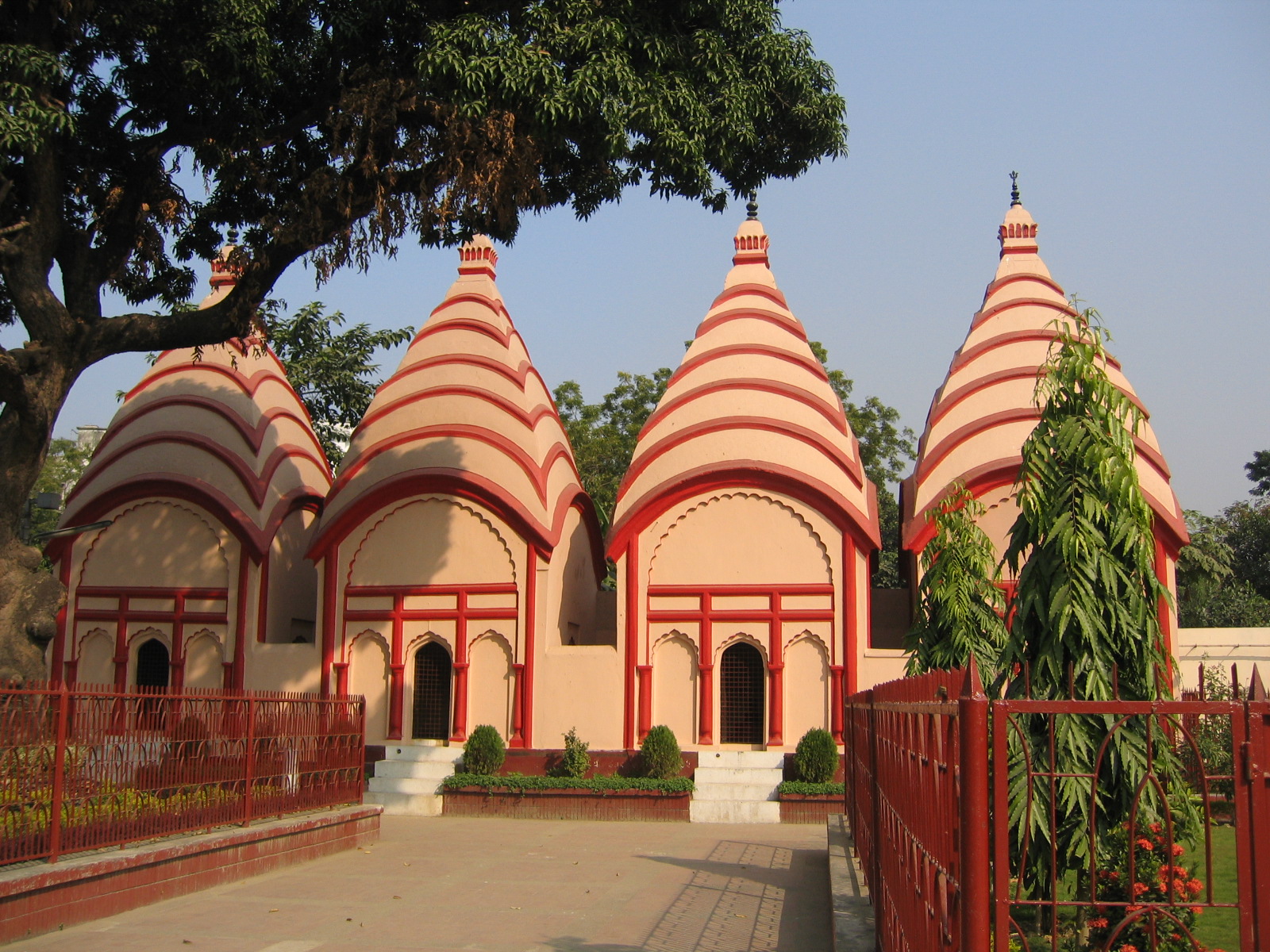
Jeshoreshwari Kali Temple
A general in the army of Maharaja Pratapaditya was walking through dense undergrowth near the Sundarbans when he noticed an unearthly glow emanating from the bushes. Pushing through the vegetation, he found a stone carved in the shape of a human palm. Or so the legend goes. That discovery became the founding story of the Jeshoreshwari Kali Temple, one of the 51 Shakti Peethas -- the sacred sites scattered across South Asia where, according to Hindu mythology, the body parts of the goddess Sati fell to earth after her self-immolation. This particular site, in the village of Ishwaripur in Bangladesh's Satkhira District, marks where Sati's palms of hands and soles of feet are believed to have landed.
The Mythology of Scattered Divinity
The story of the Shakti Peethas begins with grief. When Sati immolated herself at her father Daksha's sacrificial ceremony, the god Shiva lifted her body and wandered across the land in anguish. To end his mourning and restore cosmic order, Vishnu used his Sudarshana Chakra to dismember Sati's corpse. The fifty-one body parts fell at different locations across the Indian subcontinent and beyond, each site becoming a place of immense spiritual power. At each Shakti Peetha, two deities are worshipped: the Shakti, representing the divine feminine energy, and the Bhairava, a fierce form of Shiva as consort and guardian. At Jeshoreshwari, the Shakti is addressed as Jeshoreshwari herself -- the "Goddess of Jessore" -- and the Bhairava as Chanda. The temple's name anchors it to the old Jessore district, a region whose identity predates the modern national borders that now divide it.
A Hundred Doors and a Thousand Years
The temple's origins are layered in oral tradition rather than documented history. It is said to have been first established by a Brahman named Anari, who built a structure with a hundred doors to house the sacred site. No timeline survives for this original construction. What is known is that the temple was renovated during the reign of Lakshman Sen, the last major Hindu king of Bengal, in the late twelfth and early thirteenth centuries. Maharaja Pratapaditya, the sixteenth-century ruler of Jessore who defied Mughal authority, also restored and expanded the temple. Adjacent to the main shrine stands the Natmondir, a large rectangular covered platform from which devotees can view the face of the goddess. Lakshman Sen renovated this structure as well, though its original builders remain unknown. After 1971, when the Bangladesh Liberation War swept through the region, the Natmondir crumbled. Today only its pillars survive, standing like sentinels around an absence.
Worship at the Edge of the Mangroves
The temple sits near the northern fringe of the Sundarbans, in a landscape where the line between land and water blurs with every tide. Pilgrims arrive from across South Asia, crossing the Bangladesh-India border that runs nearby. Before 1971, worship was conducted daily. In the decades since the Liberation War and subsequent political changes, the schedule has contracted: priests now perform rituals on Saturdays and Tuesdays at noon. The annual Kali Puja remains the temple's most important event, when the current caretakers organize a full ceremony and a mela -- a fair -- fills the temple compound with vendors, devotees, and the particular energy of a religious gathering in a place that has known centuries of unbroken practice. The temple draws worshippers regardless of sectarian affiliation, a quality noted by scholars as characteristic of the older Shakti Peetha sites.
A Crown Given and Taken
On March 27, 2021, Indian Prime Minister Narendra Modi visited the Jeshoreshwari Kali Temple during a state visit to Bangladesh and offered prayers. He presented a gold-plated silver crown to the deity -- a diplomatic gesture that carried religious symbolism, linking the Indian state to a sacred Hindu site across the border. The crown was stolen in October 2024 during a period of anti-Hindu violence in Bangladesh. The theft encapsulated the fragile position of Hindu sacred sites in a Muslim-majority country navigating its own political turbulence. The temple has endured partition, war, neglect, and now targeted vandalism, yet continues to function as a living place of worship. Its survival across these disruptions speaks to something deeper than any single act of devotion or destruction -- the persistence of a sacred geography that predates the political maps drawn over it.
From the Air
Located at 22.306N, 89.113E in Ishwaripur village, Shyamnagar Upazila, Satkhira District, Bangladesh. The temple sits near the northern edge of the Sundarbans, close to the India-Bangladesh border. From the air, the area transitions from agricultural flatland to the mangrove fringe of the Sundarbans. Nearest airports include Jessore Airport (VGJR) approximately 70 km northeast, and Kolkata's Netaji Subhas Chandra Bose International (VECC) approximately 130 km north. Best viewed at 3,000-5,000 feet to spot the temple compound amid the village and surrounding farmland.