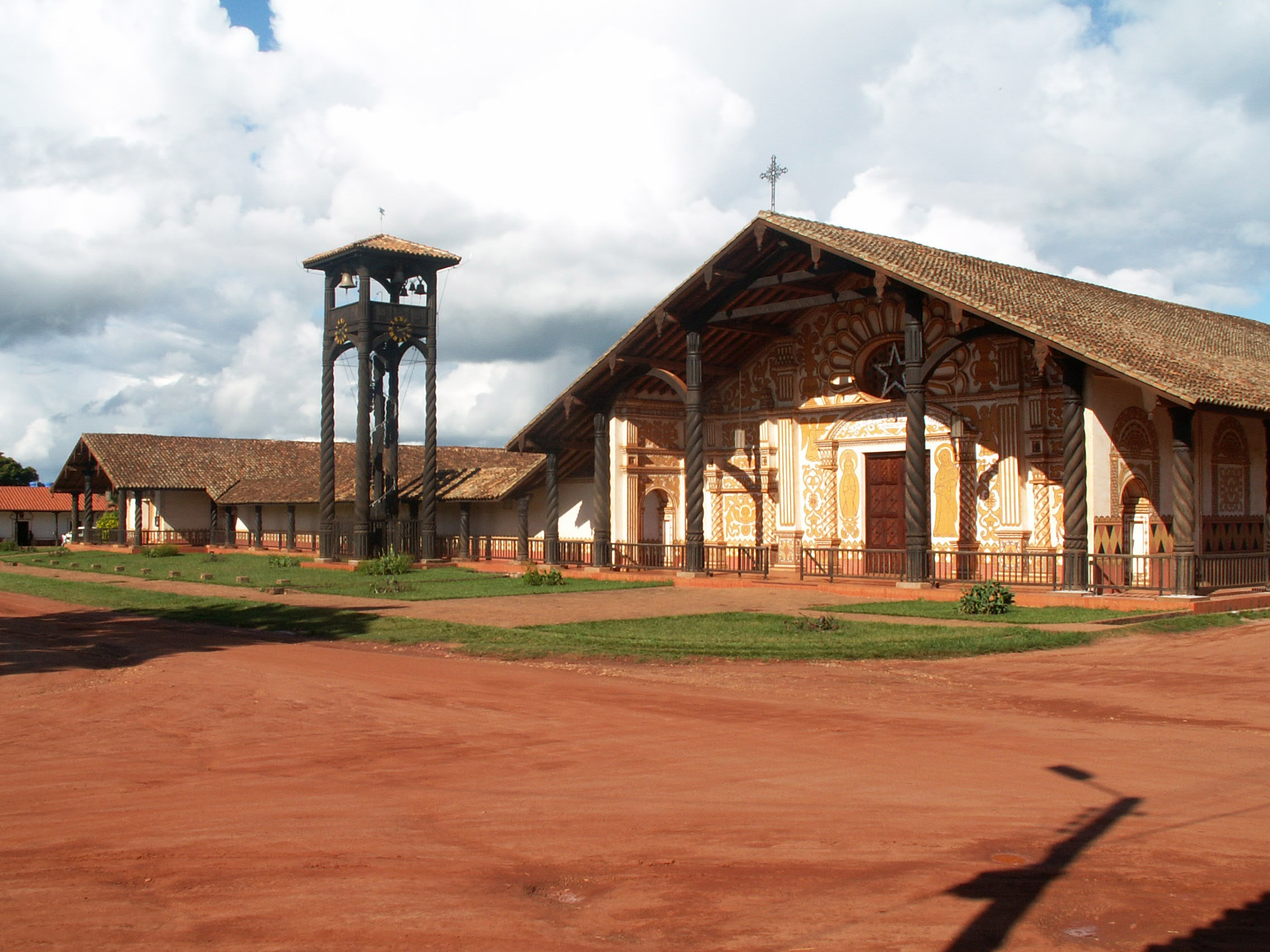
Jesuit Missions of Chiquitos
In 1691, a Jesuit priest named José de Arce and a lay brother named Antonio de Rivas set out to reach the Paraguay River. The rainy season stopped them at the first village they encountered, where the local Piñoca people, suffering from a plague, begged the Jesuits to stay. By year's end, the Piñoca had built them a house and a church. That settlement — San Francisco Xavier — became the first of eleven Jesuit missions in the Chiquitania, a remote frontier region of eastern Bolivia where the Spanish and Portuguese empires collided and the Society of Jesus attempted something unprecedented: a theocratic state within a state, where indigenous communities would live autonomous from colonial rule.
Churches Built from the Forest
The missions' most enduring legacy stands in their churches. Fr. Martin Schmid, a Swiss priest and composer who arrived in the Chiquitania in the 18th century, designed at least three of them — San Xavier, San Rafael de Velasco, and Concepción — in a style that fused European baroque architecture with indigenous building techniques. Hundreds of local carpenters worked to erect each church from tropical hardwoods. The walls were plastered with a mixture of mud, sand, lime, and straw, then painted in earth tones with ornamental motifs drawn from local flora and fauna, angels, saints, and geometric patterns. Large oval "oeil-de-boeuf" windows crowned the main doors, surrounded by relief petals. Above the entrance of each of Schmid's three churches, a quotation from Genesis 28:17 appeared: DOMUS DEI ET PORTA COELI — "The House of God and the Gate of Heaven." In San Xavier, the inscription was rendered in Spanish: CASA DE DIOS Y PUERTA DEL CIELO.
An Organ Carried a Thousand Kilometers by Mule
Music was the Jesuits' most effective tool of conversion in the Chiquitania, and Fr. Martin Schmid was its chief architect. He directed indigenous craftsmen in building violins, harps, flutes, and organs. Under his guidance, polyphonic choirs performed and full orchestras played baroque operas on handmade instruments. Schmid's most remarkable feat was constructing a six-stop organ in Potosí, disassembling it, transporting it by mule over 1,000 kilometers of difficult road, and reassembling it in the remote mission of Santa Ana de Velasco in 1751. That organ is still in use. When restoration work on the cathedral of Concepción began in 1975, workers unearthed more than 5,000 musical scores from the 17th and 18th centuries. Another 6,000 were later found in Moxos and several thousand more in San Xavier. These rediscovered compositions are now performed at the biennial International Baroque Music Festival, filling the mission churches with the same music their walls first absorbed centuries ago.
The Expulsion and What Survived
In February 1767, Charles III of Spain signed a royal decree expelling all Jesuits from Spanish territories. At the time, 25 Jesuits served a Christianized population of at least 24,000 across ten missions in the Chiquitania. The mission properties included 25 ranches with 31,700 cattle and 850 horses, and libraries holding 2,094 volumes. By September, all but four had left. The Spanish Crown, needing the settlements as a buffer against Portuguese expansion, replaced the Jesuits with secular priests — most of whom did not speak local languages and some of whom had not been ordained. The results were predictable: corruption, contraband trade with the Portuguese, and a population decline to below 20,000 within two years. Yet the Chiquitano people maintained the churches. Anthropologist Bernd Fischermann identified three reasons: memory of prosperity under the Jesuits, the desire to appear as civilized Christians, and the need to preserve an identity forged from many distinct indigenous groups united by a common language and customs the Jesuits had taught them.
Roth's Second Mission
By the 1970s, the mission churches were crumbling. In 1972, Swiss architect and former Jesuit priest Hans Roth arrived in the Chiquitania and began what would become a 27-year restoration project. Working with local communities, Roth meticulously rebuilt the wooden structures, restored the painted decorations, and stabilized the foundations. He continued until his death in 1999, and his work is the reason the churches stand as they do today. UNESCO designated six of the missions — San Xavier, Concepción, Santa Ana de Velasco, San Miguel de Velasco, San Rafael de Velasco, and San José de Chiquitos — as a World Heritage Site in 1990, citing their unique adaptation of Christian religious architecture to the local environment. Of the original eleven missions, three others survive in various states: Santiago de Chiquitos and Santo Corazón with reconstructed churches, and San Juan Bautista as ruins. Today, between 30,000 and 47,000 ethnic Chiquitanos live in the region, though fewer than 6,000 still speak the original language.
From the Air
The Jesuit Missions of Chiquitos are scattered across the eastern lowlands of Bolivia's Santa Cruz Department, centered around approximately 16.27°S, 62.51°W. The six UNESCO World Heritage settlements lie on a loop east of Santa Cruz de la Sierra, connected by roads (half paved, half rough) and a rail line to San José. Viru Viru International Airport (SLVR) in Santa Cruz is the main access point. From altitude, the landscape is flat semiarid lowland near the Gran Chaco, with scattered settlements visible along red-earth tracks. Conditions are hot and dry outside the rainy season.