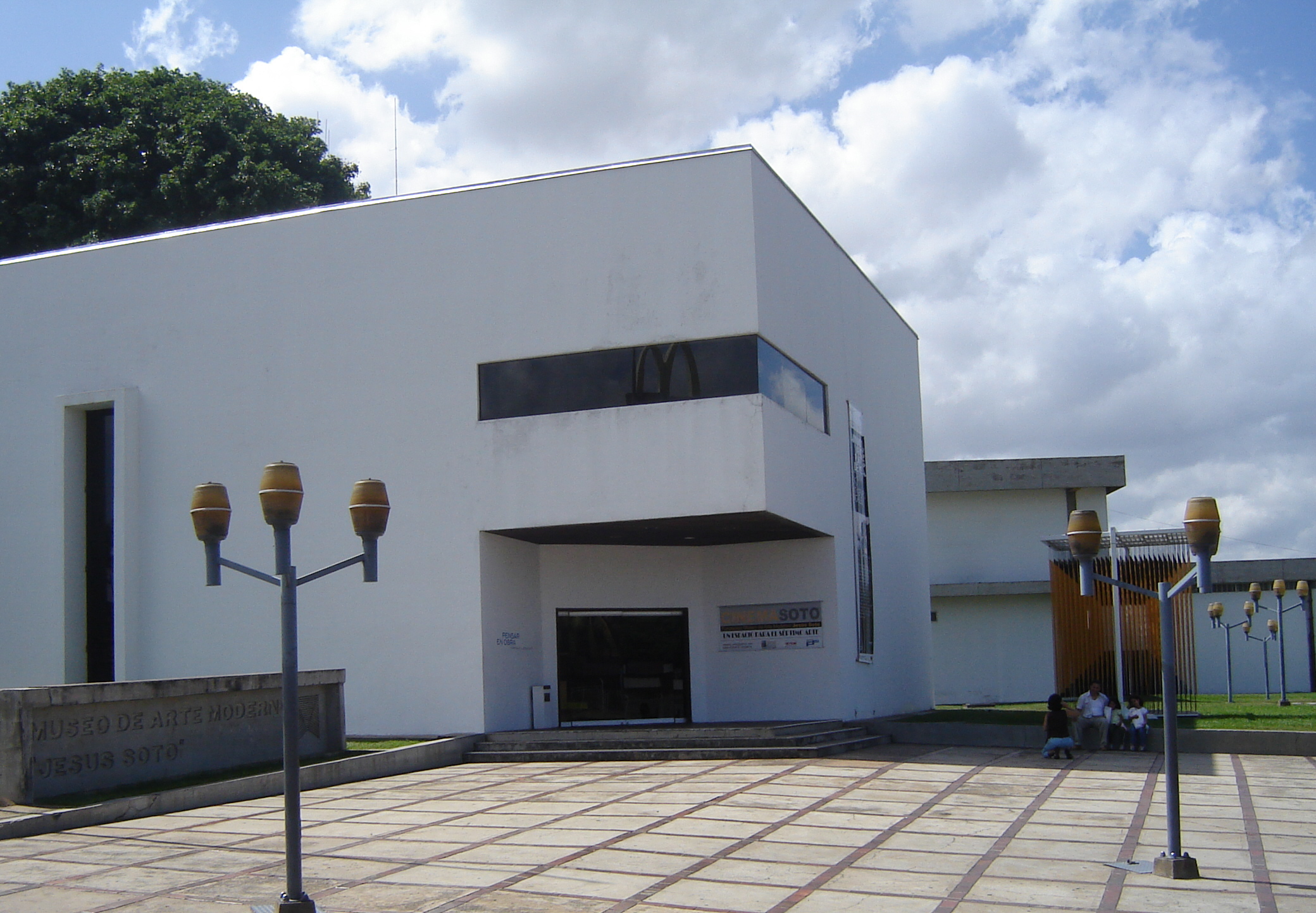
Jesus Soto Museum of Modern Art
Step inside and the walls begin to move. Not literally -- but the works of Jesus Rafael Soto, the kinetic artist born in Ciudad Bolivar in 1923, are designed to shift and shimmer as the viewer walks past them. Lines vibrate against backgrounds. Hanging filaments create fields of optical interference. What appears solid from one angle dissolves from another. This is the Museo de Arte Moderno Jesus Soto, a building conceived specifically to house art that refuses to sit still.
A Promise Made at a Prize Ceremony
The museum traces its origins to a single moment in 1959, when Soto won Venezuela's National Prize for Plastic Arts. At the ceremony, he announced his intention to create a museum in his hometown -- a city that, at the time, had no cultural institutions at all. It took a decade for the vision to take shape. In the late 1960s, Soto began donating artwork to Ciudad Bolivar, including pieces representative of each phase of his career. The city government initially offered the neoclassical Casa Wantzelius in the old town center, but when the building proved too damaged to renovate, the state governor provided a plot of land between the old and new sections of the city. The setback became an opportunity: instead of fitting art into an existing structure, architect Carlos Raul Villanueva could design a building from scratch.
Villanueva's Final Gift
Carlos Raul Villanueva was already the most celebrated architect in Venezuelan history, best known for the University City of Caracas -- a UNESCO World Heritage Site where modernist buildings and commissioned artworks form an integrated whole. The Soto Museum was one of his last major works. Constructed in just nine and a half months in 1971, the building sits at the intersection of Germanias Avenue and Mario Briceno Avenue as part of a planned cultural center neighborhood. Villanueva designed the interior spaces to serve the art's specific needs: kinetic works require room for the viewer to move, to approach and retreat, to see how the piece transforms with each shift in angle and distance. The architecture does not compete with the art. It provides the space and light that the art demands.
The Collection That Grew
When the museum opened on August 25, 1973 -- inaugurated by President Rafael Caldera himself -- it held eight Soto works spanning two decades: Muro Optico from 1952, Muro Blanco from 1953, Ritmo Vibratorio from 1957, and five more reaching to Vibracion Central, completed the year the building was finished. By 2012, the collection had grown to 350 works. Of these, 122 are by international kinetic artists, and the remainder are by Venezuelan artists including Carlos Cruz-Diez, Alejandro Otero, Rafael Martinez, Manuel Merida, Armando Perez, and Francisco Salazar. The museum became not just a shrine to one artist but a comprehensive survey of the kinetic art movement that Venezuela helped define.
Art That Asks You to Walk Through It
Soto's most radical works were his Penetrables -- large-scale installations of hanging nylon or metal filaments that viewers are invited to walk through. 'I wondered what would happen if I could put myself inside the vibration,' Soto once said, explaining the leap from optical paintings to immersive environments. Inside a Penetrable, the boundary between artwork and observer disappears. The filaments brush against your body and create sounds; light fractures through the hanging strands; your own movement becomes part of the composition. It is a fundamentally democratic form of art -- it does not require explanation or art-historical knowledge, only the willingness to step inside. That Soto brought this sensibility to his hometown, a mid-sized city on the Orinoco far from the galleries of Caracas or Paris, speaks to his conviction that art belongs where people live, not only where collectors gather.
From the Air
Located at 8.13N, 63.54W in Ciudad Bolivar, Venezuela, near the intersection of Germanias Avenue and Mario Briceno Avenue. The museum is in the newer section of the city, between the colonial old town and modern neighborhoods. Nearest airport: Jose Tomas de Heres Airport (SVCB) in the center of Ciudad Bolivar. The colonial district and Orinoco waterfront are the most visible landmarks from the air. Best viewed in context with the broader Ciudad Bolivar approach at 2,000-3,000 feet AGL.