Jet Propulsion Laboratory
In 1936, a group of Caltech graduate students and researchers drove up the Arroyo Seco above Pasadena to test rocket motors in a remote gulch where an accident would not destroy anything expensive. They called themselves the GALCIT Rocket Research Group. The university called them the Suicide Squad, a nickname they embraced. Within a decade they would be building military rockets for the U.S. Army. Within three decades their instruments would be orbiting Mars. The Jet Propulsion Laboratory today occupies 177 acres at the base of the San Gabriel Mountains and remains one of the most consequential scientific institutions in the world.
From Arroyo Seco to the Outer Planets
JPL was founded in 1936 by California Institute of Technology researchers and is now owned and sponsored by NASA, administered and managed by Caltech. The laboratory's primary function is the construction and operation of planetary robotic spacecraft — the machines that go where humans cannot, or not yet. JPL also conducts Earth-orbit and astronomy missions and operates NASA's Deep Space Network (DSN), the worldwide array of large antennas that communicates with spacecraft throughout the solar system.
The list of missions JPL has managed or contributed to reads as a history of humanity's physical reach: the Mariner program, which first mapped Mars and Venus; the Viking landers; Voyager 1 and 2, still traveling beyond the solar system; Galileo at Jupiter; Cassini at Saturn; the Mars Pathfinder and its Sojourner rover; the Mars Exploration Rovers Spirit and Opportunity; the Curiosity and Perseverance rovers; the Juno spacecraft currently orbiting Jupiter. The Europa Clipper, designed to study Jupiter's moon Europa and its subsurface ocean, is among the current major missions.
The Address and the Debate
JPL's official mailing address is 4800 Oak Grove Drive, Pasadena, CA 91109. The laboratory's physical location, however, is technically within the city limits of La Cañada Flintridge, California — a distinction that has generated occasional civic rivalry between the two municipalities over which one should claim the laboratory in press releases and media coverage. JPL uses Pasadena because it began in Pasadena and because Caltech, its managing institution, is in Pasadena.
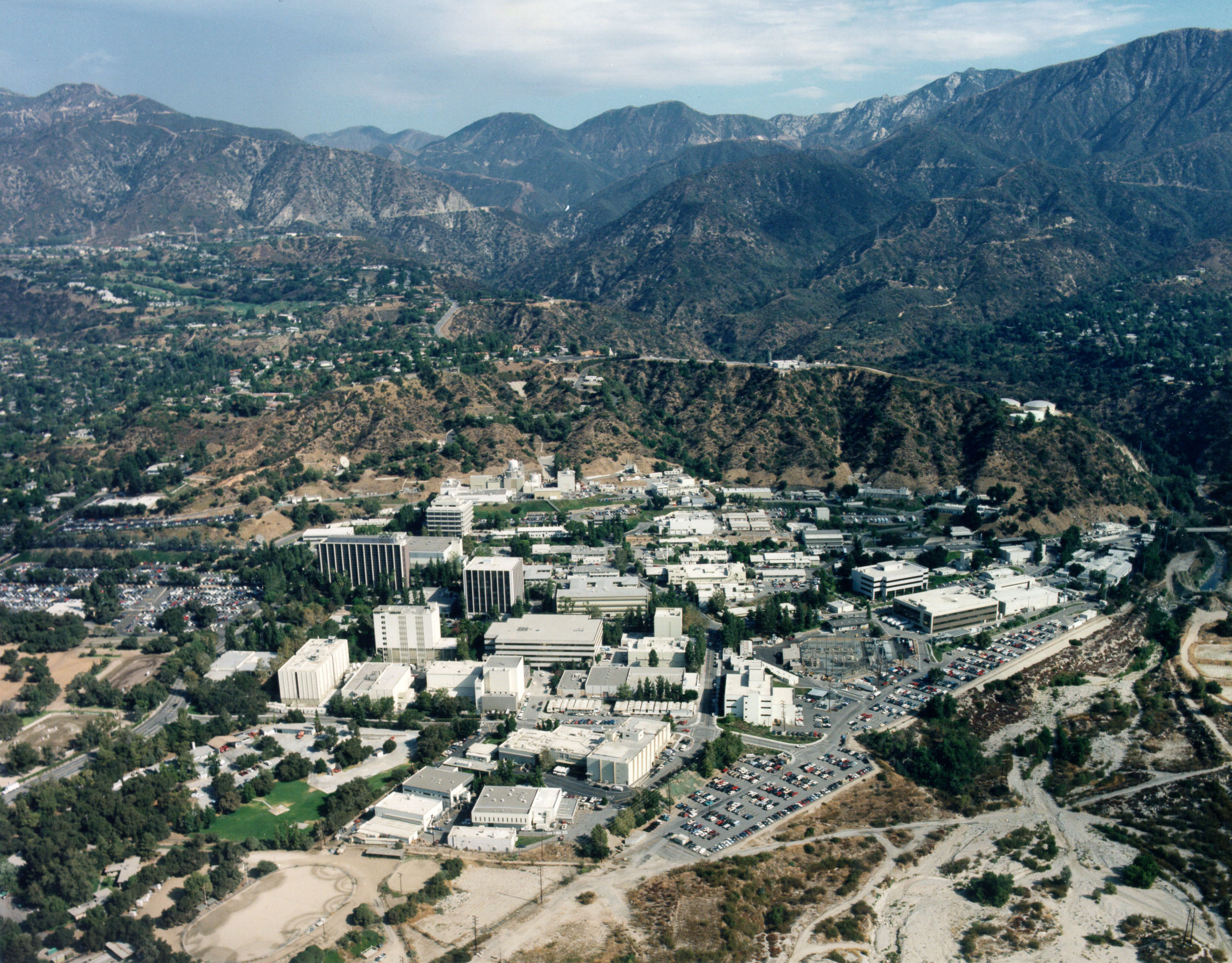
The site sits immediately west of the Arroyo Seco riverbed, north of the Devil's Gate Dam. The San Gabriel Mountains rise immediately behind the facility — the San Gabriel Wilderness begins within a short distance of JPL's northern boundary. This proximity to wild terrain, and the Arroyo Seco corridor that connects JPL southward to central Pasadena, gives the laboratory a setting that seems at odds with its function as an engine of space exploration, until you remember that its founders came up here specifically because there was nothing else around to destroy.
What JPL Does Every Day
At any given time, JPL engineers and scientists are managing spacecraft at multiple points throughout the solar system. As of recent years, the Perseverance rover is exploring Jezero Crater on Mars — a site selected as a probable ancient river delta where microbial life might have existed — while the Curiosity rover continues its own independent traverse of Gale Crater. The Mars Reconnaissance Orbiter photographs the Martian surface in extraordinary detail from above. The Juno spacecraft, launched in 2011, is studying Jupiter's atmosphere and magnetic field.
The Deep Space Network operates antenna complexes in Goldstone, California; Madrid, Spain; and Canberra, Australia — positioned to maintain constant contact with spacecraft regardless of Earth's rotation. These antennas track signals from probes traveling hundreds of millions of miles, receiving data at rates that would have seemed fantastical to the Suicide Squad in their Arroyo Seco gulch. JPL employs approximately 5,500 full-time staff. Thousands of schoolchildren from Southern California visit the laboratory annually, following in the spirit of Griffith J. Griffith's democracy-of-knowledge: making the universe accessible to people who didn't build the instruments.
From the Air
Located at 34.20°N, 118.17°W in La Cañada Flintridge (using Pasadena address), JPL sits at the base of the San Gabriel Mountains at the northern end of the Arroyo Seco. The facility's buildings and large antenna dishes are visible from low altitude. The Arroyo Seco corridor runs south toward Pasadena. Nearest airports: El Monte (KEMT, 8 miles SE), Burbank (KBUR, 8 miles W). Best viewed at 2,000–4,000 ft AGL on a north-south pass.