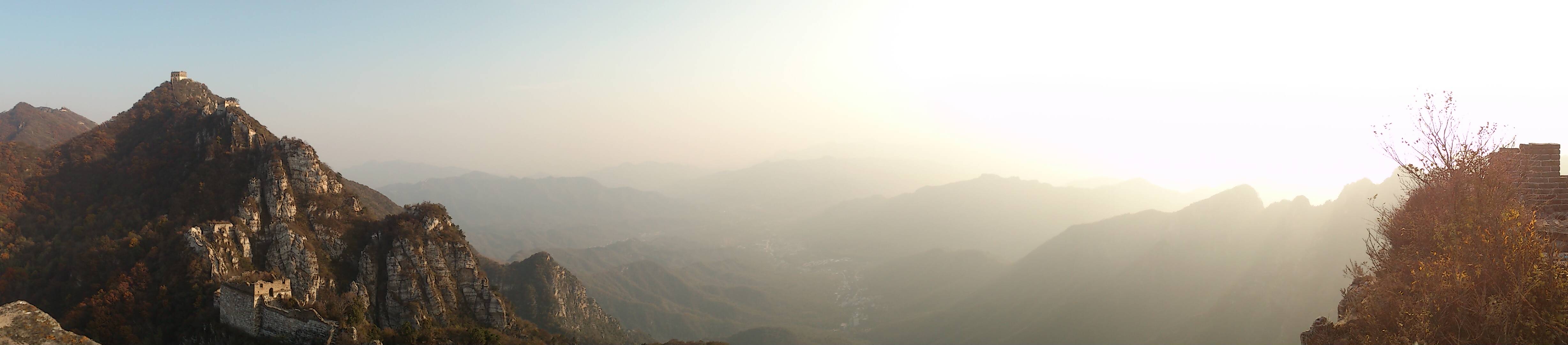
Jiankou
The mountain ridge looks like an arrow, its collapsed spine opening upward like a nock waiting for the bowstring. That is how Jiankou got its name: Arrow Nock, a description of the terrain that the Great Wall follows 73 kilometers north of Beijing. This is not the Great Wall of postcards and tour buses. This is the Great Wall as it exists across most of its 21,000-kilometer length: unrestored, unmaintained, and falling slowly back into the mountain from which it was built.
Built to Break
The Jiankou section was constructed in 1368, the founding year of the Ming dynasty, and was continuously rebuilt and reworked for nearly three centuries, until 1644 when the dynasty fell. The wall runs for 20 kilometers along some of the most precipitous terrain near Beijing, climbing ridgelines that modern hikers approach with caution and proper gear. Without maintenance, the wall has surrendered to the mountain's slow assault. Watchtowers have lost their roofs and sometimes their walls. Stairways have crumbled into loose rubble. Trees grow through cracks in the stonework, their roots prying apart joints that Ming masons fitted together with military precision. The decay is not picturesque in the way that European ruins often are; it is aggressive, the mountain actively reclaiming what was taken from it.
The Trail of Names
Hikers on the Jiankou Great Wall pass through a landscape named with the poetry of military surveying. The trail runs from the 23rd tower of the Mutianyu section to Beijing Knot, passing through landmarks whose names capture the terrain's character: Ox Horn Edge, where the wall bends around a peak shaped like a horn. Sky Ladder, a near-vertical section that earns its name honestly. Upward Flying Eagle Tower, where the wall soars upward at an angle that evokes a raptor climbing on a thermal. Nine-Eye Tower, with its multiple arched windows. Beijing Knot, where several sections of wall converge like threads meeting at a snarl. Each name was earned by someone who climbed here before trails were marked, when the only way to describe the route was to name its most memorable features.
The Hike That Earns Its Views
Jiankou is not a public tourist attraction. There are no tickets, no facilities, no safety railings, and no rescue services positioned along the route. Local guides offer tours, but the hiking is genuinely hazardous: loose stones, exposed sections where the wall's edge drops away to nothing, and sections where the wall itself has collapsed into gaps that must be navigated with hands as well as feet. The BBC has described it as China's remote and dangerous Great Wall, and the description is earned rather than sensational. But for those who make the climb, the panoramic views from the watchtowers are among the finest along the entire Great Wall. The wall stretches away in both directions, tracing the mountain ridgeline in the sinuous curves that have made Jiankou one of the most photographed sections of the Great Wall, its ruined beauty more compelling than any restoration.
From the Air
Located at 40.45N, 116.46E in the Huairou District, approximately 73 km north of central Beijing. The wall follows a dramatic mountain ridgeline that is clearly visible from moderate altitude. Nearest major airport is Beijing Capital International Airport (ZBAA/PEK), about 55 km to the south-southeast. Terrain is mountainous with significant elevation changes. The unrestored wall contrasts visually with the restored Mutianyu section to the east.