Jicheng (Beijing)
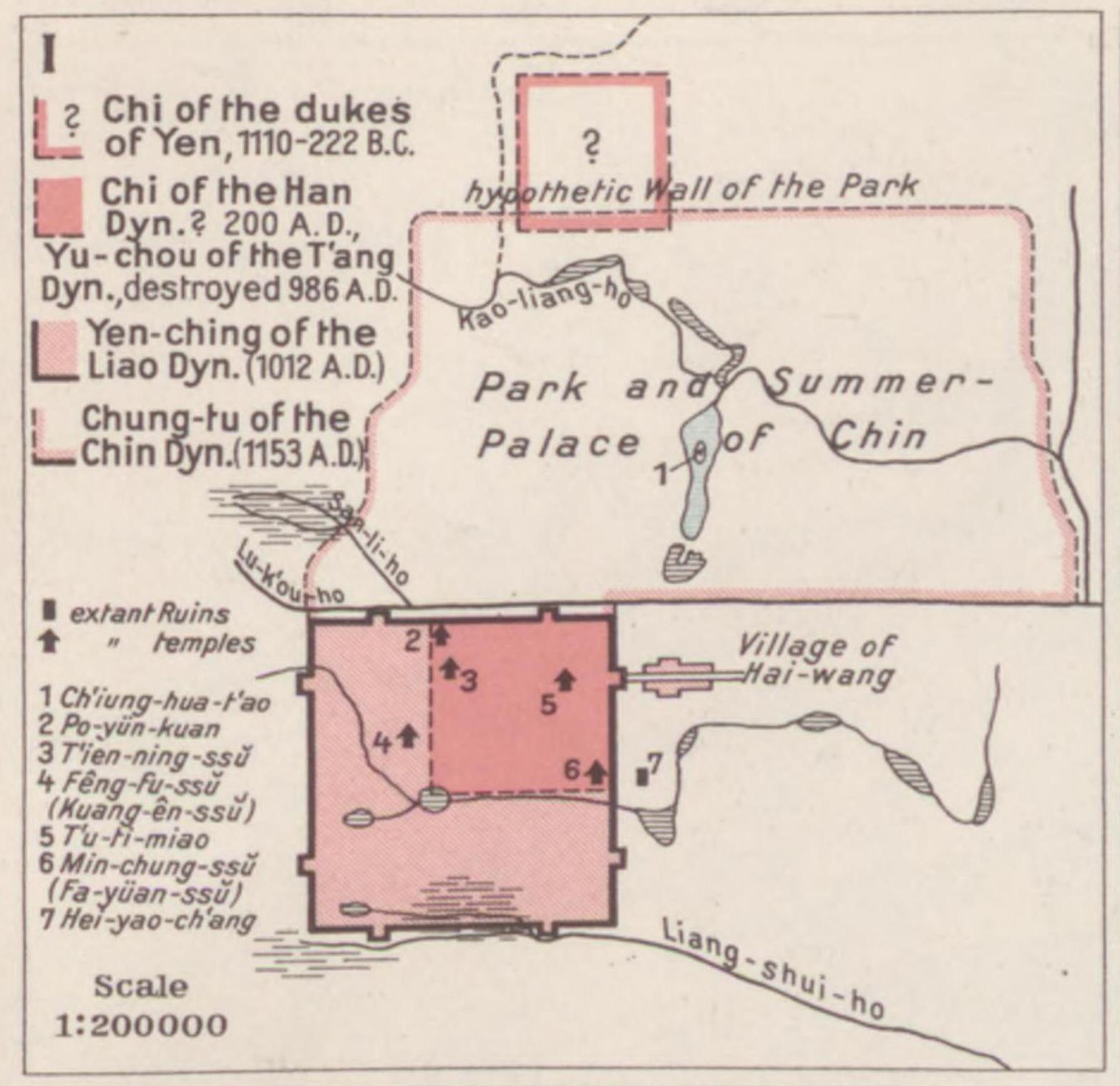
Beijing officially counts its age from 1045 BC, which makes it not merely old but ancient on a scale that most world capitals cannot approach. The city it claims as its ancestor was called Ji, and it stood in what is now southwestern Beijing, near Guang'anmen. Archaeologists searching for its ruins face a problem unique to successful cities: three thousand years of continuous habitation have buried the old one beneath the new. A commemorative pillar in Binhe Park along the western second ring road marks the spot, a modest monument to the fact that everything around it -- the subway stations, the ring roads, the skyscrapers -- sits on top of one of the oldest continuously inhabited places in East Asia.
Before Empires
According to Sima Qian's Records of the Grand Historian, King Wu of Zhou was so eager to establish his legitimacy after defeating the Shang dynasty at the Battle of Muye that before dismounting from his chariot, he granted titles to the rulers of existing city-states -- including Ji and its neighbor Yan. The Book of Rites claims he named descendants of the Yellow Emperor to govern Ji, anchoring the new dynasty's authority in mythological lineage. The Beijing Municipal Government designates 1045 BC as the city's founding year based on this account. Archaeological evidence from southwestern Beijing, south and west of Guang'anmen, confirms concentrated habitation dating to the 400s BC at minimum. Historical accounts mention a "Hill of Ji" northwest of the city, which scholars believe corresponds to the large mound at the White Cloud Abbey.
Capital of Yan
At some point during the Western or early Eastern Zhou dynasty, the neighboring state of Yan conquered Ji and made it their capital. Yan grew to become one of the seven great powers of the Warring States period, and its rulers built multiple capitals as they responded to shifting military threats. Ji served as Yan's principal seat, known as Shangdu, or the Upper Capital. When the Qin general Wang Jian invaded in 226 BC, the capital of Yan was back in Ji. After the First Emperor unified China in 221 BC, Ji became the capital of Guangyang Commandery and a crucial junction connecting the Central Plain to Mongolia and Manchuria. The emperor himself visited in 215 BC, and had the Great Wall built north of the city and Juyong Pass fortified against the Xiongnu.
A City Renamed by Every Conqueror
Ji's subsequent history reads like a ledger of regime changes. Under the Han dynasty, it served as the seat of the Youzhou Inspectorate. During the Three Kingdoms, the Wei Kingdom governed from Ji. In the Western Jin dynasty, Ji was demoted to a county seat. Then the Sixteen Kingdoms period brought a rapid succession of rulers -- the Later Zhao, the Ran Wei, the Former Yan -- each briefly controlling the city. In 352, Murong Jun of the Xianbei declared himself emperor and made Ji his capital before moving south to Ye. The Sui dynasty renamed Youzhou as Zhuo Commandery, and Emperor Yang built the Grand Canal extending to the city to support his campaigns against Goguryeo in Korea. Under the Tang, a separate Ji Prefecture was established in present-day Tianjin, and Beijing's city gradually became known as Youzhou, then Fanyang, then Yanjing.
From Ji to Beijing
The city's transformation into the capital we recognize today began with the Khitan Liao dynasty, which made it their southern capital under the name Nanjing (not to be confused with the city in Jiangsu). The Jurchen Jin dynasty renamed it Zhongdu, the Central Capital, in the twelfth century. After the Mongols razed Zhongdu, Kublai Khan built an entirely new city adjacent to it -- Khanbaliq, known in Chinese as Dadu -- which became the capital of the Yuan dynasty. The old city of Ji became a suburb. When the Ming and then the Qing dynasties developed the site of Khanbaliq into the city we now call Beijing, the ancient settlement of Ji was absorbed into the urban fabric, its walls and gates long vanished but its location preserved in the memory of scholars and, since 2002, in the commemorative pillar that stands along the second ring road where the oldest section of Beijing still lies underfoot.
From the Air
The ancient site of Jicheng is at approximately 39.894N, 116.382E in southwestern Beijing, near Guang'anmen in Xicheng and Fengtai Districts. The commemorative pillar is in Binhe Park along the western 2nd Ring Road, south of Tianning Temple. Nearest airports: ZBAA (Beijing Capital International, 27 km NE) and ZBAD (Beijing Daxing International, 44 km S). Best viewed at 3,000-5,000 ft AGL, looking for the 2nd Ring Road alignment.