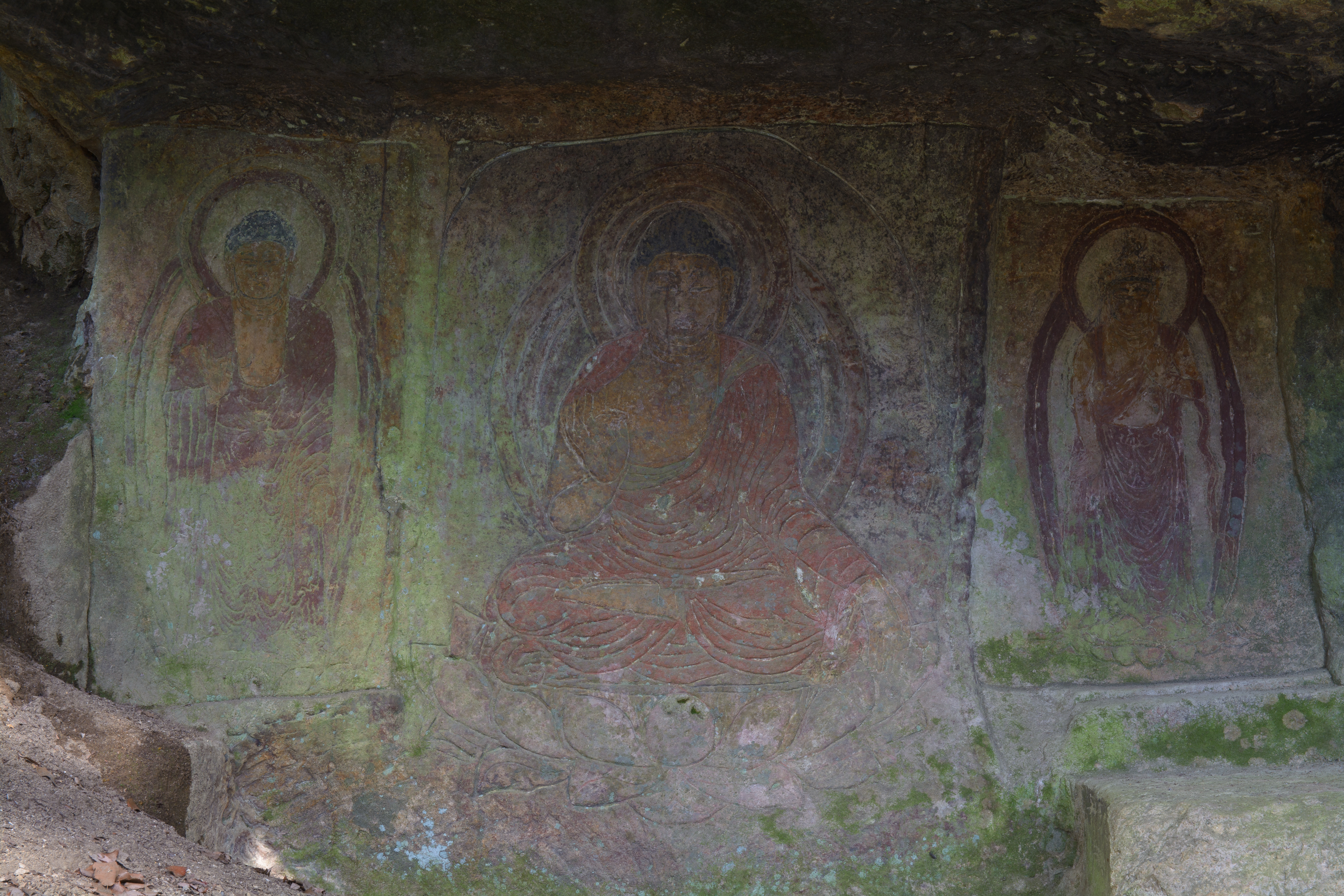
Jigokudani Stone Buddhas: Hell Valley's Hidden Shrine
The name translates as Hell Valley, but the place feels more like a forgotten chapel. A few hundred meters into the national forest southeast of Nara, where the ancient Yagyu Kaido trail climbs through cedar and cypress toward the mountains of Iga Province, a niche opens in a southwest-facing cliff of volcanic tuff. Inside, six Buddhist figures sit and stand in bas-relief, carved directly into the rock face sometime between the late Nara period and the early Heian period -- roughly the 8th to 9th centuries. They have been here longer than most of the famous wooden temples in the valley below. Designated a National Historic Site in 1924, the Jigokudani Stone Buddhas are part of a constellation of magaibutsu -- cliff-carved Buddhist images -- scattered along the mountain trails east of Nara, silent sentinels from an era when travelers needed divine protection on the road.
The Road to the Yagyu Valley
The Yagyu Kaido is an ancient highway that once linked Heijo-kyo -- the imperial capital at Nara -- with the Yagyu valley and onward to Iga Province. For centuries, the road served as a route for pilgrims, merchants, and samurai traveling between the Nara Basin and the mountainous interior of the Kii Peninsula. The trail passes through dense forest and over ridgelines where the terrain shifts from the gentle slopes of Nara Park into wilder, rougher country. Stone Buddhas appear at intervals along this road, each carved into exposed rock faces where travelers might pause, pray, and gather courage before continuing into the mountains. The Jigokudani site lies several hundred meters southeast of the better-known Kasugayama Stone Buddhas, which hold their own separate National Historic Site designation. Together, these carvings map a spiritual infrastructure that once made the forest feel less hostile and the journey less lonely.
Six Figures in Stone
The niche that shelters the Jigokudani carvings measures 3.9 meters across, 2.9 meters deep, and 2.4 meters high -- roughly the dimensions of a small room. The back wall, 1.7 meters tall, holds the central and most prominent figure: a seated Shaka Nyorai, the historical Buddha, shown cross-legged on a double lotus throne within a frame measuring 1.7 by 1.12 meters. Traces of paint and gold leaf still cling to the surface, evidence that these carvings were once vividly colored. To the left of the central Buddha sits Yakushi Nyorai, the Medicine Buddha, distinguished by a double circular halo. On the right stands a figure of Juichimen Kannon, the eleven-headed Kannon -- though this image was added later, during the Muromachi period, centuries after the original carvings. The side walls hold three more figures: Nyoirin Kannon on one wall, and Amida Nyorai alongside Senju Kannon, the thousand-armed Kannon, on the other. Together, the six figures represent a cross-section of the Japanese Buddhist pantheon, each deity offering a different form of salvation or protection.
Quarry Stone and Temple Legend
An unsubstantiated but persistent local legend connects the Jigokudani cliff to Todai-ji, the great temple four kilometers to the northwest whose Daibutsuden remains the largest wooden structure in the world. According to this tradition, the tuff rock face served as a quarry that supplied foundation stones for the temple's original 8th-century buildings. Whether or not the claim is true -- and no archaeological evidence has confirmed it -- the geological connection is plausible. Tuff, a soft volcanic rock formed from compressed ash, is easy to carve and was widely used in ancient construction throughout the Nara region. The same quality that made it useful for building made it ideal for sculptors working with chisels on a cliff face. The carvings themselves date from the late Nara period to the early Heian period, placing them in the same era as Todai-ji's construction, which lends the legend at least a chronological plausibility. The Muromachi-period addition of the Juichimen Kannon figure shows that the site continued to hold religious significance centuries after the original carving.
Weathering the Centuries
Unlike wooden temple statues, which can be repaired, repainted, and restored, magaibutsu are permanent in the truest sense. They cannot be moved indoors during typhoons. They cannot be re-gilded when the gold flakes away. They age with the rock itself, their features softening as rain and wind erode the tuff grain by grain. The Jigokudani Buddhas have endured over a millennium of this slow dissolution, and the effect is haunting -- figures that were once sharply defined and brilliantly colored now emerge from the stone like half-remembered dreams. The site lies about four kilometers by mountain trail from Todai-ji, or a 24-minute drive by modern roads. Most visitors to Nara never venture this far into the hills, drawn instead to the deer park and the great temple complexes on the basin floor. But for those who follow the old Yagyu Kaido on foot, the Jigokudani Stone Buddhas offer something the famous temples cannot: the experience of encountering sacred art exactly where it was made, unchanged by anything except time.
From the Air
Located at 34.674°N, 135.877°E in the forested hills southeast of central Nara, along the ancient Yagyu Kaido trail. The site sits within a national forest at the edge of the Nara Basin, where the terrain transitions from low-lying parkland into steeper, wooded ridges. Todai-ji's massive Daibutsuden roof is visible approximately 4 km to the northwest. The Kasugayama Primeval Forest, a UNESCO World Heritage buffer zone, lies just to the west. Nearest airports: Kansai International Airport (RJBB), approximately 70 km southwest; Osaka Itami Airport (RJOO), approximately 35 km west. The site itself is not visible from altitude due to forest canopy, but the transition from urban Nara to forested hills marks the general area. Best viewed at 3,000-5,000 feet AGL to see the mountain trail corridor heading east from Nara toward the Yagyu valley.