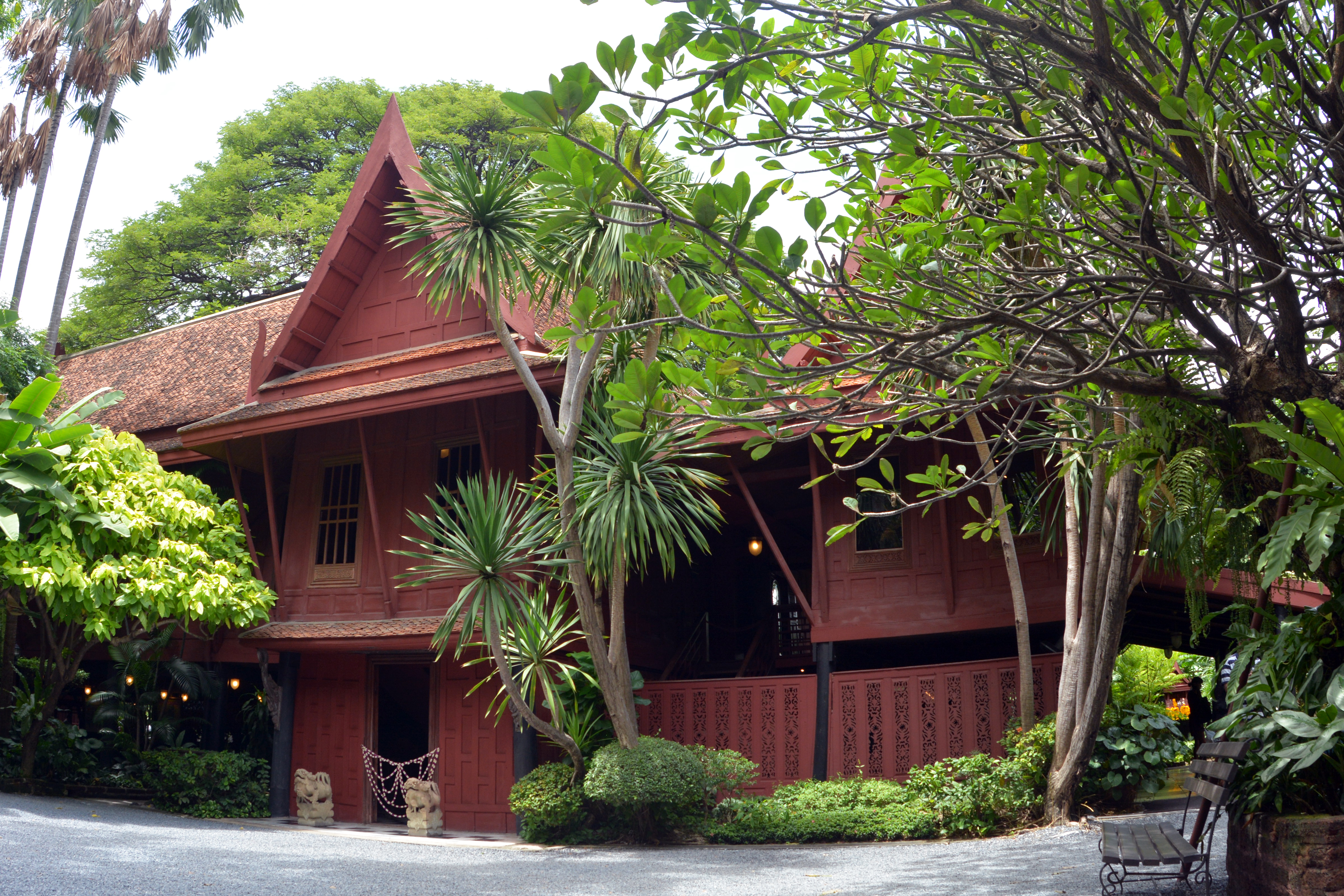
Jim Thompson House
On the afternoon of Easter Sunday, 26 March 1967, Jim Thompson told his hosts he was going for a walk in Malaysia's Cameron Highlands. He did not come back. More than 500 searchers -- soldiers, police, Orang Asli trackers, Gurkha regiments, mystics, and reward hunters -- combed the jungle. They found nothing: no body, no clothing, no footprint leading off the trail. Thompson, the American who had single-handedly revived the Thai silk industry and built one of Southeast Asia's finest private art collections, simply ceased to exist. His house in Bangkok, a compound of six traditional Thai structures arranged along a canal, remains exactly as he left it -- a museum frozen at the moment its owner stepped into the trees and disappeared.
From OSS Officer to Silk King
James Harrison Wilson Thompson arrived in Thailand by way of war. Recruited by the Office of Strategic Services -- the precursor to the CIA -- he served with the French Resistance in North Africa, then moved to Ceylon to work with the Free Thai Movement against the Japanese occupation. He reached Bangkok shortly after Victory over Japan Day in 1945 and organized the city's OSS office. When the war ended, Thompson stayed. He was captivated by the Thai silk weaving tradition he found in the Bangkrua neighborhood, a Muslim community of Cham weavers along Khlong Saen Saep. The industry was dying -- cheaper factory textiles had undercut handloom production. In 1948, Thompson founded the Thai Silk Company, sending samples to fashion editors in New York and eventually landing Thai silk in Vogue and on Broadway. The fabrics became internationally famous. Thompson became wealthy. And he began to collect.
Six Houses, One Vision
In 1958, Thompson started assembling his home. He gathered six traditional Thai-style houses from across the country -- most from Ayutthaya, the largest from the weaving community of Bangkrua itself -- and had them dismantled, transported to Bangkok, and reassembled on a half-acre plot along Khlong Saen Saep, directly across the canal from his company's weavers. The houses are primarily teak, joined without nails in the traditional Thai manner. Thompson made one architectural alteration that visitors still notice: he reversed the exterior wall panels of several houses so that the smooth inner surfaces faced outward, creating flat display walls for his art. The compound sits on raised stilts among tropical gardens, and the whole effect is of a private world turned inward, away from the noise of Bangkok -- which, in the late 1950s, was still a quiet canal city but would not remain so for long.
A Collector's Eye
Thompson's collection fills every room. Historical Buddhist statues line the corridors. Traditional Thai paintings on wood, cloth, and paper depict the life of the Buddha and the Vessantara Jataka legend. He traveled regularly to Burma, Cambodia, and Laos on buying trips, acquiring secular art that Western collectors had largely ignored. Blue-and-white Chinese porcelain -- pieces that had arrived in Thailand during the 16th and 17th centuries via maritime trade routes -- sits alongside Khmer stone carvings and Burmese teak figures. What distinguished Thompson as a collector was not just his taste but his timing: he was acquiring Southeast Asian art before the international market discovered it, buying works that museums now covet at prices that reflected how little the outside world valued them. The house itself became the frame for the collection -- each room arranged as a living space rather than a gallery, as though the owner might return at any moment.
The Disappearance That Never Resolved
Thompson's vanishing on that Easter afternoon in 1967 generated theories that have never been settled. He had intelligence connections that persisted well beyond his wartime service, and his disappearance coincided with escalating American involvement in Vietnam and political turmoil across Southeast Asia. Speculation ranged from kidnapping by communist insurgents to assassination by business rivals to voluntary disappearance into clandestine work. No ransom demand ever came. No remains were ever found. The case became one of Asia's most enduring unsolved mysteries. After his disappearance, Thompson's house came under the control of the James H. W. Thompson Foundation, under the royal patronage of Princess Maha Chakri Sirindhorn. Today the museum sits at 6 Soi Kasemsan 2, one block from Bangkok's National Stadium, offering guided tours through rooms where silk samples still drape across furniture and art hangs at the height a six-foot American preferred.
From the Air
Located at 13.7492N, 100.5283E in the Pathum Wan district of central Bangkok, along Khlong Saen Saep canal near the National Stadium BTS station. The compound's traditional teak houses and garden are shielded by surrounding development and difficult to identify from altitude. Nearest airports: Don Mueang (VTBD) approximately 14 nm north; Suvarnabhumi (VTBS) approximately 16 nm east-southeast.