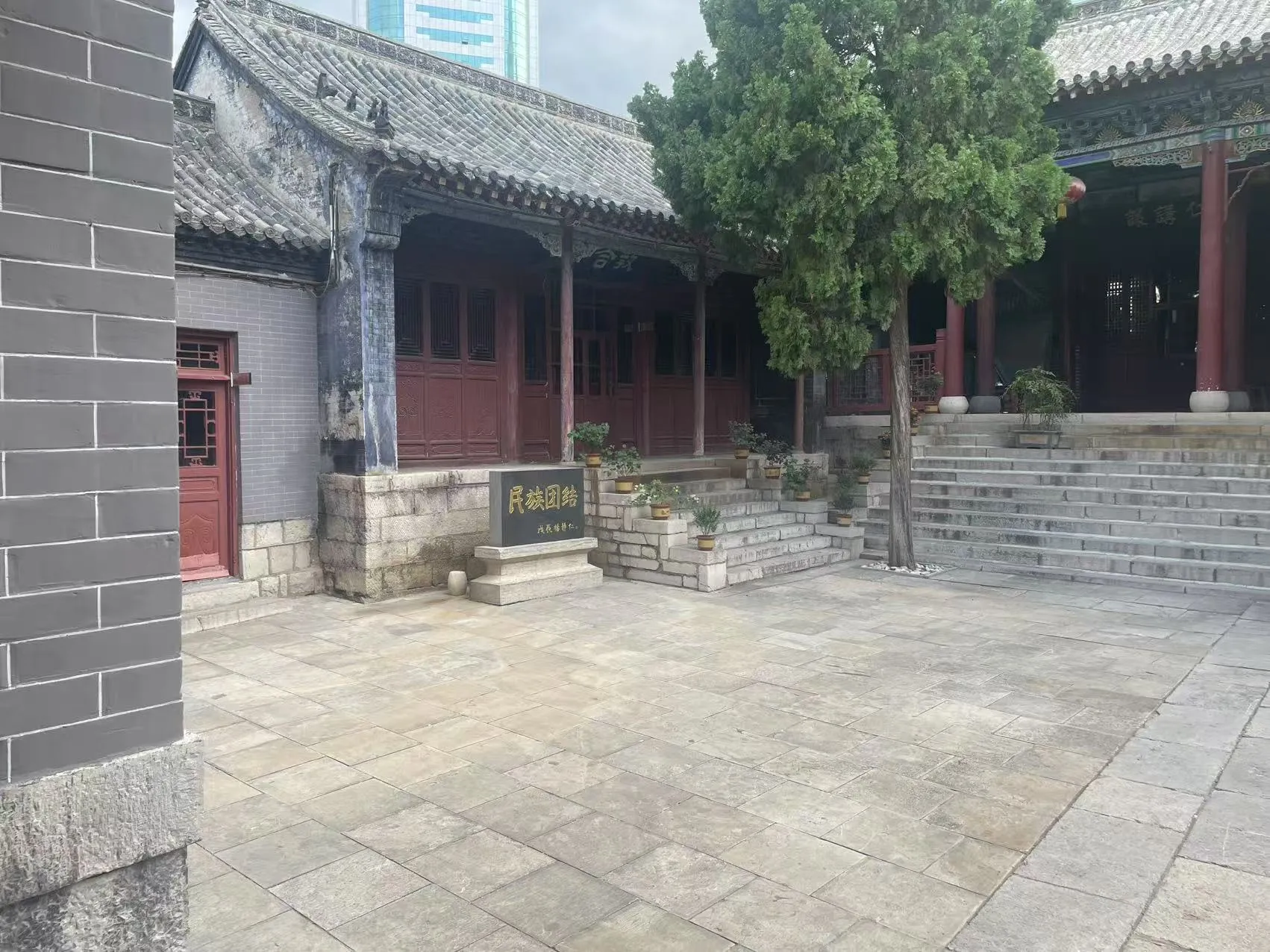
Jinan Great Southern Mosque
Walk through the main entrance of the Jinan Great Southern Mosque and you might, for a moment, believe you have entered a Chinese temple. A spirit wall guards the threshold. Courtyard buildings arrange themselves along a central axis of symmetry. Curved tile roofs rise above wooden columns. But the axis runs east-west instead of north-south, and when you step into the main prayer hall, you face Mecca. Established in 1295 during the first year of Temur Khan's reign in the Yuan dynasty, this mosque is a masterwork of cultural synthesis -- Islamic worship housed in Chinese architectural grammar, standing at the southern entrance to Jinan's Muslim quarter for over seven centuries.
Yuan Dynasty Foundations
Local legend places the mosque's founding in the Tang dynasty, but no written records survive to confirm this earlier date. The documentary record begins in 1295, during the first year of Temur Khan's reign as Emperor Chengzong of the Yuan dynasty. The Mongol-ruled Yuan was a cosmopolitan empire that drew merchants, soldiers, and scholars from across Central Asia and the Middle East, and Islam had established communities in Chinese port cities and trading centers well before the Mongol conquest. Jinan, as a provincial capital on major trade routes, was a natural place for a Muslim community to take root. The mosque's position at the southern entrance to the city's Huimin Xiaoqu -- the Muslim quarter -- suggests a community large enough and established enough to anchor an entire neighborhood.
A Temple That Prays Toward Mecca
Most of the structures standing today were built between the 1420s and 1492, during the Ming dynasty. Significant expansions were completed in 1492, the fifth year of the Hongzhi Emperor's reign. The architectural genius of the mosque lies in its fusion of Chinese temple form with Islamic function. The courtyard layout, the spirit wall at the entrance, the axial arrangement of buildings -- all follow the conventions of traditional Chinese architecture. But the axis is rotated ninety degrees from the typical north-south orientation of a Chinese temple, so that worshippers entering the prayer hall face west toward Mecca. The entire site covers 6,630 square meters, with 2,830 square meters under roof. It is not a small building adapted from Chinese forms; it is a substantial complex that demonstrates how thoroughly Islam had integrated into the architectural vocabulary of Ming-era China.
The Muslim Quarter's Anchor
The mosque sits west of Jinan's historical city center, near the Baotu Spring Park, at the gateway to the Huimin Xiaoqu. This Muslim quarter has existed alongside the mosque for centuries, its restaurants, shops, and residences forming a distinct cultural enclave within the broader city. The relationship between mosque and quarter is symbiotic: the mosque provided the spiritual center around which the community organized, while the community ensured the mosque's continuous use and maintenance through centuries of dynastic change, foreign invasion, and political revolution. From the Yuan through the Ming and Qing, through the Republic and the People's Republic, the Great Southern Mosque has remained an active house of worship -- a continuity that speaks to the depth of Islam's roots in this corner of Shandong.
From the Air
Located at 36.66N, 117.00E in the western part of Jinan's old city, near Baotu Spring Park. Jinan Yaoqiang International Airport (ZSJN) is approximately 30 km northeast. The mosque complex is part of the Muslim quarter (Huimin Xiaoqu) on the western edge of the historic center. From altitude, it is near the green space of Baotu Spring Park, which serves as the best visual reference.